3 Best Reverse Osmosis Water Filter System Options for 2026
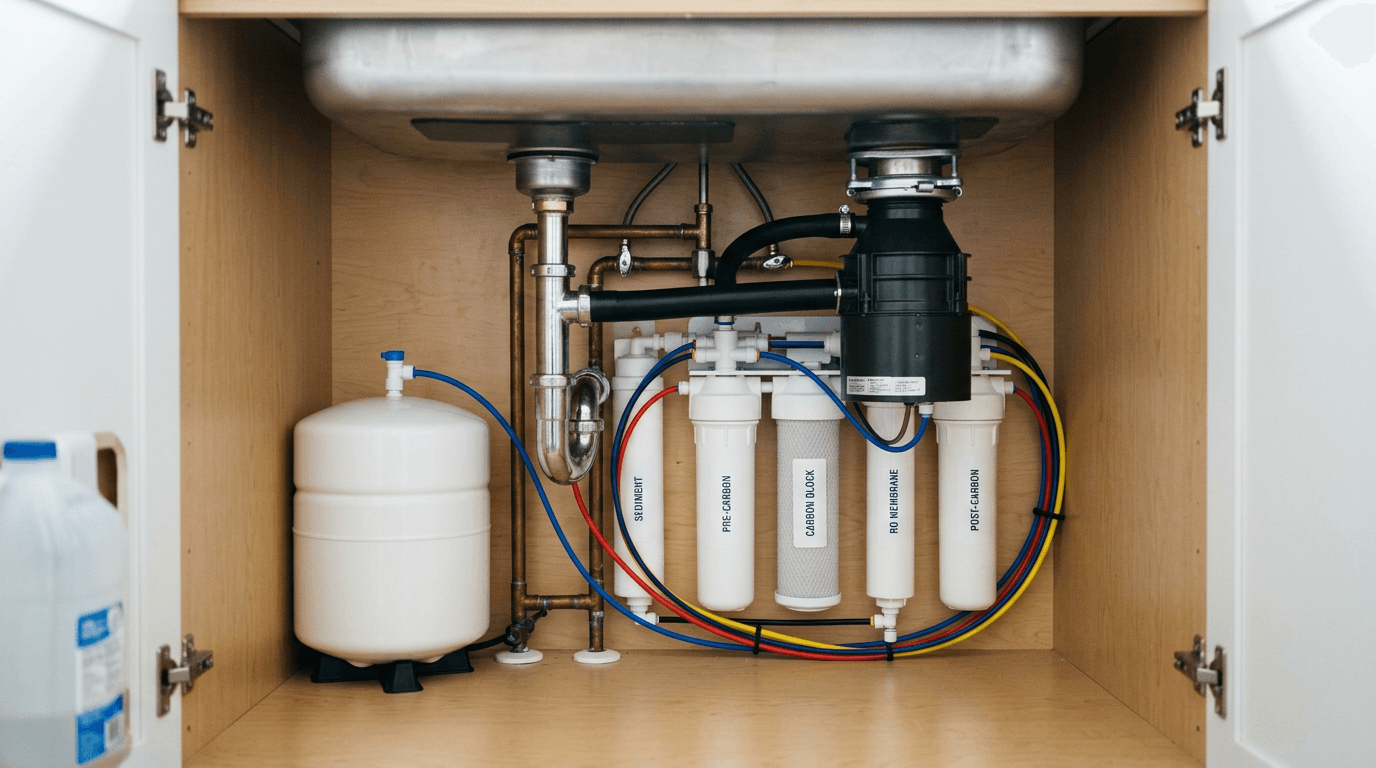
Edmonton's municipal water, drawn straight from the North Saskatchewan River, sits at a hardness level of roughly 9.6 grains per gallon and carries noticeable municipal chlorine. When that water pours into a drinking glass, the mineral density and treatment odours are immediately obvious to anyone taking a sip. Finding the best reverse osmosis water filter system is not about simply purchasing the unit with the highest number of filtration stages. Instead, it is about matching a specific purification mechanism to the physical footprint under your kitchen counter and the specific chemical makeup of the water entering your home.
Quick Summary
A reverse osmosis (RO) system is a multi-stage water purification setup that forces incoming water through a semi-permeable membrane to strip away dissolved solids, minerals, and chemical additives.
- The right unit depends heavily on available cabinet space and incoming water pressure.
- Tankless architectures save under-sink room but require nearby electrical outlets.
- Systems adding remineralization stages restore trace minerals removed during the heavy filtration process.
- Combining RO with whole-home softening prevents early membrane fouling from hard water scaling.
Table of Contents
- System Architecture: Choosing a Filtration Strategy
- 1. Waterdrop G3P800
- 2. AquaTru Under Sink
- 3. iSpring RCC7AK
- Matching Your Sink to the Right Architecture
- Recommended Reads
| Product | System Architecture | Features | Pros | Cons | Target Audience |
|---|---|---|---|---|---|
| Waterdrop G3P800 | Tankless Smart Systems | UV sterilizing light, smart faucet | Compact footprint, Real-time monitoring, Integrated UV | Requires electrical outlet, Higher upfront cost, Proprietary filters | Modern kitchens with limited cabinet storage |
| AquaTru Under Sink | Leak-Sensing Convertibles | 4-stage RO, integrated leak detection | Active leak safeguards, Simplified maintenance, Proven 4-stage method | Limited to 4 stages, Slower production rate, Specific form factor | Homeowners prioritizing water damage prevention |
| iSpring RCC7AK | Traditional Tank Remineralizers | 6-stage RO, alkaline remineralization | Restores trace minerals, Corrects pH balance, Does not require electricity | Requires large cabinet space, Slower membrane processing, Multiple filter housings | Families wanting alkaline drinking water |
System Architecture: Choosing a Filtration Strategy
When evaluating the best reverse osmosis system under sink installations, the defining metric is not the brand name, but the underlying system architecture. The physical mechanics of how water is stored and pushed through the membrane dictate what the unit can achieve and where it can be installed. We serve Edmonton, Beaumont, Leduc, and Sherwood Park, and in these areas, installing the correct architecture is critical for managing heavy river water particulates without constantly destroying delicate membrane filters.
We categorize these systems into three primary architectures:
Tankless Smart Systems: These units discard the traditional holding tank entirely, utilizing an internal pump to force water through the membrane on demand. They require continuous electrical power to operate their internal pumps and digital monitoring tools.
Leak-Sensing Convertibles: These systems utilize standard filtration stages but incorporate physical technology specifically designed to monitor for moisture pooling. Their primary function is risk mitigation for under-sink environments where a slow leak could cause extensive cabinetry damage before detection.
Traditional Tank Remineralizers: Utilizing a pressurized holding tank, these systems process water slowly and store it. Before the water reaches the faucet, it passes through a final stage that adds beneficial minerals like calcium and magnesium back into the water, correcting the slightly acidic pH that raw RO water typically exhibits.
Practical rule: Never install an RO membrane directly downstream of unsoftened 9.6 gpg hard water without expecting to replace that membrane at triple the normal frequency.
When we evaluate combined setups, reference our Triton Pure and Triton Pure Tankless packages, which pair whole-home softening with dedicated drinking water purification to ensure the RO membrane is fed appropriately treated water. Edmonton water hardness levels demand this kind of staged approach to protect the filtration equipment over the long term.
1. Waterdrop G3P800
Direct-flow pumps replace the traditional storage bladder in Tankless Smart Systems, pushing water straight to the tap on demand. By abandoning the holding tank, this design reclaims the majority of a standard under-sink cabinet, relying instead on integrated electronics and a smart faucet to deliver purified water directly to the user.

This unit functions by passing municipal water through successive tight-micron carbon and RO barriers at high pressure. As the water exits the primary membrane, it travels past a built-in UV sterilizing light housed inside the system block. This ultraviolet exposure targets microorganisms that might survive the physical membrane barrier. The attached smart faucet then reads the system's output metrics, displaying real-time filtration status and filter life directly at the sink.
Advanced Sterilization Requires Dedicated Power
Constant electricity must power both the UV sterilizing light and the on-demand pressure pump. No power means no water. The system stops completely during power outages. Furthermore, kitchens lacking an under-sink receptacle require extra work. An electrician must pull a new circuit before installation. This reliance on a power source constrains homeowners choosing smart tankless options.
We would hesitate to recommend this specific architecture if your under-sink area is entirely devoid of existing electrical outlets and running new wire is structurally prohibitive.
Pros
- Eliminates the bulky storage tank
- Integrated UV sterilization stage
- Real-time filter monitoring at the faucet
Cons
- Fails to dispense during power outages
- Requires an available under-sink electrical outlet
- Relies entirely on proprietary filter modules
2. AquaTru Under Sink
How do you prevent a slow, hidden drip from ruining your kitchen cabinets? Leak-Sensing Convertibles address this anxiety by combining a 4-stage reverse osmosis water purifier with a moisture-sensitive shut-off mechanism. This design delivers standard multi-stage purification while keeping a strict mechanical watch over its own plumbing connections.
Four physical barriers process the water in sequence. First, incoming water drops its heavy sediment. Next, a carbon block strips chlorine odours. The water then forces its way through the microscopic pores of the reverse osmosis membrane. Finally, it polishes through a post-filter. What separates this unit is the integrated leak-detection technology built into its base. If moisture bridges the sensors beneath the unit, an alert triggers. The system immediately halts further water intake. This stops continuous flooding from a compromised O-ring.
Integrated Safeguards Demand Proprietary Fitting
The strict 4-stage configuration means homeowners cannot easily add aftermarket remineralization or UV stages if their water chemistry changes. The system is structurally closed to maintain the integrity of its leak-detection tray, meaning you are locked into the exact purification sequence the manufacturer designed, with no room for modular expansion later.
This unit is a highly appropriate choice for homeowners installing their first under-sink reverse osmosis system in premium wooden cabinetry where a small undetected drip would cause expensive warping.
Pros
- Built-in leak detection safeguards cabinetry
- Proven 4-stage physical barrier mechanism
- Straightforward filter replacement process
Cons
- Cannot accept aftermarket remineralization add-ons
- Hard-locked into a 4-stage purification process
- Operates at slower production rates than pumped models
3. iSpring RCC7AK
The iSpring RCC7AK belongs to the Traditional Tank Remineralizers category, prioritizing comprehensive water chemistry correction over space-saving aesthetics. It is a 6-stage reverse osmosis water filtration system designed to not only strip the water of contaminants but to physically alter its pH profile before it reaches the glass.
Water moves through this system using standard household water pressure, slowly trickling through sediment and carbon pre-filters before hitting the RO membrane. Because the membrane processes water drop by drop, the purified water is stored in a pressurized holding tank. When the dedicated faucet is opened, the bladder inside the tank pushes the water out. Crucially, before leaving the system, the water flows through an alkaline remineralization stage. This final cartridge contains natural mineral stones that dissolve trace amounts of calcium and magnesium back into the flat RO water, correcting the acidity that results from membrane purification.
Alkaline Additions Require Substantial Storage Footprints
The combined footprint of a 6-stage manifold and a separate pressurized holding tank consumes nearly an entire standard cabinet bay. If your under-sink area already houses a garbage disposal, large plumbing traps, or pull-out garbage bins, this traditional architecture simply will not fit without extensive modifications to your kitchen layout.
We consider this system the correct path forward for homeowners seeking the best reverse osmosis water filters who prioritize the taste and pH benefits of alkaline water over keeping their under-sink storage space completely empty.
Pros
- Actively restores beneficial trace minerals
- Operates entirely on standard home water pressure
- Corrects the acidic pH of raw RO water
Cons
- Consumes massive amounts of cabinet space
- Pressurized tank delays refill times once emptied
- Requires managing six separate filter replacement schedules
Matching Your Sink to the Right Architecture
Selecting between the best under the sink reverse osmosis system options relies entirely on aligning your specific household constraints with the correct operational category.
For Tankless Smart Systems, choose this route when you possess an under-sink electrical outlet and cannot afford to lose the physical storage space a tank requires. This architecture excels in modern kitchens where monitoring water data via a smart faucet is valued over passive, non-electric operation.
For Leak-Sensing Convertibles, this architecture fits environments where water damage anxiety outweighs the need for massive output volume. Installing this in an expensive custom vanity or a high-rise condominium provides the active leak monitoring necessary to operate a water-bearing appliance safely out of sight.
For Traditional Tank Remineralizers, this remains the standard for households that have ample cabinet space and prioritize the chemical profile of their drinking water. If you require alkaline water and do not want to rely on continuous electrical draw to produce a glass of water, this passive, tank-reliant architecture is the proven mechanical solution.