3 Cheap Water Softener Systems for Edmonton Small Homes & Apartments
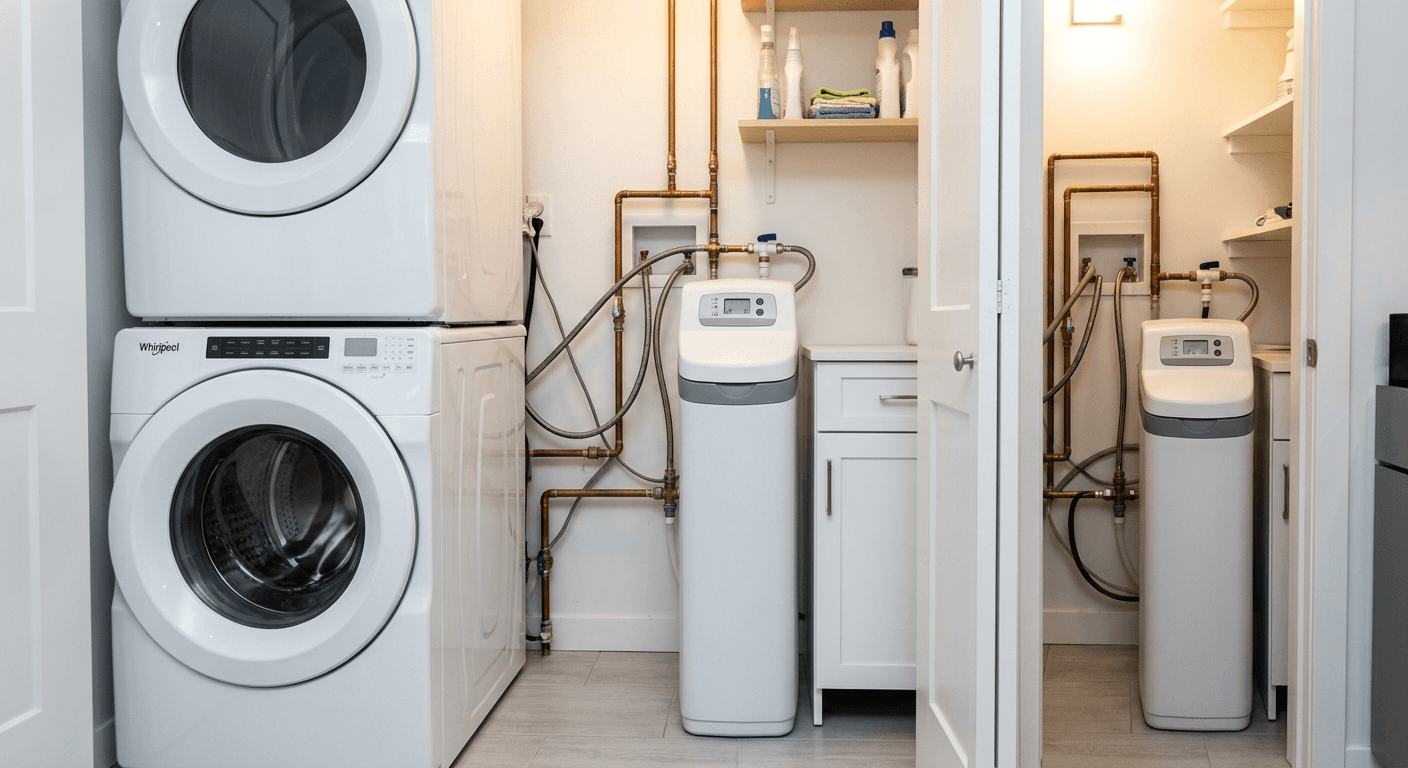
Edmonton's North Saskatchewan River water supply delivers a consistent 165 mg/L, or roughly 9.6 grains per gallon, of hard minerals straight to the tap. For homeowners with sprawling mechanical rooms, addressing that hardness simply means installing a towering two-tank resin system. However, when the utility closet measures just a few square feet in a modern condo or an older infill property, placing massive equipment simply does not work. This leaves residents choosing between sacrificing their only storage space or allowing scale to slowly destroy their water heater and dishwasher. Finding a small water softener that genuinely survives regional water chemistry requires looking past the marketing brochures and examining the physical limits of compact resin tanks. Evaluating cheap water softener systems involves calculating exact flow rates, understanding regeneration cycles, and measuring the physical volume of the brine cabinet to ensure the unit can actually keep up with daily usage.
Quick Summary
A compact water softening system utilizes tightly packed resin beds and specialized valve cycles to remove calcium and magnesium within a restricted physical footprint. While conventional setups separate the brine and resin into two distinct cylinders, space-saving units often combine them, demanding more frequent regeneration cycles to maintain soft water flow.
- The physical volume of the resin bed dictates how often the system must halt to clean itself.
- Integrated cabinets save floor space but limit your ability to swap out individual broken components.
- Flow rate capacities on smaller units will restrict how many fixtures can run simultaneously without dropping water pressure.
- High regional hardness requires accurate daily usage calculations to prevent the unit from exhausting its capacity mid-day.
Table of Contents
- How to Evaluate Cheap Water Softener Systems
- 1. WaterBoss Model 700
- 2. Whirlpool WHES18 Compact Home Water Softener
- 3. Fleck 5600SXT Water Softener
- Which Small Water Softener Fits Your Space
- Recommended Reads
| Product | System Footprint | Features | Pros | Cons | Target Audience |
|---|---|---|---|---|---|
| WaterBoss Model 700 | All-in-One Cabinet | Built-in dirt filter, fine mesh resin, low profile | Extremely fast regeneration, handles minor sediment, saves vertical space | Small resin bed, highly frequent cycling, sealed internal chassis | Small utility closets |
| Whirlpool WHES18 | All-in-One Cabinet | 18,000-grain limit, demand-initiated software, narrow build | Minimal salt consumption, easy installation, digital interface | Reduced peak flow rate, risk of salt bridging, low maximum capacity | 1-2 person households |
| Fleck 5600SXT | Modular Two-Tank | Paddlewheel meter, separate brine tank, mechanical digital head | Readily available replacement parts, customizable settings, long lifespan | Requires horizontal floor space, complex initial programming, separate salt bin | Homes with full basements |
How to Evaluate Cheap Water Softener Systems
Evaluating equipment for tight spaces means understanding exactly how Edmonton water hardness levels interact with restricted resin capacities. A standard ion exchange process relies on negatively charged resin beads pulling positively charged calcium and magnesium ions out of the water. When you shrink the physical size of the tank to fit inside an apartment utility closet, you reduce the total surface area of those beads. Less surface area means the system exhausts its softening capability much faster and must flush itself with saltwater more frequently.
To categorize these units, we evaluate them across a primary classification axis: System Footprint. The physical layout dictates where the unit can be installed and how it functions mechanically over the next decade.
The first category is the All-in-One Cabinet. In this configuration, the manufacturer places the pressurized resin tank directly inside the larger plastic salt reservoir, sealing the control valve on top. This dramatically reduces the floor space required, making it ideal for narrow laundry rooms or beneath stairs. However, submerging the mechanical connections inside the salt environment accelerates corrosion on moving parts, and if the outer plastic shell cracks, the entire system must be replaced.
Practical rule: Always measure the vertical clearance above the planned installation spot, as cabinet-style systems require you to pour heavy bags of salt directly into the top hatch.
The second category is the Modular Two-Tank. This is the traditional architecture where a tall fiberglass resin cylinder stands completely separate from the plastic brine tank, connected only by a thin flexible brine tube. While this footprint takes up roughly twice the horizontal floor space, it isolates the sensitive control valve from the corrosive salt vapor. It also allows you to replace the brine tank or the resin cylinder independently, which dramatically lowers long-term upfront water softener costs since you only pay for the component that failed.
1. WaterBoss Model 700
Square footage commands a premium. Condo developers allocate exactly twenty-four square inches of floor space for mechanical utilities. The appliance must conform to the closet. Serving perfectly as an apartment water softener, the WaterBoss Model 700 functions as a compact whole-house water softener and filtration system designed to fit small utility spaces. It operates as an All-in-One Cabinet. All internal mechanisms sit beneath a single streamlined plastic cover.
The system abandons standard standard cross-linked resin beads in favour of a tightly packed fine mesh resin. Because the fine mesh creates a massive amount of surface area in a very short column, the water undergoes aggressive ion exchange almost instantly. The unit pushes incoming water through a built-in self-cleaning dirt and sediment filter before it ever touches the resin, preventing municipal pipe debris from clogging the highly dense mesh bed. A directional flow screen then distributes the water evenly, preventing channeling down the sides of the miniature tank.
Integrated filtration limits footprint but restricts customization
The tight internal engineering leaves no room for error when water chemistry shifts. Because the total physical volume of the resin is so low, extremely hard municipal water forces constant regeneration. This wears out the internal pistons. It wastes water in the process. I would hold off on deploying this system if the property regularly houses more than three people. The constant demand will outpace the unit's ability to clean itself. The internal chassis is also permanently sealed. A failure in the sediment filter layer requires a complete system teardown rather than a simple cartridge swap.
Procure this model when installing inside a finished living space where aesthetic integration and absolute space conservation override the need for long-term component modularity.
Pros
- Regenerates in roughly twenty minutes
- Catches minor incoming sediment automatically
- Fits underneath standard utility shelving
Cons
- High frequency of waste water cycling
- Internal components are difficult to access
- Limited overall hardness capacity
2. Whirlpool WHES18 Compact Home Water Softener
While the WaterBoss relies on specialized fine mesh to shrink its height, this model utilizes a conventional resin structure scaled down into a highly narrow vertical chassis. An 18,000-grain compact salt-based water softener featuring a space-saving design, the Whirlpool WHES18 targets small households seeking an All-in-One Cabinet solution without investing in commercial-grade valve architecture.
Instead of relying on a mechanical clock, the unit uses demand-initiated digital software to monitor the exact volume of water flowing into the property. A small internal turbine spins as taps are opened, sending electronic pulses to the circuit board. Once the software calculates that the 18,000-grain capacity is nearing exhaustion, it triggers a regeneration cycle for the middle of the night. It actively calculates the remaining reserve against your historical daily averages, ensuring it only draws brine when treating Beaumont residential water that actually requires it.
Low-grain capacity forces a trade-off on flow rate
Often marketed as the cheapest water softener system at big-box hardware stores, the underlying compromise lies in the plumbing connections and internal port sizing. The restrictive internal valve diameter severely caps the maximum peak flow rate. If a resident runs a washing machine while someone else is showering, the narrow internal pathways cause a noticeable drop in household water pressure. We would heavily caution against using this unit in any home possessing multiple high-flow showerheads. Furthermore, the tall and narrow salt cabinet is prone to salt bridging, where humidity causes the salt blocks to fuse into a solid dome, leaving the water beneath it completely untreated until the bridge is manually broken.
Select this equipment for single-bathroom properties occupied by one or two residents who rarely operate multiple plumbing fixtures simultaneously.
Pros
- Lowers overall monthly salt expenditure
- Interface is highly intuitive for beginners
- Narrow width slides between existing appliances
Cons
- Noticeable drops in peak water pressure
- High susceptibility to salt crust bridging
- Circuit board is vulnerable to moisture
3. Fleck 5600SXT Water Softener
Repeated failures of sealed consumer electronics usually push homeowners toward commercial-grade mechanical setups. The Fleck 5600SXT Water Softener is a salt-based two-piece water softener system widely used for residential hardness treatment. By utilizing a Modular Two-Tank design, it completely separates the digital control head from the corrosive brine storage.
The mechanism relies on a brass-geared paddlewheel meter situated directly in the bypass loop. As water enters the home, it physically turns the paddlewheel, which communicates with the digital SXT microprocessor. When capacity is reached, the motor slowly drives a Teflon-coated brass piston through a series of internal rubber seals. This action opens and closes specific internal ports, drawing saltwater from the separate bin through a Venturi valve via vacuum suction. Because the brine and resin are kept isolated, the electronics never sit in a humid, salt-heavy environment.
Modular components outlast sealed electronics
Practical rule: Keep the brine line between the two tanks as short as possible to prevent suction loss, ensuring the control head can effectively pull the heavier saltwater up and into the resin bed.
The requirement for horizontal floor space removes this option for anyone living in tight quarters. You simply cannot squeeze two independent cylinders into a shallow front-hall closet or beneath a kitchen sink. The setup also involves a steeper learning curve during initial programming; the installer must manually input the local grains per gallon, calculate the safety factor, and set the precise backwash override days. We would always prefer deploying this architecture for our installations in Sherwood Park, provided the property actually possesses an unfinished mechanical room large enough to house both components comfortably.
Install this system when longevity and the ability to source standard replacement parts easily outweigh the need to conserve basement floor space.
Pros
- Valves and seals last exceptionally long
- Replacement parts are universally available
- Programming allows exact cycle adjustments
Cons
- Demands wide horizontal floor clearance
- Programming menu is initially confusing
- Requires assembling multiple loose components
Which Small Water Softener Fits Your Space
Selecting a cheap water softener system ultimately depends on matching your physical floor plan to the appropriate category of equipment. Trying to force the wrong shape into a utility room usually results in broken bypass valves or an inability to refill the unit safely.
If your bottleneck is a literal lack of square footage inside an apartment, condo, or modernized infill, an All-in-One Cabinet resolves the spatial conflict. By placing the resin directly inside the salt reservoir, these units slide into narrow gaps beside washing machines or underneath stairwells. However, the trade-off is reduced capacity and a shorter lifespan for the sealed internal electronics. For households demanding comprehensive whole-home softening alongside purified drinking water without sacrificing space, combining a compact cabinet softener with dedicated point-of-use reverse osmosis solutions beneath the kitchen sink provides excellent results.
If you have an unfinished basement or a dedicated mechanical room, a Modular Two-Tank layout remains the superior choice for longevity. Separating the control valve from the salt vapor prevents circuit corrosion, and standard mechanical parts can be repaired independently without discarding the entire machine. For extensive residential setups, full-scale packages like the Triton Pure and Triton Pure Tankless combine this robust two-tank softening architecture directly with high-efficiency reverse osmosis, securing the entire property's plumbing infrastructure while delivering flawless drinking water. Securing the right outcome starts with accurately testing your home water profile to ensure the resin capacity mathematically matches your daily usage.