4 Delivery Models for a Water Softener and Filter System in Edmonton
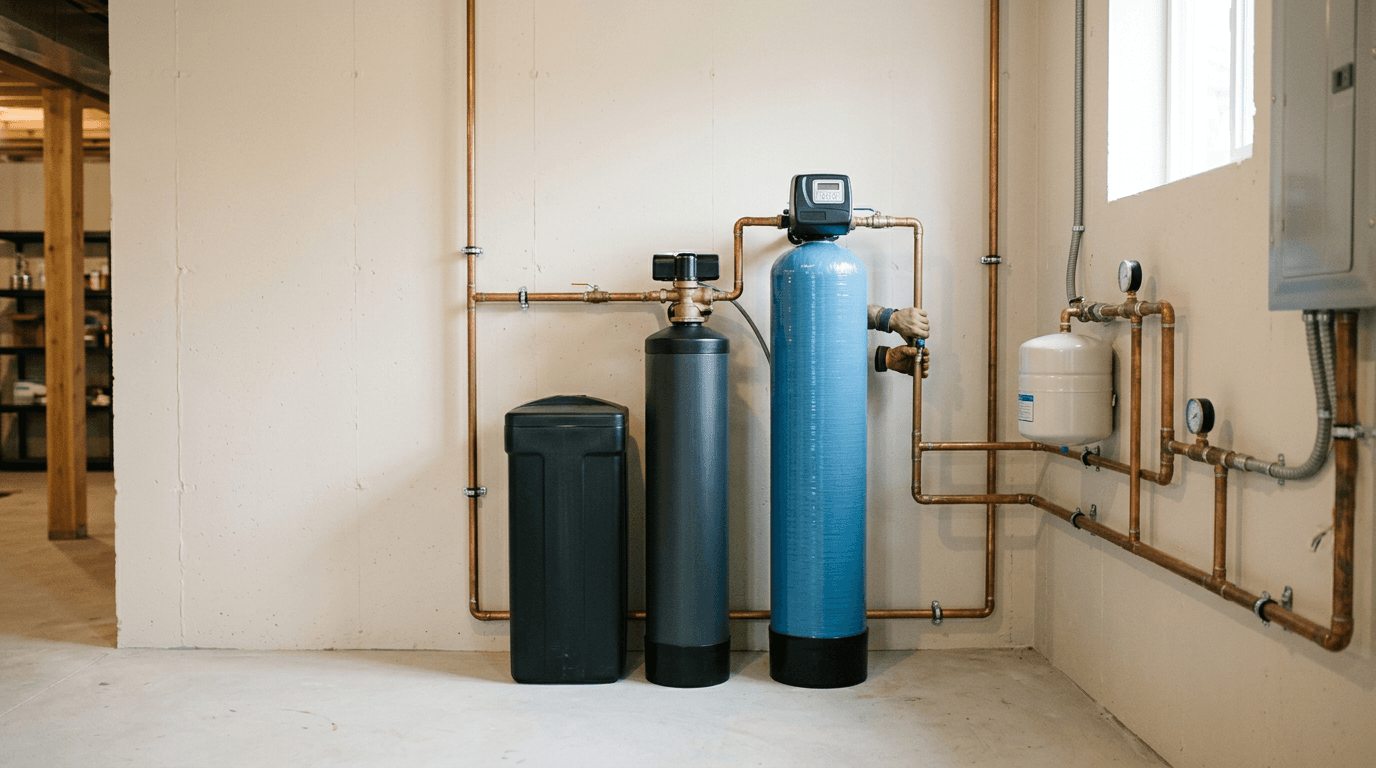
You wipe down the glass shower door in your Edmonton home, and three days later, the hard white spots have returned. Homeowners often respond to this recurring scale by searching for a water softener and filter system, assuming one single box will solve both the mineral buildup on their plumbing and the strong chlorine smell originating from the municipal supply. The reality is that these technologies address completely separate chemical issues within a property's pipes. Water Triton, which publishes this guide, is one of the options compared below to help clarify what actually removes hardness and what simply masks taste.
Quick Summary
A water softener uses ion exchange to physically extract calcium and magnesium, stopping scale buildup, while a filtration system targets chemical contaminants like chlorine, volatile organics, and dissolved solids. Edmonton residents frequently need both technologies working together to protect plumbing infrastructure and ensure clean drinking water at the tap.
- Softeners remove mineral hardness but leave municipal chlorine untouched.
- Filtration tanks remove taste and odor issues but cannot stop pipe scale.
- Point-of-use reverse osmosis handles drinking water purification at the kitchen sink.
- Chemical testing before purchase prevents overspending on unneeded tank capacity.
Table of Contents
- Why a water softener and filter system manages separate issues
- How to choose: Delivery and Integration Models
- 1. Water Triton
- 2. Water Softener Edmonton
- 3. Wise Choice Water Softeners
- 4. Culligan of Edmonton
- Matching the right delivery model to your property
- Recommended Reads
Why a water softener and filter system manages separate issues
Evaluating a water softener vs water filter system requires looking at what enters the house. Edmonton's municipal water averages 165 mg/L (9.6 grains per gallon) of hardness. A softener handles this by swapping calcium and magnesium ions for sodium, effectively protecting your water heater and dishwashers from catastrophic scale failure.

However, if you are debating a water softener or water filtration based purely on the chemical smell in your glass, remember that softening resin beads do not trap chlorine. A dedicated water filtration system vs water softener discussion usually reveals that activated carbon blocks or dechlorination tanks are strictly necessary to pull out the volatile organics that cause unpleasant tastes.
Looking closely at water softener vs filtration mechanics, the distinction comes down to ion exchange versus chemical adsorption. Ion exchange trades one mineral for another to alter the physical behavior of the water inside heating elements. Carbon adsorption traps chemicals inside microscopic pores to change the taste. Because municipal utilities heavily dose chlorine to keep pipes sterile, homeowners eventually realize that water softener and filtration systems are meant to run in tandem. A whole-home dechlorination unit strips the chemical smell as water enters the basement, while the softener follows up by stripping the minerals before they can calcify inside your walls.
Practical rule: Never size a combined system based solely on the square footage of your house. Equipment capacity must be calculated using the exact grains per gallon of hardness and the maximum flow rate of your plumbing.
How to choose: Delivery and Integration Models
When reviewing treatment equipment, the actual hardware sitting in your utility room is only half the equation. The classification axis that genuinely separates the providers operating in this market is their Delivery and Integration Model. The way a business structures its supply chain dictates who handles the plumbing, what happens when a valve fails, and whether the system is built for your specific neighborhood.
Direct-to-Consumer Installation operations maintain their own in-house plumbing and technical teams rather than handing the work off to third-party subcontractors. They rely heavily on site-specific chemical testing before prescribing equipment, meaning the hardware is tailored strictly to the raw data pulled from the property's tap.
Local Retail Supplier businesses operate as independent middle layers between equipment manufacturers and homeowners. They focus heavily on maintaining an accessible catalog of standard residential packages, providing a straightforward route for acquiring standard filtration hardware without navigating massive corporate structures.
National Franchise Service dealerships tie into a single, highly recognized proprietary brand network. They offer standard corporate hardware, extensive rental options, and standardized service protocols, operating as localized branches of large-scale manufacturing operations.
| Product | Delivery and Integration Model | Features | Pros | Cons | Target Audience |
|---|---|---|---|---|---|
| Water Triton | Direct-to-Consumer Installation | Triton Pure systems, 30-minute water test | In-house installers, lifetime tank warranties, data-driven sizing | No standalone retail parts counter, restricted regional service map, strictly water focused | Edmonton homeowners wanting verified testing and installation |
| Water Softener Edmonton | Local Retail Supplier | Filtration packages, standard softeners | Independent local operation, combined system packages, regional familiarity | Lacks proprietary engineering, narrower support infrastructure, generalized inventory | Buyers seeking a local independent equipment supplier |
| Wise Choice Water Softeners | Local Retail Supplier | Residential treatment, whole-home filtration | Specialized residential focus, local deployment, targeted whole-home units | Limited commercial capacity, smaller operational footprint, standard brand access | Homeowners needing simple, strictly residential solutions |
| Culligan of Edmonton | National Franchise Service | Proprietary systems, drinking water setups | Vast corporate backing, rental pathways available, highly recognized name | Proprietary repair parts, standardized corporate approach, potentially rigid packages | Buyers wanting an established national brand ecosystem |
1. Water Triton
Water Triton operates within the Direct-to-Consumer Installation category, designing custom treatment systems specifically engineered for the capital region's unique utility conditions. The operation serves Edmonton homeowners, environmentally conscious residents, new home owners, skin health seekers, and large families needing robust plumbing protection across Edmonton, Beaumont, Leduc, and Sherwood Park.
The system mechanism relies entirely on raw data. They avoid generalized packages. Before quoting equipment, they execute a 30-minute in-home chemical assessment. This physically measures the 165 mg/L hardness and baseline chlorine levels coming from the North Saskatchewan River supply. Based on this baseline, they deploy their Triton Pure packages for combined whole-home dechlorination and softening. To address specific point-of-use drinking purification, they utilize the Triton Pure Tankless package. This package pushes water through high-efficiency reverse osmosis membranes at the kitchen sink to aggressively strip out dissolved solids.
Evidence-based sizing eliminates guesswork from the plumbing equation
This reliance on testing ensures that plumbing-conscious homeowners do not overpay for industrial-scale resin beds. A standard residential matrix will suffice instead. They maintain an entirely in-house team. They refuse to farm out pipe cutting to the lowest bidding subcontractor. Consequently, the initial assessment directly informs the final pipe routing. They explicitly avoid high-pressure upsells. Instead, they operate on transparent pricing structures and a referral model. Under this model, existing users receive a $100 gift card when a new referral successfully completes an installation.
Practical rule: Verify whether the company quoting your system is the entity physically running the drain lines. Sales-to-subcontractor hand-offs frequently result in mismatched bypass valves and poorly programmed regeneration cycles.
Because they operate strictly as an installation and service group, they do not maintain a walk-in retail storefront for DIY enthusiasts looking to buy loose O-rings or unprogrammed control valves over the counter. Their operational footprint is rigidly bound to their defined local service areas, meaning households located entirely outside the capital region fall outside their coverage and lifetime tank warranty map.
This delivery model suits environmentally conscious residents and large families who want data-backed sizing and a single point of accountability for both the equipment and the plumbing work.
Pros
- Conducts preliminary chemical testing prior to issuing equipment quotes
- Operates entirely with in-house installation staff rather than subcontractors
- Provides lifetime tank warranties on deployed hardware
Cons
- Service radius is strictly restricted to Edmonton and specific surrounding municipalities
- Lacks a retail storefront for over-the-counter DIY parts purchasing
- Exclusively residential water focus limits heavy commercial deployments
2. Water Softener Edmonton
Operating to remove the supply chain bottleneck for residential upgrades, Water Softener Edmonton functions within the Local Retail Supplier category. They provide an accessible channel for property owners looking to acquire basic treatment hardware without engaging massive corporate dealerships.
They supply and install home water softeners alongside whole-home filtration packages, acting as a regional distributor that gets standard equipment into local basements. Their mechanism centers on matching general filtration hardware to standard property layouts, allowing for a straightforward deployment of combined systems.
Combined packages target straightforward plumbing upgrades
By packaging softeners and filters together under a local umbrella, they reduce the friction of sourcing different components from different manufacturers. This independent approach keeps the purchasing process relatively localized.
Because they function primarily as a generalized supplier of standard residential packages, buyers who require highly specialized, proprietary engineering for abnormal well-water conditions might find their inventory less suited to extreme chemical scenarios.
We would point homeowners toward this route if they are looking for a standard, independent supplier to quickly deliver a residential package.
Pros
- Localized approach to the Edmonton area market
- Offers combined softening and filtration packages
- Independent operational structure avoids corporate rigidity
Cons
- Less suited to buyers needing highly specialized proprietary engineering
- Lacks the deep corporate research infrastructure of national brands
- Generalized hardware focus may dilute highly specialized deployments
3. Wise Choice Water Softeners
Standing in contrast to operations that divide their attention across heavy industrial projects, Wise Choice Water Softeners belongs to the Local Retail Supplier category. They are a local service strictly specialized in residential water treatment.
Their operational mechanism involves deploying softeners and whole-home filtration units specifically selected to handle the demands of standard home plumbing environments. They avoid the complexities of industrial-scale cooling tower filtration, keeping their inventory and technical focus squarely on household applications.
A strictly residential scope focuses the installation hardware
This targeted residential focus means their technicians only deal with household pipe diameters, standard water heater demands, and domestic flow rates. They are not distracted by managing commercial accounts or heavy industrial equipment maintenance.
Their explicit specialization in standard home systems means they are less suited to buyers managing multi-unit apartment complexes or light industrial properties that demand massive flow capacity and specialized commercial compliance.
If a property owner wants a provider that strictly deals with standard home plumbing environments without commercial distractions, we suggest reviewing this operation's focused catalog.
Pros
- Deep specialization in standard residential treatment
- Deploys targeted whole-home filtration and softening units
- Local service footprint ensures regional familiarity
Cons
- Less suited to buyers managing commercial or industrial plumbing volumes
- Smaller operational scale limits massive multi-site deployments
- Inventory is strictly constrained to residential applications
4. Culligan of Edmonton
When standardizing equipment is the primary trigger event for a buyer, Culligan of Edmonton fits the National Franchise Service category. They serve as the localized dealer for one of the most widely recognized corporate water care networks available.
Their mechanism leverages a massive corporate supply chain to provide proprietary water softening units, specific filtration tanks, and dedicated drinking water systems. They route Edmonton residents into a highly standardized national hardware ecosystem built on proprietary control valves and franchised service protocols.
Corporate infrastructure delivers a standardized franchise platform
The backing of a national brand gives this dealership deep inventory reserves and allows them to offer flexible commercial arrangements, including long-term equipment rental pathways that smaller independents generally cannot sustain.
The heavy reliance on a proprietary hardware ecosystem means buyers are locked into the franchise network for specific replacement parts and servicing, making it less suited to those who prefer open-source plumbing fixtures that any independent technician can repair.
We suggest looking at this dealership if brand recognition and access to a standardized national product line override the need for independent, open-source hardware.
Pros
- Backed by extensive corporate infrastructure and supply chains
- Offers deep product lines covering softening and specialized filtration
- Provides established rental pathways for temporary equipment access
Cons
- Less suited to buyers who prefer open-source, universally serviceable parts
- Proprietary hardware creates a lock-in effect for future repairs
- Standardized franchise protocols can feel rigid during custom installations
Matching the right delivery model to your property
For households experiencing heavy scale but wanting concrete chemical proof before committing to a system size, the Direct-to-Consumer Installation route fits best. Water Triton addresses this requirement by linking raw data directly from the tap to the physical capacity of the installed tanks, ensuring the plumbing work is handled strictly by the same team that ran the testing.
When straightforward equipment access is the main hurdle and the buyer simply wants functional hardware delivered without navigating a corporate ladder, a Local Retail Supplier provides a practical bridge. This category offers an independent, localized path to acquiring standard filtration packages.
Properties that require heavily established corporate backing, standardized franchise protocols, or the financial flexibility of renting their treatment equipment align smoothly with a National Franchise Service. This model trades independent hardware flexibility for the predictability of a vast proprietary network.
Recommended Reads
- Reviewing the Water Softener Cost in Edmonton (2026 Prices)
- Understanding Reverse Osmosis System Installation in Edmonton