4 Verified Hard Water Filter Systems for Canadian Homes
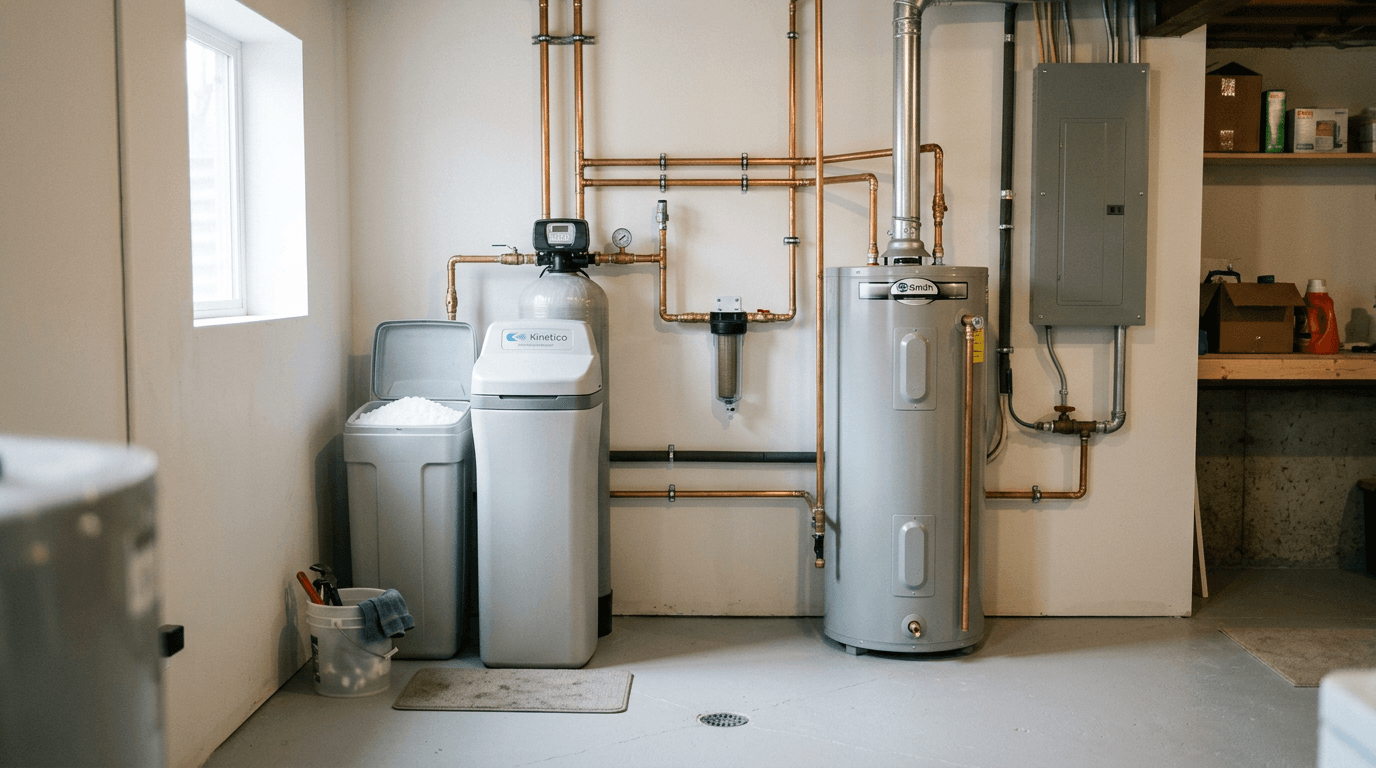
When a new homeowner stares at the chalky white crust forming on a recently installed showerhead, the immediate reaction is usually a search for a quick fix. Finding a functional hard water filter means looking past the basic carbon pitcher and understanding the mineral load actually entering your home. Whether you are dealing with aggressive calcium deposits from a municipal feed or complex iron issues from a private well, selecting the right equipment dictates whether your plumbing survives the decade. The architecture of a proper treatment plant for your basement requires matching the specific chemical profile of your water to the exact filtration media designed to remove it.
Quick Summary
Choosing an effective system to manage household mineral buildup relies on mapping your specific water chemistry to the correct distribution and support model. A hard water filter relies on ion exchange to remove calcium and magnesium, while addressing well water requires dedicated stages for sediment and dissolved metals.
- Determine your exact mineral load and flow rate before evaluating equipment.
- Online retailers provide massive inventories but leave physical integration to you.
- DIY suppliers offer granular component access for those with mechanical aptitude.
- Direct manufacturers bypass intermediaries but may lack hyper-local tuning.
- Full-spectrum manufacturers bring industrial-grade durability to complex residential water profiles.
Table of Contents
- Decoding Water Filtration Architecture
- System Comparison Table
- 1. Aquatell Canada
- 2. Water eStore
- 3. Excalibur Water Systems
- 4. SpringWell Water
- Matching the System to Your Plumbing Reality
- Recommended Reads
Decoding Water Filtration Architecture
The landscape of residential water treatment is defined primarily by how the equipment is acquired, engineered, and supported. For this analysis, we are evaluating options across a specific classification lens: Distribution Model. Understanding whether a provider is an Online Retailer, a DIY Component Supplier, a Full-Spectrum Manufacturer, or a Direct Manufacturer tells you exactly what kind of support, warranty, and technical burden you are taking on.

A system installed on a private well operates under entirely different stressors than one attached to a treated city line. Finding the best filter system for well water requires managing fluctuating sediment levels, dissolved gases, and heavy metals before the water ever touches a softening resin. If heavy particulate matter is present, a dedicated sediment filter for well water must be installed as the first line of defence. This typically involves a spin-down separator or a pleated paper cartridge that captures grit and sand, preventing those abrasive materials from destroying the delicate seals inside your downstream control valves.
Similarly, dealing with well-sourced water often necessitates an iron filter for well water. Iron manifests in two primary forms: ferrous (clear water iron, which is completely dissolved) and ferric (red water iron, which has oxidized into rust particles). Standard water softeners can handle trace amounts of ferrous iron, but relying on them for heavy iron removal quickly fouls the resin bed. Dedicated iron filtration uses specific media - such as Birm, Greensand, or catalytic carbon - to force the iron to oxidize inside the tank, trapping the solid particles and backwashing them down the drain.
Practical rule: Never use a water softener as your primary method for removing high levels of iron or heavy sediment; the resin bed will inevitably foul, drastically shortening the lifespan of the appliance.
Municipal water presents its own distinct challenges. While sediment and iron are largely managed by the city, extreme hardness and chemical disinfectants remain. We serve Edmonton, Beaumont, Leduc, and Sherwood Park locally, and these regions pull water from sources heavily laden with calcium and magnesium. For homes facing severe municipal hardness, combining robust ion-exchange softening with dedicated point-of-use filtration - like our Triton Pure and Triton Pure Tankless packages - effectively handles the destructive scale while preserving drinking water quality. Reviewing an Edmonton water hardness and quality guide is a critical step in diagnosing the baseline demands your new equipment will face.
System Comparison Table
| Product | Distribution Model | Features | Pros | Cons | Target Audience |
|---|---|---|---|---|---|
| Aquatell Canada | Online Retailer | Whole-house iron filters, water softeners | Extensive inventory, iron focus, e-commerce support | No physical installation, sizing relies on buyer, self-managed maintenance | Buyers with an experienced local plumber lined up |
| Water eStore | DIY Component Supplier | Filtration systems, treatment parts, DIY resources | Granular component access, robust DIY guides, modular options | Demands mechanical aptitude, self-diagnosed warranties, no local support | Mechanically inclined homeowners willing to self-install |
| Excalibur Water Systems | Full-Spectrum Manufacturer | Standard and specialty purification, residential to industrial | Industrial-grade parts, handles complex contaminants, established manufacturer | Over-engineered for simple feeds, higher physical footprint, premium acquisition cost | Rural property owners with complex, multi-contaminant water profiles |
| SpringWell Water | Direct Manufacturer | Residential filtration, direct distribution | Bundled configurations, in-house manufacturing, direct pricing | Lacks hyper-local tuning, requires arranging installation, prohibitive return shipping | Buyers with predictable municipal hardness seeking an all-in-one package |
1. Aquatell Canada
A homeowner standing in front of a heavily stained porcelain sink will immediately recognize the value of a supplier entirely focused on bulk water treatment. Aquatell Canada operates as a Canadian e-commerce retailer that specializes in home water treatment, including whole-house iron filters and water softeners.
The mechanism of their inventory relies on matching specific chemical anomalies with the correct tank media. For iron treatment, systems utilize an oxidation process where dissolved ferrous iron is exposed to an oxygen-rich environment inside the tank, forcing it to precipitate into a solid state. The media bed then traps these ferric particles. Every few days, a digital control valve initiates a backwash cycle, reversing the water flow to lift the media bed, flush the trapped rust down the drain line, and resettle the tank for the next cycle. This prevents the iron from ever reaching the household plumbing.
Broad inventory requires careful sizing
This approach operates strictly within the retail space. They supply the mechanical equipment. Integrating that hardware into your basement falls entirely on the buyer or a hired contractor. The process involves calculating necessary drain flow rates and ensuring the setup meets local plumbing codes. If a tank is undersized for the home's peak flow rate, water will channel through the media without actually being treated. Buyers should avoid ordering massive tanks online without first verifying their home's specific drain capacity. A high-capacity iron filter that lacks sufficient water pressure to backwash properly will become permanently fouled within months.
An ideal acquisition for a household that has secured an experienced local plumber and knows exactly what flow rates their plumbing demands.
Pros
- Extensive Canadian inventory across multiple treatment categories
- Clear focus on solving iron and heavy hardness problems
- Dedicated e-commerce support for pre-purchase specifications
Cons
- Installation relies entirely on third-party contractors
- System sizing requires accurate, self-directed water testing
- Post-purchase physical maintenance remains the buyer's responsibility
2. Water eStore
Contrasting with the broad retailer approach, this option leans heavily into the self-installation and repair market. Water eStore functions as a Canadian online supplier of water filtration systems, treatment parts, and DIY troubleshooting resources.
Their mechanism is entirely modular. Rather than simply shipping a sealed, proprietary box, they supply discrete components - ranging from spin-down separators that use centrifugal force to eject heavy sand, to raw bags of cation-exchange resin used for rebuilding tired softeners. A homeowner can purchase a raw mineral tank, a separate digital control valve, and the specific riser tubes required, assembling a bespoke water filtration hard water setup directly on their basement floor. The platform backs this up with extensive video teardowns showing how to rebuild valve assemblies and program electronic head units.
Component-level sourcing shifts the engineering risk
This extreme modularity breaks down during complex system failures. The homeowner often lacks the time or skill for technical triage. There is a heavy reliance on DIY troubleshooting resources. If a control valve fails to draw brine during a regeneration sequence, the homeowner is the primary technician tasked with diagnosing the sequence. The sheer burden of self-diagnosis is a major hurdle. When a mechanical failure happens, having a technician handle the tear-down is simply preferable to diagnosing a clogged venturi valve over the phone.
This route is best reserved for mechanically inclined buyers willing to turn wrenches and configure control valve sequences independently.
Pros
- Unrestricted access to granular replacement components
- Highly robust library of DIY maintenance resources
- Allows for modular upgrading of existing systems
Cons
- Demands significant mechanical and plumbing aptitude
- Warranty execution often involves self-diagnosis of parts
- Entirely lacks hands-on, local service support
3. Excalibur Water Systems
Removing the bottleneck of residential-only engineering limitations, this provider brings commercial-grade durability directly into the home. Excalibur Water Systems operates as a Canadian manufacturer of standard and specialty water purification systems for residential, commercial, and industrial markets.
The system mechanism relies on over-engineering standard residential processes. Where a standard water softener might use a basic cross-link resin, industrial-grade systems often employ a highly cross-linked resin matrix, which is significantly more resistant to degradation from chlorine and physical attrition. The control valves feature wider internal porting to permit higher continuous flow rates without dropping household water pressure. By utilizing robust distributor baskets and heavily reinforced fiberglass tanks, the equipment handles aggressive, multi-contaminant water profiles that would typically crush a standard off-the-shelf unit. Choosing proper water softeners means evaluating these valve bodies and resin capacities against your peak household demand.
Commercial-grade manufacturing ensures operational longevity
The reach across heavy commercial markets means residential buyers often pay a premium for hardware designed for scenarios they will never encounter. If your home operates on a clean, treated municipal feed that only suffers from moderate hardness and chlorine taste, installing an industrial-grade softening plant is an inefficient deployment of capital. We frequently advise against deploying commercial-scale hardware for straightforward city feeds simply because the massive physical footprint and steep upfront cost severely outweigh the residential benefits.
The logical choice for rural property owners managing complex, multi-contaminant profiles that routinely overwhelm standard off-the-shelf units.
Pros
- Industrial-grade component durability
- Capable of addressing complex, multi-contaminant profiles
- Manufactured by an established Canadian entity
Cons
- Often over-engineered for basic municipal feeds
- Commands a higher initial acquisition cost
- Demands a larger physical installation footprint
4. SpringWell Water
The sudden drop in household water pressure caused by scale buildup inside older pipes is the trigger event that sends many homeowners searching for direct-ship solutions. SpringWell Water operates as a water treatment brand that manufactures residential filtration systems and distributes directly to customers in Canada.
Their mechanism focuses on pre-configured, bundled processing. A typical direct-ship setup pairs a robust sediment pre-filter housing with a primary softening tank. The softening mechanism utilizes downflow ion exchange, where hard water enters the top of the tank and is forced down through a bed of negatively charged resin beads. The calcium and magnesium ions are stripped from the water and replaced with sodium ions. Once the system reaches capacity, it automatically flushes the resin with a brine solution to reset the chemical charge. Addressing the taste of city water often requires whole-home dechlorination systems placed immediately after these softening stages.
Factory-direct distribution bypasses the local intermediary
Because they engineer and ship configurations to cover the broadest possible swath of North American water conditions, their base models sometimes lack the hyper-local tuning required for extreme regional anomalies. A home facing exceptionally high, localized mineral spikes might need a specific resin blend or a custom backwash programming sequence that a mass-market configuration does not offer out of the box. We find direct-ship systems highly efficient for straightforward applications, though we caution against them if your local water profile features severe, highly localized irregularities that require bespoke engineering.
Practical rule: Always request a system to be sized based on your actual, current water test results rather than relying on historical municipal averages, which rarely reflect the exact chemistry flowing from your specific tap.
A fitting match for those facing predictable municipal hardness who prefer receiving an all-in-one, pre-configured package directly to their driveway.
Pros
- Eliminates intermediary distributor markups
- Pre-bundled system configurations simplify ordering
- Manufactured directly in-house by the brand
Cons
- Lacks hyper-local tuning for extreme regional water conditions
- Buyer is responsible for arranging third-party installation
- Prohibitive return shipping logistics for heavy resin tanks
Matching the System to Your Plumbing Reality
Evaluating the categories of distribution models is the final step in ensuring your home receives the right water treatment architecture.
Opting for an Online Retailer suits homeowners who already possess a deep understanding of their plumbing setup and have an experienced contractor ready to deploy the hardware. You gain access to a massive inventory of specific solutions, but you completely own the responsibility of sizing the equipment correctly and ensuring your home has the drain capacity to support it.
Choosing a DIY Component Supplier makes sense for mechanically inclined property owners who view home maintenance as a weekend project rather than a chore. If you are comfortable replacing a broken riser tube or diagnosing a faulty venturi valve, this model provides the raw parts necessary to keep a system running indefinitely without paying hourly service rates.
Moving toward a Full-Spectrum Manufacturer is necessary when dealing with severe, multi-contaminant well water that destroys standard residential equipment. If your property suffers from aggressive iron bacteria, heavy silt, and extreme hardness simultaneously, the over-engineered, commercial-grade hardware ensures the system survives the harsh environment.
Selecting a Direct Manufacturer works best for households on municipal feeds dealing with predictable, straightforward hardness. Combining these softeners with under-sink reverse osmosis systems provides a highly effective, all-in-one residential package, provided you are willing to manage the physical installation logistics yourself.