4 Water Systems: Water Softener vs Reverse Osmosis
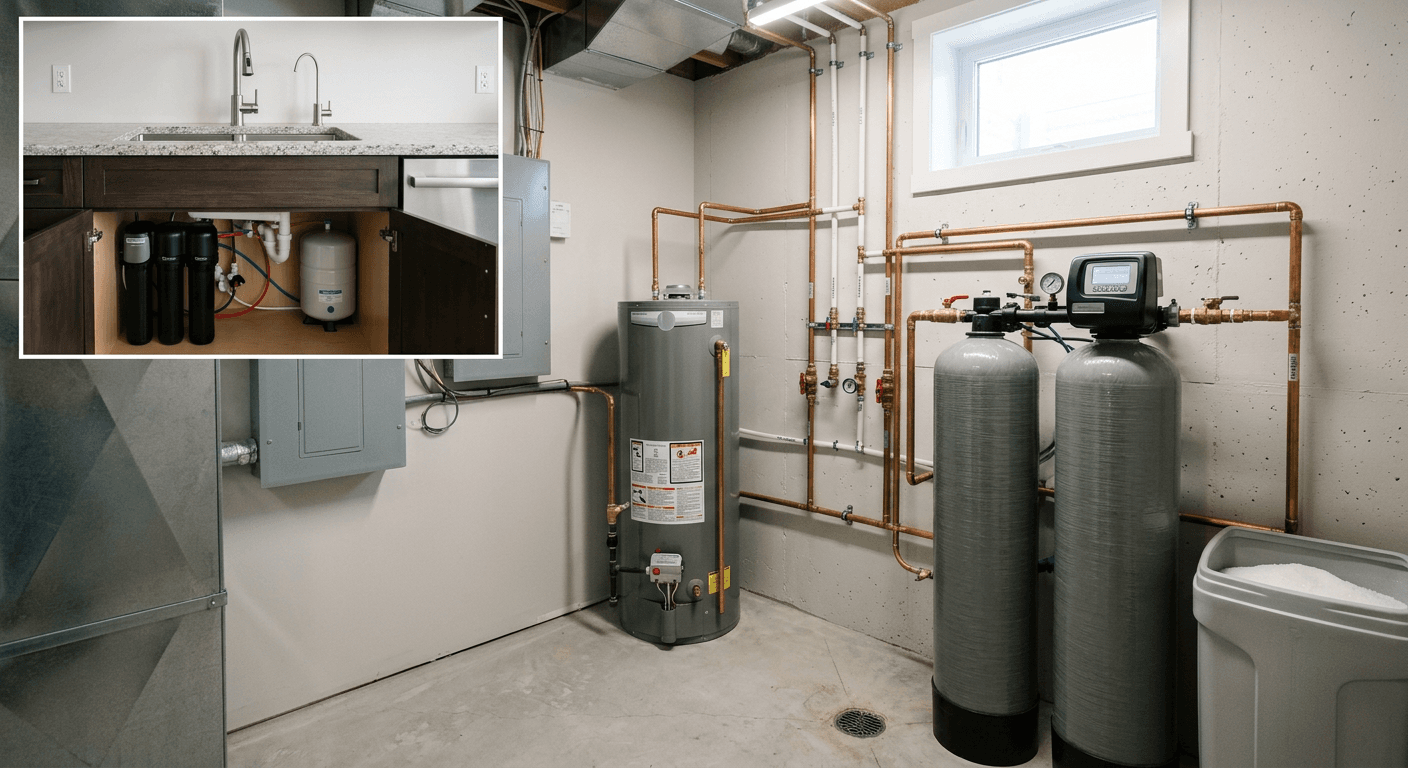
The most common misunderstanding about residential plumbing infrastructure is assuming that removing mineral hardness and removing chemical contaminants are the exact same process. When homeowners weigh a water softener vs reverse osmosis setup, they are not looking at two versions of the same tool. They are comparing entirely different mechanical processes designed to solve distinct problems. Hard water damages appliances and dries out skin, while dissolved solids affect drinking water taste and safety. This guide breaks down the mechanisms separating these technologies, examining how they actually alter municipal supply lines and which configurations genuinely suit local property requirements.
Quick Summary
A water softener prevents scale buildup by extracting calcium and magnesium from the main water line, while a reverse osmosis system purifies drinking water by forcing it through a semipermeable membrane at a single tap. Choosing between a water softener vs filter depends entirely on whether the property requires plumbing protection or dedicated drinking water purification.
- Softeners target hard minerals to protect water heaters, dishwashers, and piping.
- Reverse osmosis focuses on dissolved solids, heavy metals, and chlorine taste at the kitchen sink.
- Standard filtration removes sediment and chemicals without altering the mineral hardness of the water.
- Combining both systems addresses the entire spectrum of municipal supply issues.
Table of Contents
- Comparison Table
- Buying Guide: Defining Treatment Scope
- 1. Excalibur Water Systems
- 2. Kinetico Canada
- 3. Culligan Canada
- 4. Aquasana
- Single Systems Rarely Solve Severe Municipal Water
- Recommended Reads
Comparison Table
| Product | Treatment Scope | Features | Pros | Cons | Target Audience |
|---|---|---|---|---|---|
| Excalibur Water Systems | Whole-Home Conditioning | Canadian manufactured, digital control valves, specialized resin | Local supply chain, broad configuration options, accessible maintenance parts | Requires precise baseline sizing, reliant on grid power, bulky installation footprint | Buyers prioritizing domestic manufacturing and standard parts |
| Kinetico Canada | Point-of-Use Purification | Non-electric kinetic valves, twin-tank continuous flow, mechanical metering | Continuous soft water delivery, no electrical failures, automated cleaning cycles | High initial capital cost, proprietary internal gearing, restricted independent maintenance | Households demanding uninterrupted conditioning and zero electronics |
| Culligan Canada | Comprehensive Filtration | Volumetric metered regeneration, proprietary digital tracking, complete integration | Rapid dealer dispatch, minimal brine discharge, hands-off maintenance | Locked service contracts, restricted aftermarket filter use, ongoing operational fees | Homeowners wanting fully outsourced utility room management |
| Aquasana | Comprehensive Filtration | Salt-free template assisted crystallization, flow-through design, zero brine | No environmental brine discharge, eliminates heavy salt hauling, preserves dietary minerals | Does not remove calcium, spotting remains on glass, expensive media replacement | Eco-conscious residents facing municipal brine restrictions |
Buying Guide: Defining Treatment Scope
Navigating the residential market requires separating equipment by what it actually pulls out of the plumbing. Evaluating reverse osmosis vs water softener hardware comes down to understanding three primary categories of treatment scope.
Whole-Home Conditioning These systems install at the main shut-off valve to treat every drop entering the property. They use resin beads and ion exchange to physically trap calcium and magnesium, swapping them for sodium ions. The primary job here is mechanical protection: preventing scale buildup inside water heaters and reducing the abrasive effects of hard water that lead to dry skin.
Point-of-Use Purification Rather than treating the entire house, these units install under a specific fixture, usually the kitchen sink. They rely on municipal water pressure to force molecules through a semipermeable membrane, rejecting dissolved solids, heavy metals, and chlorine. A reverse osmosis system falls into this category, focusing entirely on consumable drinking and cooking water.
Comprehensive Filtration This category includes combined setups or whole-house filters designed to remove sediment and chemicals like chlorine before they reach the taps. For regions managing aggressive river-sourced municipal water, such as Edmonton municipal water conditions, homeowners often require a hybrid approach. The hard minerals damage the plumbing, while the seasonal chlorine spikes affect the taste.
Practical rule: Never buy a system designed for drinking water to solve a whole-house plumbing problem. Scale requires conditioning at the entry point, while purification belongs entirely at the tap.
1. Excalibur Water Systems
Excalibur Water Systems is a Canadian manufacturer of residential water filtration equipment, operating primarily as Whole-Home Conditioning for properties seeking domestic hardware. It suits households that want a traditional, programmable approach to their utility room setup rather than proprietary locked boxes.
This hardware uses conventional ion exchange to physically grab calcium out of the municipal line. Water passes through a pressurized tank filled with negatively charged resin beads that attract positively charged hardness minerals. Once the resin reaches its maximum saturation point, a digital control valve initiates a specialized backwash. The system draws a sodium-heavy brine solution from an adjacent tank, soaking the resin bed to break the ionic bonds holding the calcium, and then flushes the resulting wastewater directly into the home's drain line.
Local manufacturing shortens the supply chain
Because the components are assembled domestically, acquiring replacement valves, circuit boards, or specialized o-rings takes days rather than weeks. The hidden limit of this platform is the extreme precision required during the initial installation. The sheer variety of available configurations means selecting the exact valve and tank size requires precise flow-rate calculations based on the number of bathrooms and modern multi-head showers. Guessing the load will lead to restricted water pressure during peak morning usage or wasted salt from premature regeneration cycles. If the tank is undersized, fast-moving water drills a single path through the resin bed, bypassing the media entirely.
We would specify this platform when a property demands non-standard tank sizing and the buyer wants to ensure their lifetime tank warranty specifications are backed by a manufacturer operating in the local market.
Pros
- Parts availability bypasses international shipping delays.
- Wide variety of tank sizes accommodates extreme flow rates.
- Standardized resin options allow for straightforward future media replacement.
Cons
- Improper initial sizing heavily penalizes water pressure.
- Digital control heads require resetting after prolonged power outages.
- Large installation footprints can dominate smaller utility closets.
2. Kinetico Canada
While Excalibur relies heavily on digital control panels and grid power, Kinetico Canada engineers non-electric water softeners alongside multi-stage Point-of-Use Purification drinking water systems. It targets users who want to eliminate electronics entirely from damp utility spaces.
The system operates strictly on mechanical kinetic energy. Moving water turns an internal turbine inside the control head, physically ratcheting a gear system that tracks exact water volume rather than relying on an electronic sensor. When the gear reaches a pre-set limit, it mechanically opens a valve to shift the incoming water flow to a secondary tank. Because it features this twin-tank design, one resin bed remains online providing conditioned water while the other is actively cleaning itself, preventing the hard water bleed-through that occurs when standard single-tank systems regenerate in the middle of the night.
Non-electric operation removes a point of failure
By stripping out circuit boards, solenoids, and wiring, the equipment ignores power surges and electrical outages, continuing to meter usage accurately as long as the municipal pressure remains steady. However, the operational limit lies in its internal complexity. The upfront capital required for a twin-tank kinetic system sits at the absolute premium end of the market, but the internal gearing is a labyrinth of moving parts that cannot be serviced with a standard wrench. It requires factory-certified technicians to rebuild the control head, permanently locking the owner out of independent maintenance.
When clients ask about a water softener or reverse osmosis setup that requires zero electrical outlets to function, we consider this the definitive benchmark for continuous, uninterrupted conditioning.
Pros
- Twin-tank design guarantees soft water during cleaning cycles.
- Absence of circuit boards eliminates electrical failures in damp basements.
- Mechanical metered regeneration reduces unnecessary salt consumption.
Cons
- Upfront purchase costs heavily outweigh standard electric units.
- Complex internal gearing requires specialized technicians for overhauls.
- Proprietary design restricts DIY maintenance capabilities.
3. Culligan Canada
The decision to overhaul a home's plumbing infrastructure often starts with severe scale buildup on brand-new appliances, which is the exact trigger event Culligan Canada targets. It operates as a nationwide provider of water softeners, under-sink reverse osmosis systems, and Comprehensive Filtration solutions designed specifically for outsourced management.
Rather than relying on basic time clocks, the digital control head centralizes treatment by tracking exact gallon usage through an advanced volumetric meter. The mechanism reads the water usage down to the exact gallon. It adapts the regeneration schedule to match household activity. If family guests arrive, it cleans more frequently. When the house is empty, it pauses. When paired with their reverse osmosis units under the sink, a separate mechanical process uses municipal pressure. It forces water through a highly restrictive membrane. This effectively separates pure molecules from heavy metals and dissolved solids.
Brand scale guarantees parts availability
The sheer size of their distribution network ensures that replacement filters and maintenance components are perpetually stocked in regional warehouses. However, their proprietary valve designs, specific circuit board pin connections, and unique filter threadings lock future repairs into their specific dealer network. Suppose the system fails on a holiday weekend. A generic plumbing contractor cannot simply bypass the valve with off-the-shelf parts. The homeowner must wait for a dispatched fleet vehicle. This commits them to premium service rates for the lifespan of the equipment.
If a household simply wants a completely hands-off maintenance contract rather than handling their own specialized water treatment systems, we recommend outsourcing the utility room to this established network.
Pros
- Nationwide dealer footprint ensures rapid dispatch for maintenance.
- Volumetric tracking sharply reduces wastewater and brine discharge.
- Integrated tracking provides real-time water usage analytics.
Cons
- Proprietary threading prevents the use of aftermarket replacement filters.
- Mandatory dealer network servicing increases long-term operational costs.
- Initial purchase often involves commitments to ongoing service contracts.
4. Aquasana
According to its own published catalogue, Aquasana builds its reputation entirely on avoiding sodium. It operates as a water filtration brand offering whole-house salt-free water softeners, under-sink reverse osmosis filters, and shower filters for users attempting to avoid the physical labor of heavy salt bags.
Instead of extracting hard minerals through traditional ion exchange, the salt-free systems use a process known as Template Assisted Crystallization. As water flows upward through the specialized media tank, the media acts as a catalyst, pulling dissolved calcium and magnesium ions together to form microscopic, inactive crystals. Because these crystals are structurally stable, they lose the ionic charge required to stick to the inside of heating elements, shower mixing valves, or copper piping. It is a behavioral modifier for the minerals rather than an extraction tool.
Conditioning minerals differs from removing them
The process fundamentally changes how scale behaves without dumping chlorides into the local wastewater system, leaving the natural mineral content of the water intact for drinking. Nothing is actually removed from the municipal supply line. The water retains its exact original hardness rating. When water evaporates on a glass shower door or a dark tile floor, the microscopic crystals are left behind as visible white spots. Homeowners expecting the traditional slick feel of soft water and the total elimination of soap scum will be heavily disappointed.
We would deploy this Comprehensive Filtration architecture solely for environmentally conscious residents restricted by local municipal bans on brine discharge. When comparing a water softener vs water filter approach that avoids salt entirely, this mechanical trade-off is unavoidable.
Pros
- Zero brine discharge complies with stringent environmental regulations.
- Eliminates the physical labor of hauling heavy salt bags to the basement.
- Preserves natural mineral content for tap consumption.
Cons
- Glassware and shower doors still require aggressive wiping to prevent spots.
- Does not provide the distinct lathering ability of conditioned water.
- Scale control media requires expensive whole-tank replacement when exhausted.
Single Systems Rarely Solve Severe Municipal Water
The final decision between these architectures comes down to mapping the hardware directly to the specific municipal challenges of the property.
Whole-Home Conditioning If the primary bottleneck is failing water heaters, crusted showerheads, and chronic dry skin, the property requires physical mineral extraction at the main line. This is exactly where standard ion-exchange softening belongs. It handles the structural damage of hard water but leaves heavy chlorination and dissolved solids completely untouched.
Point-of-Use Purification When the household plumbing is safe but the tap water tastes heavily chlorinated or carries high dissolved solids, an under-sink membrane is the correct specialized tool. Evaluating reverse osmosis or water softener configurations individually often reveals that RO alone solves drinking complaints without offering any protection to the pipes.
Comprehensive Filtration For homes in Sherwood Park, Leduc, Beaumont, and Edmonton dealing with both aggressive scaling from river water and heavy municipal chlorination, single-category solutions fail. This is the scenario where combining approaches becomes strictly necessary. For instance, pairing a softener with a membrane purifier - such as the Triton Pure or the space-saving Triton Pure Tankless packages - addresses the mechanical plumbing threat while simultaneously delivering highly refined drinking water. Relying on just a water filter versus water softener in severe hard water zones simply ensures the carbon filters will prematurely choke on scale.
Practical rule: Secure a baseline water chemistry analysis before buying anything. Installing purification when you actually need conditioning is an expensive way to leave your property's plumbing entirely exposed.