5 Best Water Softener Systems in Canada for 2026
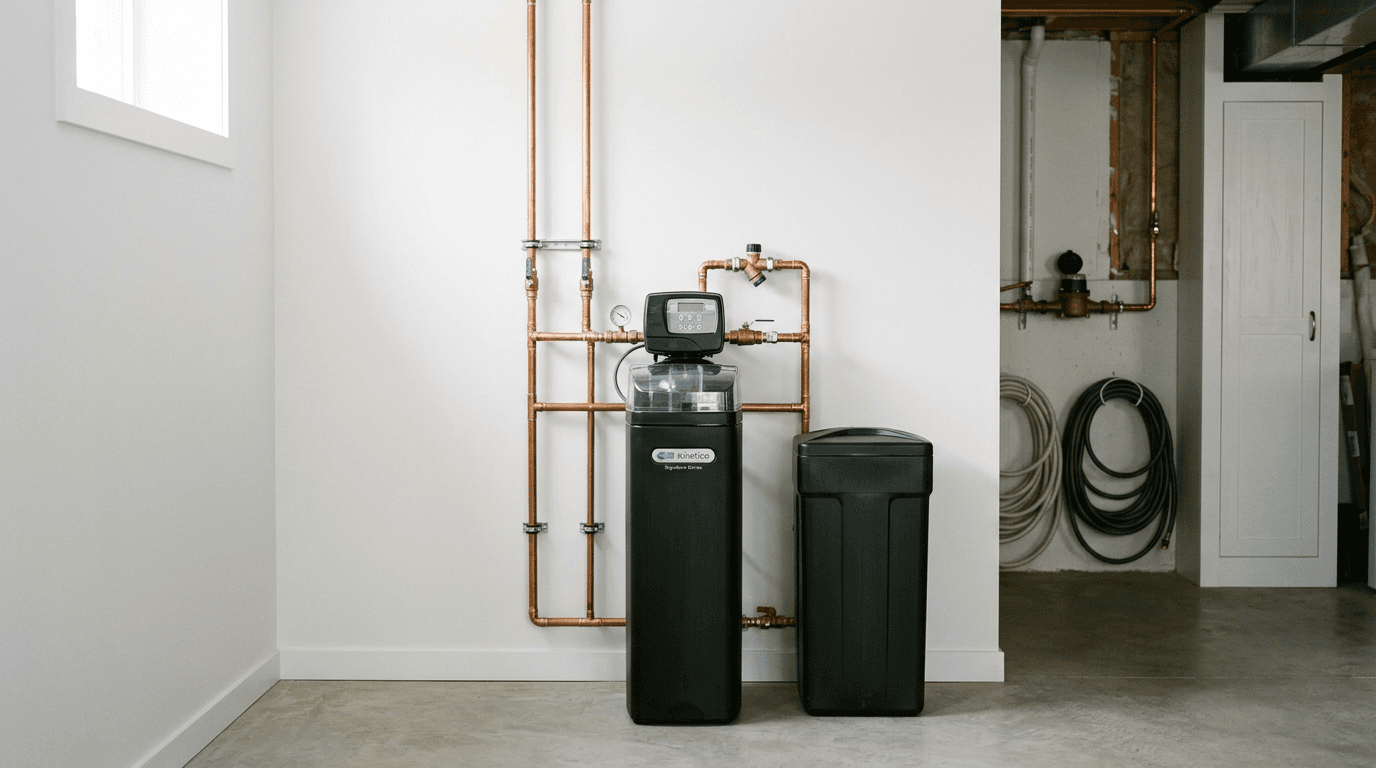
A sudden drop in water pressure from a showerhead coated in white scale is often the first moment homeowners realize how aggressive hard water can be on a home's plumbing. In regions like Edmonton, Beaumont, Leduc, and Sherwood Park, the water pulled from the North Saskatchewan River carries significant mineral content. Left untreated, those minerals shorten the lifespan of water heaters, calcify fixtures, and leave skin feeling persistently dry.
Quick Summary
The best water softener systems for Canadian homes are ion-exchange units that replace calcium and magnesium with sodium or potassium, preventing scale buildup and protecting plumbing.
- Hard water damages appliances and plumbing infrastructure.
- Salt-based systems are the most effective method for true softening.
- Sizing depends on water hardness levels and household usage.
- Combining softening with reverse osmosis addresses both scale and drinking water quality.
Table of Contents
- How to Choose a Water Softener
- 1. Kinetico Premier XP
- 2. Whirlpool WHES40 40,000 Grain Water Softener
- 3. Aquasure Harmony Series 32,000 Grains Water Softener
- Choosing Based on Household Demand
- Recommended Reads
How to Choose a Water Softener
Before evaluating individual systems, it is necessary to understand the criteria that separate them. The primary distinction among the best water softener systems is their Control Valve Mechanism. This axis determines how and when the system regenerates, which directly impacts salt efficiency and water waste.
We categorize systems into three main types based on this axis:
- Non-Electric Demand: Uses water flow to trigger regeneration, operating without electricity.
- Digital Metered: Uses an electronic sensor to track water usage and schedules regeneration accordingly.
- Timer-Based: Regenerates on a set schedule regardless of actual water usage (mostly phased out in high-efficiency models).
When testing water in Edmonton, we find hardness levels around 9.6 grains per gallon. Knowing your specific hardness level ensures you select a system that can handle the load without overworking.
| Product | Control Valve Mechanism | Features | Pros | Cons | Target Audience |
|---|---|---|---|---|---|
| Kinetico Premier XP | Non-Electric Demand | Multi-tank design, non-electric | Continuous soft water, highly efficient, durable | Higher upfront cost, requires professional setup, complex mechanics | High-demand households |
| Whirlpool WHES40 | Digital Metered | Single-cabinet, demand-initiated | Space-saving, handles iron, accessible | Single tank limits flow during regeneration, reliant on power, electronic parts wear | Moderate households dealing with iron |
| Aquasure Harmony | Digital Metered | Automatic digital control head | Predictable regeneration, customizable settings, straightforward installation | Can interrupt soft water supply, electronic dependency, bulkier footprint | Budget-conscious homeowners |
1. Kinetico Premier XP
The Kinetico Premier XP is a heavy-duty, salt-based system engineered for households that cannot afford an interruption in their soft water supply. It falls squarely into the Non-Electric Demand category.
Instead of relying on an electronic timer, this system uses the kinetic energy of moving water. This energy powers its control valve. It features a multi-tank design. When one tank is saturated and enters regeneration, the system automatically switches to the second tank. This ensures that soft water is always available, even if a heavy usage event triggers a regeneration cycle during the day.
Reliability requires mechanical complexity
The honest limit of this system is its mechanical complexity. While it avoids electronic failures, the intricate gearing within the non-electric valve requires specialized knowledge to service. Homeowners looking for a simple DIY repair will find this valve intimidating, and it generally requires a certified technician for maintenance.
I would recommend this system for large families where multiple bathrooms run simultaneously, provided the budget allows for premium equipment.
Pros
- Delivers soft water 24/7 without interruption.
- Operates entirely without electricity.
- Highly efficient on salt and water usage.
Cons
- Commands a premium purchase price.
- Maintenance requires specialized technicians.
- Initial setup is more complex than standard units.
2. Whirlpool WHES40 40,000 Grain Water Softener
For homes where space in the utility room is tight, the Whirlpool WHES40 integrates the resin tank and brine tank into a single, compact cabinet. This unit operates as a Digital Metered system, tracking water flow to optimize regeneration.

The system uses demand-initiated regeneration. This means it only flushes the resin beads when the programmed capacity is reached. According to its published specifications, it handles high hardness. It also handles clear-water iron. The digital control panel allows the user to input the specific hardness level, and the system calculates the most efficient regeneration schedule based on actual household water consumption.
Compact design limits capacity during regeneration
Since this system relies on a single tank, a temporary interruption in softening occurs during its regeneration cycle. When the unit flushes - typically scheduled for 2:00 AM - hard water bypasses the system to keep water flowing if a tap is opened. Shift workers or night owls will experience hard water if they run the shower during this cycle.
This is a solid choice for homeowners with moderate water usage who need to fit a softener into a small mechanical room.
Pros
- Space-saving single-cabinet design.
- Capable of treating clear-water iron.
- Accessible controls for easy programming.
Cons
- Hard water bleeds through during regeneration.
- Reliant on a stable electrical connection.
- Electronic circuit boards are susceptible to surges.
Practical rule: Always input your tested hardness level slightly higher than the actual result to account for seasonal fluctuations in municipal water supplies.
3. Aquasure Harmony Series 32,000 Grains Water Softener
The Aquasure Harmony Series is a traditional two-tank Digital Metered system designed for straightforward residential water softening. It provides an accessible entry point for those dealing with the negative effects of hard water.
This system relies on an automatic digital metered control head. The mechanism tracks the gallons of water passing through the resin bed. Once the pre-set capacity is exhausted, the control head initiates a backwash and brine draw to recharge the resin. The separate brine tank provides a larger capacity for salt storage compared to cabinet models, reducing the frequency of refills.
Standard capacity requires careful sizing
Having a 32,000-grain capacity means this system is best suited for light to moderate softening needs. In regions with extremely hard water, this capacity will be exhausted quickly, forcing frequent regenerations that consume more salt and water over time. It is not suited for large homes with high hardness levels, as it will struggle to keep up with peak flow demands.
I would suggest this unit for smaller households or homes where the incoming water hardness is moderate.
Pros
- Straightforward, proven digital control valve.
- Separate brine tank holds more salt.
- Customizable regeneration settings.
Cons
- 32,000-grain capacity limits use in high-hardness areas.
- Requires more floor space than cabinet models.
- Soft water is unavailable during the regeneration cycle.
Choosing Based on Household Demand
Selecting the right system depends entirely on matching the Control Valve Mechanism to your household's daily rhythm.
If your household requires soft water at all hours and you cannot afford interruptions, the Non-Electric Demand category is the necessary choice. The dual-tank setup ensures continuous supply, making it ideal for large families or shift workers.
If your water usage is predictable and mostly occurs during the day, a Digital Metered system offers a balance of efficiency and cost. It tracks your usage and regenerates overnight, suiting most standard schedules.
For those seeking comprehensive water treatment, combining a softener with a reverse osmosis system, such as a Triton Pure or Triton Pure Tankless package, addresses both the plumbing protection and drinking water purity.