3 Whole Home Water Filtration Systems Evaluated: 2026 Cost Guide
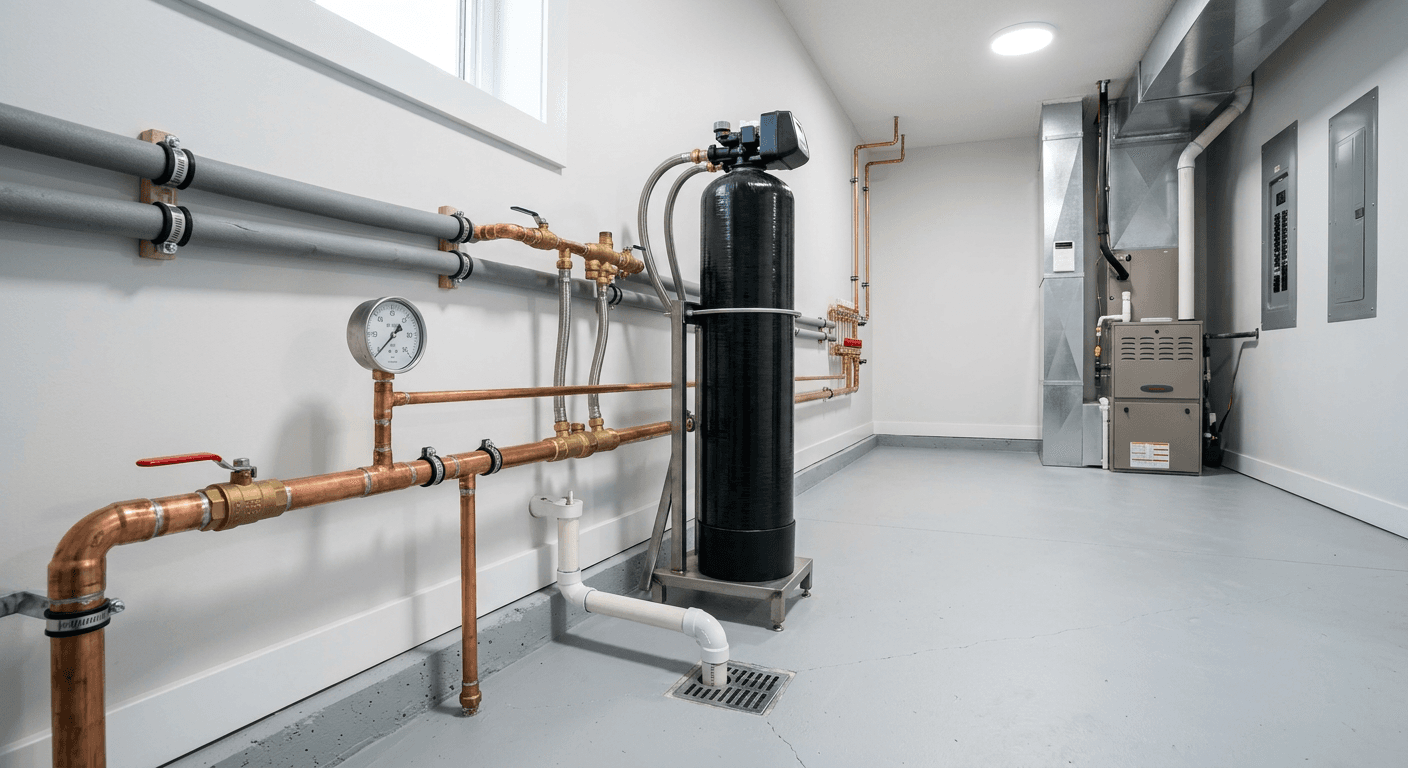
Most homeowners evaluating whole home water filtration systems assume their dry skin and scaling plumbing fixtures come from a single water quality issue that a basic carbon filter will resolve. In reality, municipalities drawing from the North Saskatchewan River deliver highly treated, heavily chlorinated water mixed with significant mineral hardness that shifts dynamically during the spring runoff. Treating this effectively requires separating the removal of dissolved minerals from the extraction of chemical disinfectants, rather than hoping a single retail tank will catch everything.
Quick Summary
Whole home water filtration systems are centralized treatment units installed where the main water line enters a property, designed to extract sediment, chemicals, and biological contaminants before they reach the internal plumbing.
- Sizing requires matching the tank's service flow rate to the home's peak water demand.
- Municipal water demands chlorine removal, while rural wells require iron and biological treatment.
- Hardware costs represent only a fraction of the investment; plumbing retrofits heavily dictate total expenditure.
- Delivery models dictate whether you receive ongoing technical support or just a box of parts.
Table of Contents
- Why whole home water filtration systems demand exact sizing
- Comparison Table
- Buying Guide / How to Choose
- Calculating the whole home water filtration system cost
- 1. Aquatell
- 2. Water Filters Canada
- 3. Waterdrop Canada
- Matching situations to delivery models
- Recommended Reads
Why whole home water filtration systems demand exact sizing
When evaluating entire home water filtration systems, the most common failure point is not the filter media itself, but a mismatch between the hardware's flow capacity and the property's plumbing infrastructure. Water filtration for whole house applications must process water at the exact speed your fixtures demand. If a tank is rated for seven gallons per minute and you run two showers simultaneously requiring ten gallons per minute, the water pressure either drops drastically, or the sheer velocity pushes raw, untreated water past the media bed.
Residents in Edmonton, Beaumont, Leduc, and Sherwood Park face unique municipal water chemistry that heavily influences these sizing decisions. Because the local water supply contains both aggressive chlorine and high calcium hardness, selecting the right equipment often means deploying modular, multi-stage whole house water purification systems rather than single all-in-one cabinets that quickly become overwhelmed.
Comparison Table
| Product | Delivery and Support Model | Features | Pros | Cons | Target Audience |
|---|---|---|---|---|---|
| Aquatell | Specialized Equipment Distributor | Tank-based media systems, atmospheric oxidation units | Free shipping >$249, heavy-duty hardware, standard valves | 25% restocking fee, $100 northern shipping, no in-field sizing | Buyers with lab tests and licensed plumbers |
| Water Filters Canada | Component Reseller | Ultraviolet disinfection, quick-ship replacement parts | Fast shipping, high-grade UV systems, 30-day return window | 20% restocking fee, zero field support, DIY diagnostics required | Rural property owners with pipe-fitting skills |
| Waterdrop Canada | Direct-to-Consumer Brand | Tankless reverse osmosis, unified plastic manifolds | Compact footprint, 1-2 year limited warranties, 24h shipping | 10% restocking fee, proprietary lock-in, postal code exclusions | Modern households prioritizing aesthetic design |
Buying Guide / How to Choose
Categorizing whole house water treatment systems by their underlying technology is a mistake; the control valves and carbon media are practically identical across the industry. The genuine difference lies in how the vendor supports the installation long-term. We classify these vendors into three distinct categories based on their Delivery and Support Model:
- Specialized Equipment Distributor: These businesses ship commercial-grade, non-proprietary tanks directly to your driveway. They offer robust equipment capable of handling severe municipal hardness or well water iron, but they outsource the installation and engineering risk entirely to you and your local plumber.
- Component Reseller: These warehouses focus on replacement parts, UV lamps, and specialized singular housings. They are built for speed and inventory depth, serving contractors and highly capable DIYers who know exactly which part number they need to splice into their existing manifold.
- Direct-to-Consumer Brand: These manufacturers prioritize aesthetics and user experience, wrapping their filtration media in proprietary plastic housings. They shrink the physical footprint dramatically, but lock the buyer into purchasing replacement filters exclusively from their ecosystem for the life of the machine.
Practical rule: Never evaluate a filtration vendor without first reading their restocking policy; the financial penalty for ordering a tank with an incorrect bypass valve diameter routinely exceeds twenty percent of the purchase price.
When dealing with heavily treated municipal water, environmentally conscious residents and skin health seekers often require targeted chlorine removal alongside softening. In these scenarios, combined approaches - like deploying Triton Pure or Triton Pure Tankless packages - handle both scale reduction and reverse osmosis drinking water without cobbling together mismatched retail brands. Reviewing local water quality data for Edmonton explains why municipal treatment demands this layered approach throughout the year.
Calculating the whole home water filtration system cost
Evaluating whole home water filtration system cost requires separating the price of the tanks from the reality of the plumbing retrofit. A premium carbon backwashing tank might retail for a thousand dollars, but installing it in a finished basement can double that figure in an afternoon.
The primary variable driving installation cost is the location of the main water shut-off valve relative to the property's drainage infrastructure. Backwashing filters and softeners must discharge wastewater. If your water main enters the house on the opposite side of the basement from the floor drain, a plumber must trench the concrete or route overhead drain lines equipped with proper air gaps to prevent municipal sewer backups from contaminating your drinking water. Examining a provider's warranty coverage details will reveal whether you are covered for labor or just replacement parts if these newly routed lines ever leak.
Additionally, the transition materials matter. Splicing a bypass valve into modern PEX tubing takes a fraction of the time required to unsweat, cut, and re-solder rigid copper pipe in a confined mechanical room. Always budget for the required pressure-reducing valves and thermal expansion tanks that local plumbing codes often mandate when altering the main line geometry. Because water cannot expand backward into the city main when heated in a closed-loop system, the pressure inside the house spikes, which can easily crack the plastic housings on newly installed filtration manifolds if an expansion tank is omitted.
Practical rule: Measure your incoming pipe diameter and static water pressure before ordering any filtration vessel; a tank rated for fifteen gallons per minute will choke a home's flow if stepped down through incorrect three-quarter-inch bypass fittings.
1. Aquatell
Heavy-duty water treatment requires robust hardware. Aquatell operates as a Specialized Equipment Distributor. They supply complex residential water treatment hardware directly to Canadian property owners managing specific well or municipal water issues. They do not push single-cartridge aesthetics. Instead, they focus on established tank-based media systems requiring dedicated floor space and proper drain routing. Understanding a company's background through their about the local team section helps verify operations. Do they utilize subcontractors or strictly internal technical staff for these complex heavy-duty tanks?
The mechanism relies on proven industrial principles scaled down for residential use. For instance, their Atmos-AIO Iron & Sulphur Water Filter processes incoming water by drawing a pocket of ambient air into the top of the pressure tank. As raw water sprays through this air pocket, dissolved iron and hydrogen sulfide oxidize into solid particles. The water then flows downward through a specialized catalytic media bed that traps these solid precipitates. During its automated regeneration cycle, the control valve backwashes the media, lifting the bed to flush the trapped iron and sulfur down the drain before pulling a fresh pocket of air into the tank. This completely avoids chemical injectants or replacement filter cartridges, relying entirely on mechanical oxidation.
Broad inventory requires precise sizing
Because they distribute professional-grade hardware, the responsibility for system engineering shifts entirely to the buyer. You are purchasing components designed for specific flow rates, pipe diameters, and water chemistries.
Engineering responsibility transfers completely to the buyer. Returns carry a 25% restocking fee. Ordering the wrong tank size or valve type triggers a substantial financial penalty. Qualifying items must remain unused, in sellable condition, and in their original packaging. Most orders over $249 before tax ship free to primary Canadian destinations. However, properties located in Nunavut, Yukon, or the Northwest Territories face a $100 flat shipping fee. Newfoundland orders incur a $40 flat fee. I would hold off if expecting a plug-and-play installation. You must know your exact flow rate and pipe diameter before checking out.
Deploy this distributor when you possess a comprehensive laboratory water test and have already secured a licensed plumber ready to program standard, non-proprietary control valves.
Pros
- Provides free shipping on most orders over $249 before tax across primary Canadian delivery zones.
- Supplies heavy-duty oxidation units like the Atmos-AIO Iron & Sulphur Water Filter starting from $1,359.99 CAD.
- Focuses on non-proprietary, rebuildable tank systems that local technicians recognize.
Cons
- Charges a flat shipping fee of $100 for orders to Northern territories and $40 to Newfoundland.
- Enforces a 25% restocking fee on unused items returned in their original packaging.
- Offers no in-home consultation to verify pipe sizing or validate water chemistry before purchase.
2. Water Filters Canada
Where do homeowners source specific replacement parts? Water Filters Canada
Water Filters Canada functions as a Component Reseller, providing whole house UV disinfection systems and replacement plumbing parts directly to homeowners and contractors executing their own retrofits. They bridge the gap between commercial supply houses and residential buyers by maintaining an accessible online catalogue of specialized treatment components.
This supplier operates by warehousing high-turnover ultraviolet and filtration components for rapid deployment rather than custom-building integrated systems. A system like their VIQUA VH150 Whole House UV System acts as a biological checkpoint for the property. Incoming water is forced through a narrow stainless steel chamber containing a quartz sleeve. Inside this sleeve, a specialized lamp emits a precise wavelength of ultraviolet light. As water passes the lamp, the UV energy scrambles the DNA of microbiological contaminants, neutralizing bacteria and viruses so they cannot reproduce. Because UV treatment requires perfectly clear water to prevent shadowing - where microorganisms hide behind suspended sediment particles - this unit must be installed strictly downstream of a fine sediment filter. Most orders process through their Canadian warehouse within 1 to 2 business days, with delivery taking 2 to 5 business days to most addresses.
Online supply demands independent technical support
Procuring hardware through a high-volume warehouse model strips away the safety net of local, hands-on diagnostics. If you lack the required pipe-fitting skills, reaching out to technical support to source local in-field servicing is safer than attempting a DIY installation on a pressurized main.
They operate strictly as an online supplier. They do not offer in-field servicing, installation, or system maintenance. A UV ballast might throw an error code. A filter housing could crack under static pressure. The homeowner is entirely responsible for managing the plumbing bypass while initiating a warranty claim. Most new, unused VIQUA items can be returned within 30 days of delivery. Returns require their original packaging. Refunds are issued minus a 20% restocking fee. You must diagnose any pressure fault alone in a wet basement without direct factory support to guide the repair.
Purchase hardware through this channel if you are managing a rural property and already maintain the pipe-fitting skills necessary to isolate, drain, and replace plumbing fixtures independently.
Pros
- Processes and ships most warehouse orders within 1 to 2 business days for rapid delivery.
- Offers specialized disinfection equipment like the VIQUA VH150 Whole House UV System for $645.00 CAD.
- Allows returns on most new VIQUA items within 30 days of delivery.
Cons
- Deducts a 20% restocking fee from refunds on eligible returned hardware.
- Provides zero field support, in-home servicing, or direct maintenance assistance.
- Leaves the diagnosis of any electrical or pressure faults entirely to the buyer.
3. Waterdrop Canada
Moving away from traditional bulky tanks leads to Waterdrop Canada.
Waterdrop Canada operates as a Direct-to-Consumer Brand, engineering enclosed, cartridge-based reverse osmosis systems and whole house filters for households prioritizing aesthetic design and compact footprints. They target the segment of the market that views water filtration as a consumer appliance rather than a piece of industrial infrastructure. For customers passing deals to neighbours, reviewing community referral guidelines demonstrates how local incentive programs differ from direct-to-consumer online discounts.
Instead of utilizing separate fibreglass media tanks and external brine drums, this manufacturer integrates the filtration media directly into quick-change, disposable cartridges housed inside unified plastic manifolds. For their reverse osmosis units, the mechanism relies on active pressure rather than passive flow. An internal electric booster pump pushes municipal tap water against a tightly wound, semi-permeable membrane. This membrane physically blocks dissolved solids, heavy metals, and fluoride, routing the concentrated reject water to the drain while dispensing purified water instantly to a dedicated faucet. This tankless design eliminates the bulky storage bladder typically associated with drinking water systems, generating purified water strictly on demand. The company requires 24 to 48 hours of handling time to prepare orders, with most packages shipping out within 24 hours except on weekends and holidays.
Proprietary designs trade standardization for aesthetics
The engineering that makes these systems visually appealing and easy to maintain also creates a closed hardware ecosystem. By abandoning standard filter housings, the manufacturer ensures that off-the-shelf replacement parts from a local hardware store will never fit their manifolds.
They deliver products to most areas in Canada, excluding regions where zip codes start with X or Y, and a 10% restocking fee applies to all non-quality-related return requests where customers remain responsible for the return shipping costs. We would hold off on this hardware if you live in a restricted postal code or refuse to be permanently locked into purchasing proprietary replacement cartridges exclusively from one vendor, as a discontinued filter line renders the entire manifold useless.
Install this class of equipment in modern environments where under-sink space is severely constrained and prioritizing a two-minute cartridge swap outweighs the long-term flexibility of standard open-source housings.
Pros
- Backs most RO systems with a 1-year limited warranty and eligible X Series units with a 2-year limited warranty.
- Shrinks the required installation footprint by utilizing tankless, integrated filter manifolds.
- Prepares and ships most orders within 24 hours after the initial handling period.
Cons
- Excludes delivery to Canadian regions with postal codes starting with X or Y.
- Imposes a 10% restocking fee plus return shipping costs for non-defective returns.
- Locks the homeowner into purchasing proprietary replacement cartridges exclusively from their ecosystem.
Matching situations to delivery models
Selecting the correct hardware depends entirely on your capacity to manage plumbing infrastructure and your willingness to tolerate proprietary ecosystems.
Choose a Specialized Equipment Distributor when you are building a new home or undertaking a major mechanical room renovation. The upfront burden of sizing the tanks and coordinating a professional installation pays off in the long run through access to standard, rebuildable valves that any local water technician can service.
Opt for a Component Reseller if you already operate a rural property running on well water and simply need to replace a failing UV ballast or cracked filter housing rapidly. This route demands that you act as your own project manager and diagnostic technician when the pressure drops.
Commit to a Direct-to-Consumer Brand only when physical space is your absolute bottleneck. If retrofitting a large media tank into your condominium or modern kitchen is structurally impossible, accepting the vendor lock-in of proprietary cartridges is the necessary trade-off to achieve immediate water purification.