6 Essential Components of a Well Water Softener System
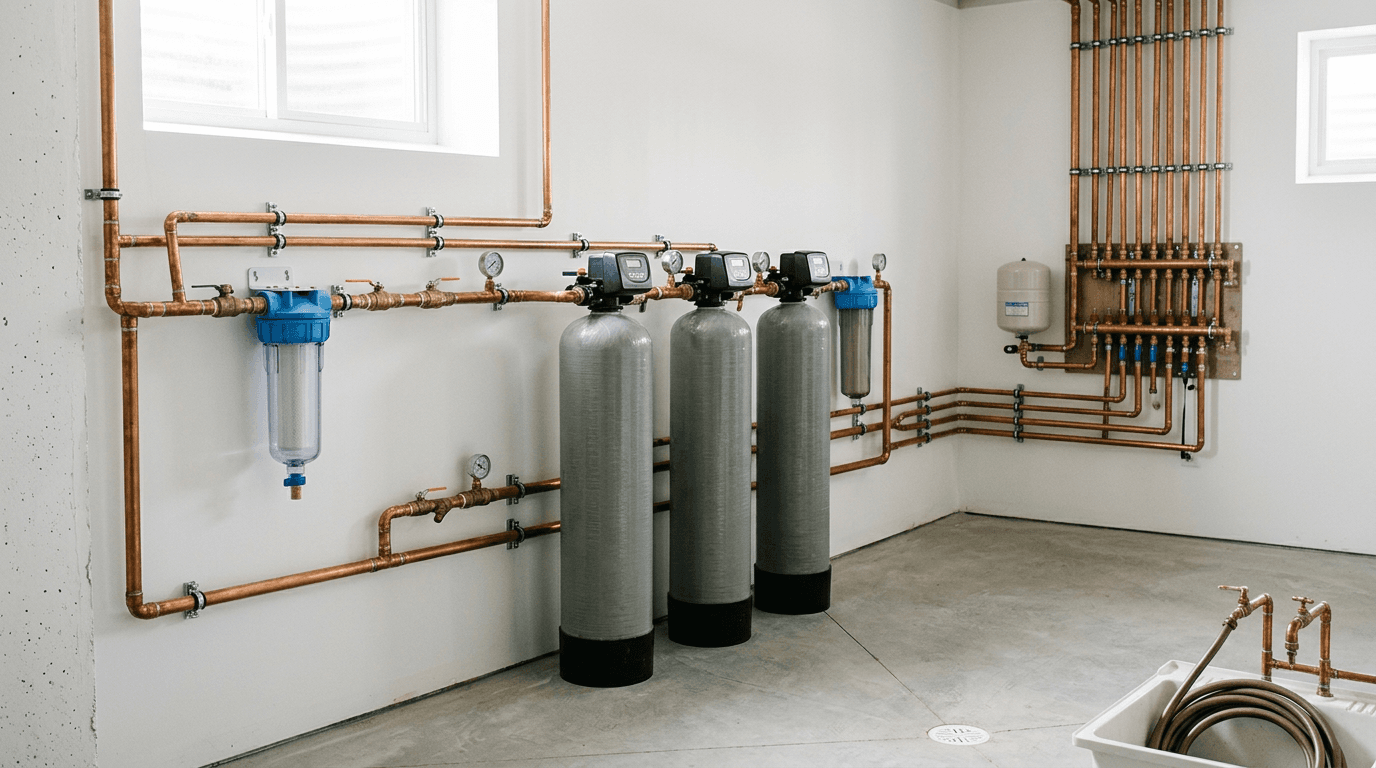
A common misconception among homeowners moving to rural properties is that treating well water requires nothing more than purchasing a heavy-duty well water softener. In reality, routing untreated well water directly into a resin tank is the fastest way to destroy it. A softener is designed to remove dissolved hardness minerals; it is not a primary filter for the mud, sand, and oxidized metals commonly pulled from a private aquifer. When you skip the pre-treatment steps, iron coats the resin beads, sediment clogs the control valve, and the system fails within a few years.
For residents in the rural outskirts of Edmonton, Beaumont, Leduc, and Sherwood Park, well water chemistry varies drastically from one property to the next. Building a functional treatment sequence requires understanding exactly what contaminants are present and addressing them in the correct order.
Quick Summary
A well water treatment system is a sequenced series of filtration and conditioning equipment designed to remove sediment, iron, hardness, and pathogens from private well water before it enters the home's plumbing.
- Sediment filters must be placed first to protect subsequent control valves.
- Iron filtration requires dedicated oxidation stages, as softeners cannot handle heavy iron loads.
- Ion-exchange softeners remove calcium and magnesium to prevent scaling.
- Ultraviolet purification acts as a final safeguard against bacterial contamination.
- Thorough water testing dictates the exact sequence and sizing of the equipment.
Table of Contents
- The Sequence of Treatment
- 1. Spin-Down Sediment Filters
- 2. Cartridge Sediment Filters
- 3. Air Injection Iron Filters
- 4. Ion-Exchange Well Water Softeners
- 5. Point-of-Use Reverse Osmosis
- 6. Ultraviolet Purification Systems
- Mapping Your Well Water Solution
- FAQ
- Recommended Reads
The Sequence of Treatment
Comparing well water equipment requires looking at the sequence of filtration. The lens for evaluating these components is their position in the treatment line and their specific contaminant target. A component that excels at the end of the line will fail immediately if placed at the beginning. Every item below is judged by what it removes, how it protects the equipment downstream, and where its capabilities end. Before installing any of these, you must know your baseline chemistry, which is why Free In-Home Water Testing Edmonton is the mandatory first step.
1. Spin-Down Sediment Filters
A spin-down filter is a first-line defense mechanism installed immediately after the pressure tank. It is designed for homes drawing water from sandy or gritty aquifers, acting as a physical barrier to keep large particulate matter out of the delicate control valves of downstream equipment.

These filters work using centrifugal force. As water enters the filter housing, it is directed in a circular motion. The heavier particles - like sand, coarse dirt, and pipe scale - are thrown to the outside of the clear housing and drop to the bottom of the collection bowl. The filtered water then passes through a reusable mesh screen (typically rated between 50 and 100 microns) and continues into the home. When the bowl fills with debris, the homeowner opens a flush valve at the bottom to purge the trapped sediment into a bucket or drain.
Excellent for coarse grit, useless for silt
The primary advantage of a spin-down filter is that it has no ongoing consumable costs; the mesh screen is reusable, and purging takes seconds. It prevents heavy sand from shredding the seals in your water softener for well water.
However, its honest limit is particle size. Spin-down filters are entirely ineffective against fine silt, clay, or colloidal particles. If your well produces water that looks cloudy or milky but does not settle quickly, a spin-down filter will let those fine particles pass right through. Homeowners in Beaumont with fine glacial till in their aquifers should skip standalone spin-down filters and move directly to a staged cartridge approach, or use the spin-down only as a rough pre-filter.
2. Cartridge Sediment Filters
Cartridge sediment filters are the standard pre-filtration method for most rural homes. They consist of a large plastic housing (often a 10-inch or 20-inch "Big Blue" style) containing a replaceable cylindrical filter element. They are for homeowners who need to remove fine particulate matter that a spin-down filter misses.
Water is forced through the walls of the cartridge from the outside in. The filter media - usually pleated polyester, spun polypropylene, or string-wound cotton - traps particles in its microscopic pores. Pleated filters offer a large surface area for trapping dirt and can sometimes be rinsed and reused. Spun polypropylene filters are depth filters, trapping larger particles on the outside and finer particles deeper within the material, making them highly effective for varied sediment sizes. A sediment filter water softener sequence ensures the resin tank never sees physical dirt.
High clarity, high maintenance
Cartridge filters provide exceptional water clarity, often filtering down to 5 or even 1 micron. They are the only reliable way to stop fine silt from coating the inside of your plumbing and appliances.
Cartridge filters naturally restrict your water flow as they trap dirt, creating a direct trade-off between clean water and water pressure. If your well pulls a heavy sediment load, you may find yourself changing a saturated, heavy cartridge every three weeks to restore your shower pressure. For homes with extreme sediment, a single cartridge is a bottleneck. Those users should skip single housings and install a backwashing sediment tank instead, which cleans itself automatically.
Practical rule: Size your cartridge filter housings for flow rate, not just pipe diameter. A 20-inch "Big Blue" housing will maintain household water pressure far longer than a standard 10-inch housing, even if both connect to a 1-inch plumbing line.
3. Air Injection Iron Filters
An air injection iron filter is a dedicated tank system designed to remove high concentrations of dissolved (clear water) iron, manganese, and hydrogen sulfide (the rotten egg smell). It is essential for rural properties where the water comes out of the tap clear but turns orange after sitting in a glass.
This system works by oxidizing dissolved metals so they become solid particles that can be filtered out. The control valve draws in a pocket of compressed air at the top of the tank. As well water sprays through this air pocket, the oxygen forces the dissolved ferrous iron to convert into solid ferric iron rust. The water then passes through a specialized catalytic media bed (such as Birm, Katalox Light, or Filox), which catches the rusted particles. Every few days, the system backwashes, violently flushing the trapped iron down the drain and replenishing the air pocket. This is far superior to relying on a basic iron water softener.
Chemical-free oxidation, requires strong well pressure
The massive benefit of air injection is that it requires no chemical regenerants - no chlorine mixing tanks, no potassium permanganate stains, and no constant consumable costs. It effectively shields the downstream softener from iron fouling.
These systems rely entirely on aggressive backwash flow rates to lift and clean the heavy catalytic media bed. To clean the media bed and lift the trapped iron out of the tank, the well pump must be capable of delivering 5 to 10 gallons per minute of sustained flow during the backwash cycle. If you are on a low-yield well in Leduc that can only produce 3 gallons per minute, an air injection filter will fail to clean itself. The media will cement together into a solid brick of rust within a year. Low-yield wells must use chemical injection systems or water softeners specifically configured for low-level iron instead.
4. Ion-Exchange Well Water Softeners
The well water softener is the core conditioning unit designed to eliminate calcium and magnesium - the minerals responsible for scaling pipes, destroying hot water heaters, and causing stiff laundry. It is for any home drawing from a hard water aquifer.
Inside the tank are millions of microscopic resin beads charged with sodium ions. When hard water flows through the bed, the resin beads act like magnets, attracting the calcium and magnesium ions and releasing sodium ions in exchange. Once the resin is saturated with hardness minerals, the system initiates a regeneration cycle. It draws a concentrated brine solution from the salt tank, floods the resin to break the bond with the hardness minerals, flushes them down the drain, and recharges the beads with fresh sodium. To understand sizing for these systems, reviewing Water Softeners Edmonton provides a baseline for local hardness capacities.
Masters of calcium, vulnerable to iron fouling
A properly sized ion-exchange system completely stops scale formation, protecting the plumbing infrastructure and reducing soap usage by up to 50 percent.
Chemical boundaries strictly govern how much iron a water softener can safely handle. While a softener can technically remove small amounts of dissolved ferrous iron through ion exchange, doing so damages the resin. Iron binds to the resin beads much tighter than calcium does. During a standard salt regeneration, the brine is not strong enough to force all the iron off the beads. Over time, the iron oxidizes inside the tank, permanently coating the resin in a layer of rust and destroying its ability to soften water. Anyone with more than 1.0 part per million (ppm) of iron must use a dedicated iron filter prior to the softener; relying on the softener alone will cut its lifespan from fifteen years down to three.
5. Point-of-Use Reverse Osmosis
Reverse Osmosis (RO) systems are intensive purification units typically installed under the kitchen sink. Because well water can carry elevated sodium (especially after passing through a softener) or trace agricultural run-off, an RO system is for homeowners who want bottled-quality drinking and cooking water without the plastic waste.

The mechanism relies on municipal or well pressure to force water through a semi-permeable membrane. The membrane's pores are so small (0.0001 microns) that only pure water molecules can pass through. The rejected contaminants - including dissolved solids, heavy metals, and sodium - are flushed down the drain. Because this process is extremely slow, producing only drops per minute, standard systems store the purified water in a small pressurized holding tank. For a combined approach, we frequently install our Triton Pure and Triton Pure Tankless packages to pair whole-home softening with localized RO purification in areas like Sherwood Park.
Ultimate drinking water purity, terrible for whole-home flow
An RO system provides the highest level of purification available for residential drinking water, stripping out 95 to 99 percent of total dissolved solids.
Slow processing speeds and high wastewater ratios make whole-house reverse osmosis highly impractical. RO membranes cannot process water fast enough to support a whole house without massive, commercial-grade booster pumps and hundreds of gallons of atmospheric storage. Attempting to filter a whole home with RO is financially ruinous and completely unnecessary for showering or flushing toilets. Furthermore, RO membranes will foul immediately if fed hard, iron-laden water; they must be installed downstream of the softener and iron filter.
6. Ultraviolet Purification Systems
An Ultraviolet (UV) purification system is a biological safeguard. Unlike municipal water, which is treated with chlorine, well water has no residual disinfectant. A UV system is for rural homeowners who need to protect against E. coli, coliform bacteria, and other pathogens that can enter a private aquifer after heavy rainfall or spring melts.
The system consists of a stainless steel chamber housing a high-intensity UV lamp, protected by a quartz glass sleeve. As water flows through the chamber, it is exposed to the UV-C light. The light penetrates the cell walls of bacteria and viruses, scrambling their DNA and rendering them instantly sterile. Because they cannot reproduce, they cannot cause infection.
Instant bacterial neutralization, blind in cloudy water
UV purification is entirely chemical-free. It adds no taste or odor to the water and acts instantly as the water passes through the chamber, providing 24/7 protection against microbiological threats.
A physical vulnerability of UV technology is a phenomenon known as "shadowing." The UV light must physically strike the pathogen to neutralize it. If the water contains suspended sediment, turbidity, or heavy discoloration from tannins, the bacteria can hide behind these particles as they pass the lamp. Furthermore, if iron or hardness minerals are allowed to coat the quartz glass sleeve, the light is blocked from entering the water entirely. UV systems must be the absolute last step in the treatment chain, and they require strict pre-filtration (down to 5 microns) to guarantee the water is perfectly clear before it enters the chamber.
Practical rule: Never turn a UV system off when you go on vacation. The lamp needs to remain at optimal operating temperature, and frequent power cycling degrades the bulb faster than leaving it running continuously.
Mapping Your Well Water Solution
Selecting the right equipment depends entirely on what your well is producing.
- If your bottleneck is heavy sand that clogs your fixtures, install a spin-down filter before any other equipment.
- If your primary issue is water that smells like sulfur and stains your sinks orange, prioritize an air injection iron filter.
- If your water is clear but destroys your appliances with white scale, a high-capacity ion-exchange softener is your primary requirement.
- If you have a combination of hardness and concerns about drinking water quality, pairing a whole-home softener with a Triton Pure Tankless RO at the kitchen sink provides the most practical balance of protection and purity.
Treating well water is an exercise in sequencing. To keep these systems running efficiently, routine professional check-ups are required. Reviewing Water Softener Service & Maintenance outlines what is needed to maintain rural equipment longevity.
FAQ
Can I use a regular water softener for iron removal on my well?
No. While a softener can trap minor amounts of dissolved iron, levels above 1.0 ppm will foul the resin beads, preventing them from removing hardness and drastically reducing the lifespan of the softener. A dedicated iron filter is required first.
Why does my well water sediment filter get clogged so fast?
Rapid clogging usually means the filter's micron rating is too tight for the volume of sediment your well produces, or you lack a coarse pre-filter. Staging a 50-micron spin-down filter ahead of a 5-micron cartridge filter distributes the load and extends cartridge life.
Do I need an RO system for my whole house if I have well water?
No. Whole-home RO is highly inefficient and expensive. The standard approach is to use filtration and softening for the whole house to protect plumbing, and install a point-of-use RO system under the kitchen sink for drinking and cooking water.
How often should I test my well water?
Private wells should be tested at least annually for bacteria and nitrates, and whenever you notice a change in the water's taste, color, or odor.