6 Water Filtration Systems for Home Use: 2026 Edmonton Guide
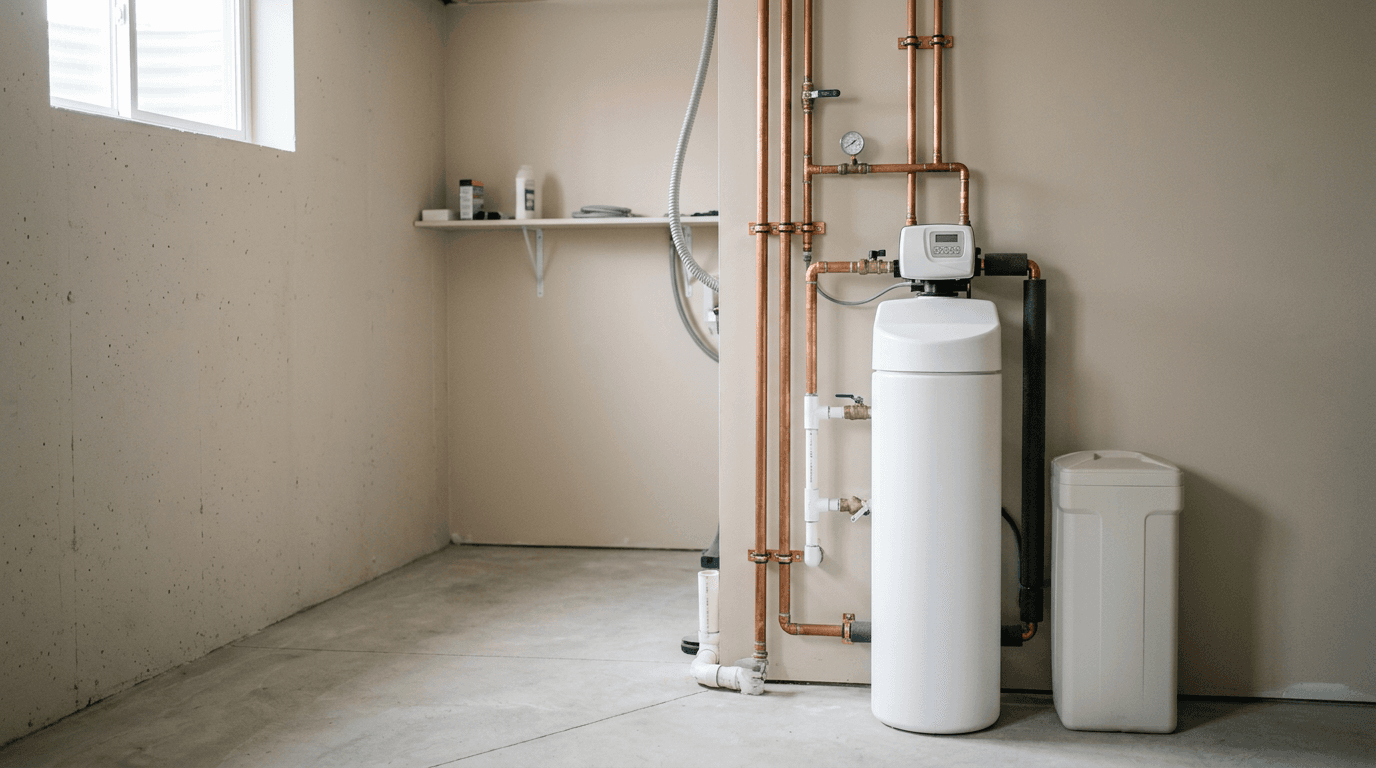
Watching soap instantly turn into a useless milky film instead of a thick lather is a familiar frustration when your municipal supply consistently hits 165 mg/L of hardness. Alberta's capital region delivers exceptionally safe water, but its heavy mineral load and seasonal chlorine variations require mechanical intervention at the residential level. Evaluating the right water filtration systems for home installation means looking past generic marketing to understand exactly what each technology removes, what it leaves behind, and how it directly impacts your plumbing infrastructure.
Quick Summary
Selecting residential water treatment equipment requires matching the underlying technology to the exact chemical profile of your supply. A system designed to remove chemical disinfectants will not stop mineral scale buildup, and a standard softening unit will not improve the taste of your drinking water.
- Ion-exchange targets calcium and magnesium to protect appliances.
- Carbon adsorption removes chemical disinfectants and odours.
- Reverse osmosis provides point-of-use purification for drinking water.
- Combined setups address multiple municipal water variables simultaneously.
Table of Contents
- How We Evaluate Treatment Options
- 1. Ion-Exchange Water Softeners
- 2. Whole-Home Carbon De-chlorination
- 3. Combined Softener and Carbon Units
- 4. Tank-Based Reverse Osmosis
- 5. Tankless Reverse Osmosis
- 6. Inline Sediment Filtration
- Matching the System to Your Mechanical Room
- FAQ
- Recommended Reads
How We Evaluate Treatment Options
Not every household requires comprehensive purification, and overbuilding a mechanical room wastes both capital and floor space. To properly evaluate these systems, you must filter the options through the lens of local water chemistry and household flow demands. The municipal supply in the Edmonton area averages roughly 9.6 grains per gallon (gpg) of hardness. Any effective residential system must first address this baseline scale threat without severely bottlenecking the dynamic water pressure required to run multiple showers simultaneously. We judge the following categories based on their mechanical efficiency, their true utility room footprint, and their ability to handle both hard minerals and municipal chlorine.
| System Category | Primary Target | Pressure Impact | Typical Location |
|---|---|---|---|
| Ion-Exchange Softener | Calcium, Magnesium | Minimal | Mechanical Room |
| Carbon De-chlorination | Chlorine, VOCs | Moderate | Mechanical Room |
| Combined Systems | Hardness, Chlorine | Moderate | Mechanical Room |
| Tank-Based RO | Dissolved Solids | Point of Use | Under Sink |
| Tankless RO | Dissolved Solids | Point of Use | Under Sink |
| Sediment Filtration | Physical Particulate | Varies | Water Main Entry |
1. Ion-Exchange Water Softeners
The baseline defense against hard water in Alberta is the traditional water softener. This technology is engineered specifically for homes suffering from white scale buildup on fixtures, prematurely failing hot water tanks, and dry skin after bathing.

The mechanism at work is cation exchange. The system consists of a primary tank filled with negatively charged resin beads that are pre-loaded with sodium ions. As hard water enters the tank, positively charged calcium and magnesium ions are drawn to the resin. Because the mineral ions have a stronger electrical charge than the sodium, the resin drops the sodium and grabs the minerals, allowing completely softened water to flow into the home's plumbing. Once the resin is saturated, the system initiates a regeneration cycle, pulling a concentrated saltwater brine from a secondary tank to forcefully strip the minerals off the resin and flush them down the drain.
Practical rule: Never size a softening system based solely on the number of bathrooms; you must calculate your peak flow rate in gallons per minute (GPM) to ensure the valve body and pipe diameter will not throttle your shower pressure.
Solves scale but leaves chlorine untouched
The honest limit of standard ion-exchange technology is its absolute blindness to chemical contaminants. A softener does nothing to improve the taste or smell of your water. Furthermore, the municipal chlorine present in the supply actually attacks the divinylbenzene cross-linking that holds the resin beads together. Over years of exposure, chlorine oxidizes these beads, turning them into a mushy gel that restricts flow and eventually requires a complete media re-bed. Homeowners who expect a single resin tank to act as a comprehensive purifier will be disappointed when their drinking water still smells like a swimming pool.
2. Whole-Home Carbon De-chlorination
For households where the primary complaint is the taste, smell, and drying effect of chemical disinfectants, carbon de-chlorination serves as the primary point-of-entry treatment. These systems are typically installed immediately after the water meter, ensuring that every tap, showerhead, and appliance receives chemical-free water.
The core mechanism is adsorption. High-quality systems utilize catalytic or activated carbon media, which features a massively porous surface area. As water flows through the bed, chlorine molecules, chloramines, and volatile organic compounds (VOCs) become trapped in the microscopic pores of the carbon. Unlike a mechanical screen that eventually clogs, carbon chemically bonds with these contaminants. Advanced units incorporate an automated control valve that periodically backwashes the media. This lifting action fluidizes the carbon bed, preventing the water from carving permanent channels through the media - a failure mode called channeling that allows untreated water to slip past.
Eliminates chemical odours at the expense of flow rate
The primary drawback of whole-home carbon filtration is its inherent restriction on flow. Forcing household water through a dense bed of granular carbon inevitably causes a pressure drop. If the system is undersized, flushing a toilet while someone is showering will result in a noticeable loss of water pressure. More importantly, carbon does absolutely nothing to alter the mineral composition of the supply. It will leave Edmonton's 165 mg/L of dissolved rock entirely intact, meaning your fixtures will still scale, your glass shower doors will still spot, and your water heater elements will still calcify over time. It is a targeted solution for chemistry, not a fix for hard water.
3. Combined Softener and Carbon Units
When a household requires both mineral extraction and chemical removal, combined setups offer comprehensive treatment. Solutions like the Triton Pure package are designed specifically for municipal environments where both scale and chlorine degrade the plumbing system simultaneously. This approach suits new home builds and established residences seeking a complete mechanical room overhaul.
The mechanism generally involves running the water through two distinct stages of treatment in sequence. The incoming municipal supply first passes through a dense carbon bed, which thoroughly strips the chlorine and VOCs from the water. This de-chlorinated water then feeds directly into the ion-exchange resin. By removing the chlorine before it can reach the softening media, the carbon acts as a sacrificial shield, protecting the resin from oxidation and drastically extending the operational lifespan of the softener. This sequential processing ensures the home receives water that is both completely soft and entirely free of chemical odours.
Complete municipal treatment with a larger footprint
The trade-off for this comprehensive treatment is the physical footprint required in the utility room. True twin-tank combined systems take up considerably more floor space than a standalone unit, requiring distinct drain connections and careful plumbing layouts. While some manufacturers attempt to blend carbon and resin into a single "mixed bed" tank to save space, this design is inherently flawed. Carbon exhausts much faster than softening resin, and in a single-tank configuration, you cannot replace the spent carbon without throwing away perfectly good resin. Dedicated, sequential dual-stage systems avoid this trap but demand the upfront capital and physical space to accommodate them.
4. Tank-Based Reverse Osmosis
Traditional tank-based reverse osmosis (RO) remains the standard for achieving highly purified drinking water at a single point of use, typically the kitchen sink or refrigerator dispenser. This technology is strictly for consumption, not for whole-home plumbing protection.
The purification mechanism relies entirely on household water pressure. It forces water through a semi-permeable membrane. The pores on an RO membrane are incredibly fine, often rated down to 0.0001 microns. As water is pushed against the membrane, pure H2O molecules pass through to a pressurized storage tank, while heavy metals, dissolved salts, fluoride, and leftover trace minerals are forcefully rejected and flushed continuously down the drain. The membrane processes water very slowly. It often filters drop by drop. Therefore, the pressurized bladder tank is necessary to store a few gallons of purified water so you can fill a glass quickly when you open the faucet.
Bottled-water quality with high wastewater ratios
The limiting factor of traditional RO is its aggressive waste ratio. For every one gallon of purified water stored in the tank, a standard system will send roughly three gallons of reject water down the drain. Furthermore, the storage tank occupies the majority of the cabinet space under the kitchen sink. If you drain the tank entirely by filling a large boiling pot, you must wait several hours for the membrane to slowly replenish the supply. The water it produces is exceptionally pure, but the delivery method is highly inefficient and permanently claims your under-sink storage.
5. Tankless Reverse Osmosis
To bypass the limitations of traditional bladder tanks, modern purification has shifted toward tankless reverse osmosis. High-output options like the Triton Pure Tankless are engineered for households that demand continuous, high-purity drinking water without sacrificing their entire kitchen cabinet.
The mechanism of a tankless system abandons passive household pressure in favour of an internal, electric booster pump. When you open the dedicated drinking faucet, the pump instantly drives the water pressure up to 70 PSI or higher, forcing it across a massive, high-capacity membrane. Instead of producing 50 gallons per day and storing it, these membranes are rated for 400 to 600 gallons per day, allowing them to purify water in real-time as it flows out of the spout. The purified water goes straight to your glass, and the system shuts down the moment you close the tap.
Practical rule: Verify that your chosen tankless RO unit includes an automatic flush feature; without it, the first cup of water drawn after the system sits idle will suffer from "TDS creep," tasting slightly metallic.
Continuous flow at a premium price
The convenience of on-demand purification comes with strict installation constraints and a higher lifecycle cost. A tankless system absolutely requires a dedicated 110V electrical outlet located directly under the sink to power the internal pump - a feature missing in many older homes. Additionally, the massive, proprietary filter cartridges that enable this high flow rate are significantly more expensive to replace than the generic cylindrical filters used in older tank-based systems. You are paying a premium for continuous flow and reclaimed cabinet space.
6. Inline Sediment Filtration
Inline sediment filtration acts as the physical gatekeeper for the home. It is often installed as a pre-filter ahead of more sensitive water filter systems, protecting control valves and delicate membranes from physical debris.
The mechanism is straightforward mechanical exclusion. The water passes through a physical barrier - typically a pleated paper cartridge or a cylinder of spun polypropylene. These filters are rated in microns, commonly ranging from 5 to 50. Any physical particle in the water - such as sand, silt, rust flakes from aging municipal mains, or dislodged pipe scale - that is larger than the micron rating gets physically wedged into the filter material. Over time, the filter darkens and builds up a heavy cake of debris, requiring a manual cartridge swap to restore flow.
Protects plumbing but ignores dissolved solids
While a sediment filter is excellent at trapping dirt, it is completely useless against dissolved chemistry. It will not stop calcium, it will not adsorb chlorine, and it will not remove lead or fluoride. A sediment filter blindly lets dissolved minerals pass through. Furthermore, selecting a micron rating that is too tight (such as a 1-micron filter on a heavily silted supply) will cause the cartridge to blind over rapidly, crippling the water pressure to the entire house in a matter of weeks. It is a necessary protective step, but never a standalone treatment solution.
Matching the System to Your Mechanical Room
Choosing the right equipment depends entirely on what is failing in your home.
If you are a resident in Beaumont or Sherwood Park dealing with premature appliance failure, stiff laundry, and severe white scale on your fixtures, a traditional ion-exchange softener is your mandatory starting point.
If you are an environmentally conscious homeowner who cannot tolerate the smell of chemical disinfectants while showering, you must add whole-home carbon de-chlorination. New homeowners looking to protect their plumbing infrastructure from day one while maximizing appliance lifespan are best served by combined packages that sequence carbon before resin.
Conversely, if your only complaint is the taste of your morning coffee and you want the highest possible purity for cooking, bypass the mechanical room entirely and install a point-of-use reverse osmosis system. The home water filter you choose must directly target the specific chemical or physical problem you are trying to solve, without strangling the flow rate your household relies on.
FAQ
Can one single tank handle both hard water and chlorine? While mixed-bed systems exist, they are inefficient. Carbon exhausts much faster than softening resin. In a single tank, you are forced to discard functional resin just to replace the spent carbon. Sequential dual-tank systems are the industry standard for handling both.
Does softening my water make it unsafe to drink? No, but it does add trace amounts of sodium to the water through the ion-exchange process. For residents in Leduc or Edmonton dealing with ~9.6 gpg hardness, the added sodium is minimal, but those on strictly sodium-free diets often install a reverse osmosis system at the kitchen sink to remove it entirely.
How often do these systems require maintenance? A water softener requires you to replenish the brine tank with salt every few months. Sediment filters usually need changing every 3 to 6 months depending on municipal flushing events. Reverse osmosis membranes typically last 2 to 3 years, while their pre-filters require annual replacement.