7 Components of Commercial Water Treatment and Purification Systems
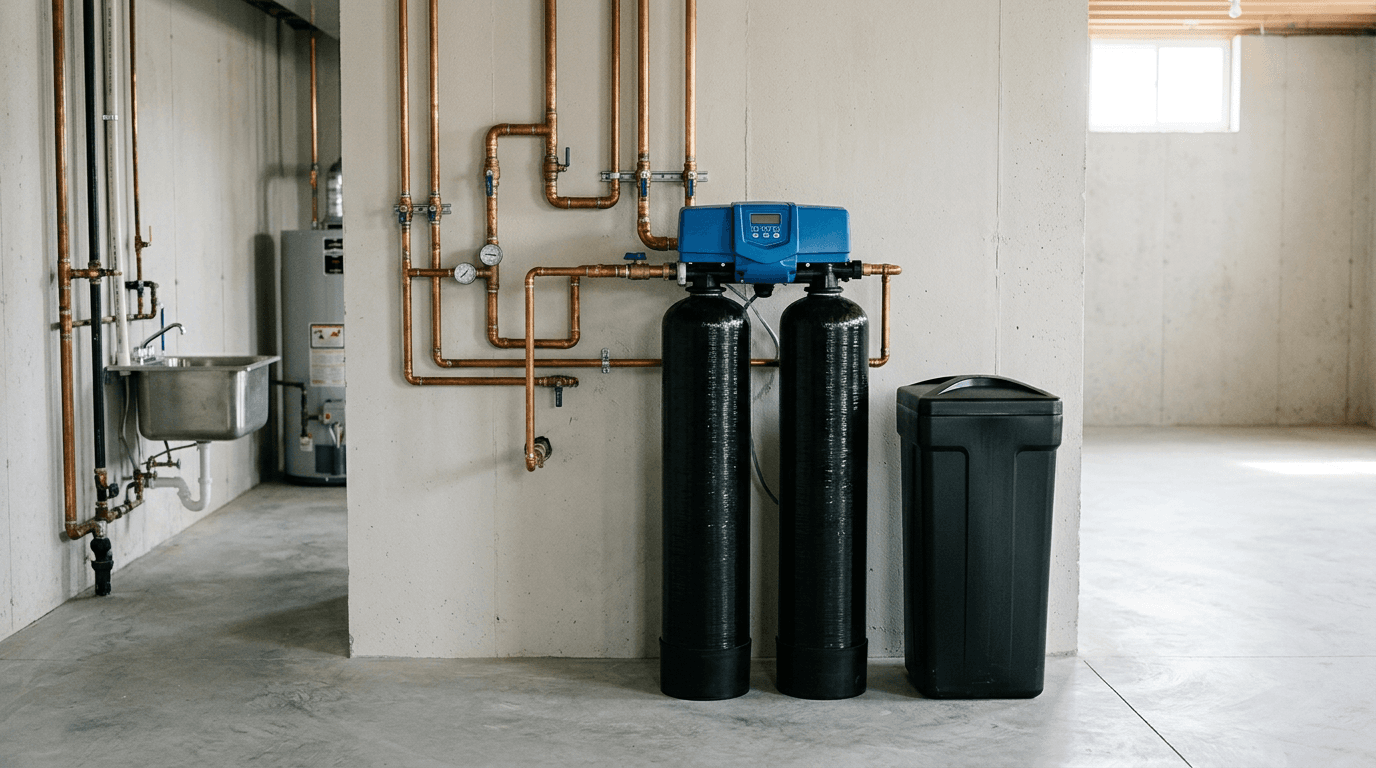
Scale buildup inside a commercial boiler drastically increases energy consumption by insulating the heat exchanger. In the Edmonton capital region, where municipal water chemistry averages 165 mg/L (approximately 9.6 grains per gallon) of hardness, pushing untreated water through cooling towers, commercial dishwashers, or industrial laundry equipment guarantees premature failure. A properly sized commercial water softener is not simply a larger version of a residential tank; it is a critical piece of continuous-flow infrastructure.
Quick Summary
Evaluating large-scale purification requires matching flow rates to continuous demand, sequencing filtration to protect downstream membranes, and ensuring staff can maintain the infrastructure over the long term. A robust commercial treatment strategy isolates critical process water to prevent costly downtime and equipment degradation across the facility.
- Twin-alternating control valves guarantee zero downtime during mandatory regeneration cycles.
- Dedicated operators must monitor pressure differentials daily, rather than just checking salt levels.
- Carbon pre-treatment is mandatory to protect reverse osmosis membranes from municipal chlorine exposure.
- Splitting plumbing lines to treat only necessary process water reduces the required hardware footprint.
Table of Contents
- 1. Sizing a commercial water softener
- 2. Point-of-use vs. centralized water treatment services
- 3. High-capacity reverse osmosis integration
- 4. Investing in water treatment courses
- 5. The role of the water treatment operator
- 6. Sequencing the water treatment steps
- 7. Routine maintenance for water systems treatment
- What breaks when infrastructure mismatches demand
- FAQ
- Recommended Reads
1. Sizing a commercial water softener
Industrial and large residential applications require continuous soft water, meaning the system cannot shut down to clean itself. Sizing these units involves calculating peak flow rate against the total grain capacity of the resin bed. For context, large-scale water softener installations often feature tanks holding upwards of 300,000 grains, processing tens of thousands of gallons before the media is exhausted.

The core mechanism relies on a twin-alternating configuration. A centralized, motorized control valve connects two identical resin tanks. A water meter tracks the exact volume flowing through the active tank. The moment that tank reaches its volumetric limit, the control valve diverts incoming hard water to the standby tank and immediately triggers a regeneration cycle on the exhausted one. This mechanical handoff ensures that 24-hour operations - like hospitals or hotels in Sherwood Park - never draw hard water into their boilers during a cleaning cycle.
Continuous demand dictates twin-alternating designs
Facilities that try to save money by installing a single, massive tank inevitably pull hard water during regeneration. Because commercial spaces operate around the clock, there is no safe "2:00 AM window" to take the system offline.
Practical rule: Size the control valve based on the facility's peak instantaneous demand, not the average daily flow. A valve that is too small will restrict pressure during peak hours, starving downstream equipment regardless of how large the resin tanks are.
The honest limit of any softening system is pressure loss. Pushing 60 gallons per minute through a valve and manifold designed for 30 gallons per minute causes severe friction loss. The water becomes soft, but the pressure drops so drastically that upper floors lose flow and flushometers fail to clear commercial toilets.
2. Point-of-use vs. centralized water treatment services
Facility managers often assume that treating the entire building at the main intake is the most efficient approach. However, comprehensive water treatment services usually recommend auditing the plumbing to segregate process water from domestic cold water.
The mechanism involves installing dedicated plumbing loops. Instead of softening the cold water heading to outdoor irrigation, floor drains, or public washrooms, engineers split the feed. Only the water heading to the domestic hot water tanks, cooling towers, and kitchen dishwashers runs through the treatment plant. By isolating the flow, the required size of the treatment equipment drops significantly, conserving salt, water, and capital expenditure. For facilities in regions like Leduc, where industrial demands are high, plumbing segregation is a standard engineering step.
Treating every drop wastes infrastructure capacity
Centralized treatment simplifies the installation but punishes the operating budget. Sending zero-grain, highly treated water to a loading dock hose bib provides zero return on investment while rapidly exhausting the resin bed.
Retrofit costs in existing buildings severely restrict the feasibility of point-of-use segregation. If a fifty-year-old facility features a single main trunk line that feeds everything indiscriminately, ripping open drywall or trenching concrete to separate the lines will cost more than simply buying an oversized, whole-building treatment plant. Segregation is highly effective for new builds, but cost-prohibitive for older infrastructure.
3. High-capacity reverse osmosis integration
When a commercial space or a large custom home requires absolute control over total dissolved solids (TDS), softening alone is insufficient. Softeners trade calcium for sodium, meaning the total dissolved mineral count remains largely the same. High-capacity reverse osmosis (RO) integration strips those remaining dissolved minerals, providing spot-free water for precision manufacturing, boiler feed, or premium drinking lines.
The mechanism involves using high-pressure booster pumps to force softened water across semi-permeable polyamide membranes. The membranes reject dissolved ions, sending them down the drain as brine while passing pure permeate to a storage tank. Integrated packages, such as the Triton Pure and Triton Pure Tankless systems, combine high-efficiency softening with scaled RO membranes to handle elevated demand without the pressure drops typical of piecemeal residential units.
Pre-treatment determines membrane survival
An RO membrane is a delicate physical barrier. If hard water hits the membrane directly, the calcium carbonate will rapidly blind the microscopic pores, permanently ruining the element in a matter of weeks.
Managing wastewater places a hard boundary on commercial RO. Standard membranes require a recovery ratio - often dumping three to four gallons of brine for every one gallon of pure water produced. Pushing high volumes of RO water without recycling the concentrate strains municipal sewer limits and dramatically increases the facility's monthly utility costs. RO should only be deployed on the specific lines that require pure water, never as a blanket facility solution.
4. Investing in water treatment courses
A complex, multi-stage purification plant requires staff to understand the chemistry happening inside the tanks. Facilities cannot rely entirely on external vendors for daily oversight. Investing in professional water treatment courses ensures on-site personnel can safely monitor and troubleshoot the system.
These courses teach the mechanics of water chemistry. Staff learn how to perform a Hach titration test to measure hardness in grains per gallon, how to read a mass balance, and how to safely handle and store regeneration chemicals or clean-in-place (CIP) acids. The mechanism is standardizing knowledge through certified training, moving the facility away from informal "tribal knowledge" where only one senior employee knows how to reset a faulted valve.
Hardware cannot replace operational knowledge
The most sophisticated PLC (Programmable Logic Controller) will still fail if the person operating it does not understand why the system is alarming. Courses bridge the gap between mechanical installation and long-term sustainability.
Staff turnover constantly threatens the return on this education. Sending a single maintenance manager to a specialized course leaves the facility highly vulnerable if that employee resigns. Training must be institutionalized into site-specific standard operating procedures (SOPs). General course knowledge fades quickly if the daily maintenance schedule is not clearly documented in the mechanical room.
5. The role of the water treatment operator
The water treatment operator is the designated on-site professional responsible for the health of the plant. They do not merely load salt into the brine tank; they monitor the ongoing efficiency of the entire filtration skid.
The mechanism of their daily work is the operational logbook. A qualified operator tracks the delta-P (pressure differential) across every filter housing. By logging the inlet pressure and comparing it to the outlet pressure, they can track the exact rate at which a sediment filter or carbon bed is blinding off. For light industrial sites and large facilities in Beaumont, this proactive logging prevents sudden flow restrictions from halting production.
Daily logging catches the catastrophic failure
A sudden spike in pressure differential across a membrane array indicates that pre-treatment has failed, allowing scale or biological growth to reach the RO elements. Catching a 5-psi deviation on a Tuesday allows the operator to schedule a chemical cleaning before the membrane fully clogs on a Friday.
Alert fatigue routinely degrades the daily monitoring process. If the operator checks the gauges daily but the facility lacks a strict threshold for action - such as a documented rule to change filters at a 10-psi drop - the logging becomes a pointless administrative exercise. Data collection only protects the facility if management empowers the operator to spend money on consumables when the numbers demand it.
6. Sequencing the water treatment steps
The physical order of the hardware dictates the survival of the entire plant. Proper water treatment steps are non-negotiable; you cannot simply plumb tanks together based on where they fit in the mechanical room.
The standard progression follows a strict logic. First, sediment filtration removes suspended solids that would physically clog downstream resin. Second, carbon filtration removes free chlorine. Third, the twin-alternating softener removes scale-forming calcium and magnesium. Fourth, reverse osmosis strips the remaining dissolved solids. Finally, ultraviolet (UV) sterilization neutralizes any biological contaminants just before the water heads to the process lines.
Chlorine destroys membranes before scale can
Municipalities use chlorine or chloramines to keep distribution pipes safe. However, chlorine physically breaks down the amide bonds in thin-film composite RO membranes. Skipping the carbon filtration step guarantees that municipal water will disintegrate the expensive RO elements within months.
Practical rule: Never place a UV sterilizer ahead of a reverse osmosis system or a water softener on hard water. The heat from the UV lamp will instantly bake calcium onto the quartz sleeve, turning the glass opaque and rendering the germicidal light completely useless.
The required square footage strictly controls how these steps can be sequenced. A fully sequential commercial skid demands significant floor space. Attempting to compress these steps into fewer, multi-media tanks usually results in uneven flow dynamics, premature media exhaustion, and channelling inside the beds.
7. Routine maintenance for water systems treatment
Installing the infrastructure is a capital expense; keeping it running is an operational discipline. A proactive water systems treatment program involves scheduled teardowns rather than waiting for flow restrictions.
The mechanism of this routine maintenance involves rebuilding control valves before they leak. Technicians isolate the tanks, pull the motorized valve assemblies apart, and replace the piston seals and spacers. Additionally, they run chemical cleaners - such as sodium hydrosulfite - through the resin bed to strip accumulated ferric iron that regular brine cannot remove. For RO systems, this includes running low-pH cleaners through the membrane array in a controlled loop to dissolve silica and calcium scale before it hardens.
Preventive teardowns outpace emergency replacements
Valve seals wear down through continuous friction against the pistons. If the seals are not replaced annually, hard water begins to bypass the resin bed internally, sending scale into the facility even though the digital interface claims the water is soft.
Running equipment to failure creates a false economy that defeats routine maintenance. Waiting for the system to stop producing soft water means the resin bed has likely fractured into mush from chlorine exposure or iron fouling. At that point, you are no longer maintaining the system; you are paying emergency labour rates to vacuum out the tank, replace the media entirely, and flush debris out of the facility's downstream plumbing.
What breaks when infrastructure mismatches demand
Selecting the right commercial setup requires diagnosing exactly where the facility's current water supply fails its equipment.
- If your primary bottleneck is boiler scaling or heating element failure, your focus must be on properly sized twin-alternating softeners that can handle your peak flow without pressure drops.
- If your bottleneck is spotting on glassware, total dissolved solids in a manufacturing process, or providing premium drinking water across a large site, focus on reverse osmosis integration paired with strict pre-treatment.
- If your bottleneck is sudden, unpredictable system shutdowns despite having the right hardware, your failure point is operational. Focus on water treatment courses for your staff and enforcing the daily operator log to catch pressure differentials early.
Commercial treatment is an ongoing process of pressure management, chemistry, and routine servicing. Ignoring any one of these elements turns an expensive capital investment into a recurring maintenance liability.
FAQ
What is the standard lifespan of commercial softening resin?
In continuous commercial applications, standard cation resin typically lasts between five and eight years. Its lifespan is heavily dependent on the levels of chlorine and iron in the municipal supply, which cause the resin beads to swell, fracture, and lose their ion-exchange capacity.
How often should a twin-alternating system regenerate?
The frequency depends entirely on water usage and tank capacity. In high-demand environments, it is common for a tank to regenerate daily or every other day. The twin-alternating design ensures this frequency does not interrupt the facility's soft water supply.
Can a commercial facility operate safely on a single-tank softener?
Only if the facility completely shuts down water usage for at least two hours every night. If a boiler, cooling tower, or night-shift washdown requires water during the regeneration cycle, a single tank will bypass hard water directly into the equipment, defeating the purpose of the system.
Why is carbon filtration necessary before reverse osmosis?
Municipalities treat water with chlorine to prevent bacterial growth. Thin-film composite RO membranes are highly sensitive to oxidation; exposure to chlorine will quickly disintegrate the membrane material. Carbon pre-filters remove this chlorine before the water reaches the RO array.