7 Types of Drinking Water Filter Systems for Edmonton Homes
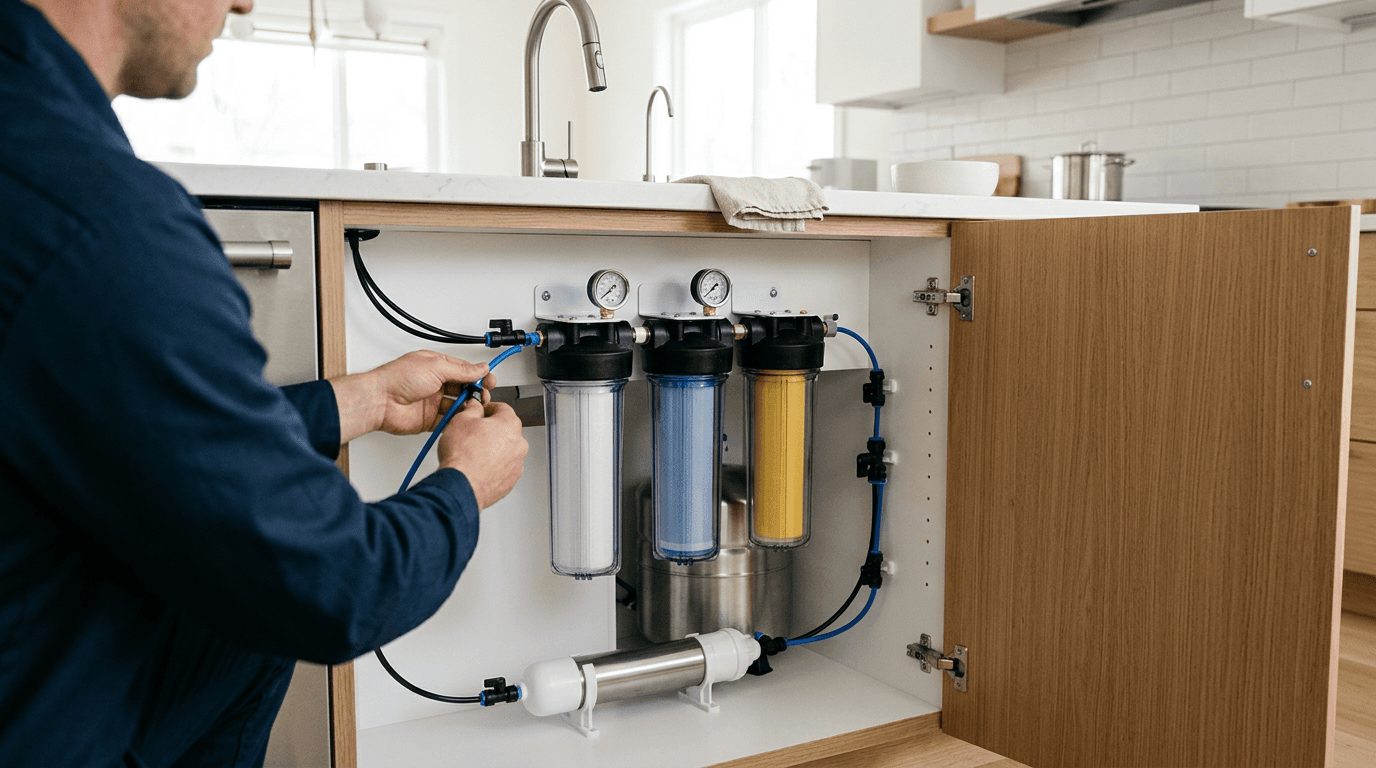
Edmonton's municipal water treatment handles the heavy lifting of public safety, but by the time that water reaches your tap, it carries a noticeable load: an average hardness of 165 mg/L (9.6 grains per gallon) and significant chlorine residuals used to keep the distribution lines sanitary. For families relying on the tap for daily hydration, relying solely on municipal treatment often means putting up with chemical tastes, spring runoff odours, and potential pipe scale. Upgrading to dedicated drinking water filter systems shifts the control directly into your kitchen, allowing you to strip out disinfection byproducts, heavy metals, and aesthetic impurities just before the water hits your glass.
Quick Summary
A home drinking water filter system targets the aesthetic and health-related impurities municipal treatment leaves behind, from chlorine taste to trace heavy metals. For Edmonton, Beaumont, Leduc, and Sherwood Park residents, choosing the right setup means balancing under-sink space, purification depth, and maintenance frequency.
- Reverse Osmosis (RO) strips water down to the molecular level, offering the highest purity.
- Carbon filters focus specifically on chlorine taste and odour removal.
- Combined systems address both whole-home hardness and specific drinking water needs.
- Tankless options save premium cabinet space while delivering on-demand flow.
Table of Contents
- How to Judge Your Filtration Options
- 1. Under-Sink Reverse Osmosis Tanks
- 2. Tankless Reverse Osmosis Systems
- 3. Whole-Home Carbon Dechlorination
- 4. Point-of-Use Carbon Sink Filters
- 5. Combined Softener and RO Packages
- 6. Countertop Distillation Units
- 7. Ultraviolet Purification Systems
- Matching the System to Your Home
- FAQ
- Recommended Reads
How to Judge Your Filtration Options
Not every water filtration system for drinking approaches the problem the same way. When evaluating these setups for an Edmonton home, you must measure them against three specific criteria: depth of filtration (does it just remove chlorine, or does it tackle dissolved solids like lead and fluoride?), spatial footprint (can you sacrifice half your under-sink cabinet?), and ongoing maintenance obligations (are you changing a filter every three months, or once a year?). The items below are assessed strictly against these realities.
| System Type | Primary Target | Installation Location | Maintenance Frequency |
|---|---|---|---|
| RO Tanks | Dissolved solids, heavy metals | Under-sink | 6-12 months (pre-filters) |
| Tankless RO | Dissolved solids, heavy metals | Under-sink | 6-12 months (pre-filters) |
| Carbon Dechlorination | Chlorine, volatile organics | Utility room | Minimal (no cartridges) |
| Sink Carbon | Chlorine, taste, odour | Under-sink / Faucet | 3-6 months |
| Combined Packages | Hardness, chlorine, solids | Utility room & Under-sink | Varies by component |
| Distillation | All contaminants | Countertop | Daily cleaning |
| UV Purification | Bacteria, viruses | Utility room | Annual bulb replacement |
1. Under-Sink Reverse Osmosis Tanks
An under-sink reverse osmosis system with a storage tank is the traditional workhorse of residential water purification. Designed for homeowners who want the highest level of contaminant removal without relying on electricity, these setups use standard household water pressure to force tap water through a semi-permeable membrane. They are ideal for families who consume large volumes of cooking and drinking water daily.

These systems operate through multiple stages. Water first passes through sediment and carbon pre-filters to remove silt and chlorine (which would otherwise destroy the RO membrane). The water is then pushed through the membrane itself, rejecting dissolved solids like fluoride, lead, and arsenic, sending the waste water down the drain. Because this process is inherently slow - often producing water drop by drop - the purified water is stored in a pressurized holding tank under the sink, ready for immediate use when you open the dedicated drinking faucet.
Thorough purification, bulky footprint
The reliance on a storage tank guarantees you always have a few gallons of pressurized, highly purified water ready for a coffee pot or a large pasta pot. A standard Triton Tank RO system handles about 75 gallons per day, which comfortably supports a large family. However, the physical reality of this system is demanding.
The honest limit here is cabinet real estate. The holding tank and the manifold of filter housings will consume at least half of a standard 36-inch sink cabinet base. If your kitchen heavily utilizes under-sink pull-out bins or you have a garbage disposal unit taking up the center space, a tank-based system simply will not fit without major compromises. Furthermore, once the tank is depleted by filling a massive soup pot, you must wait for it to slowly refill over several hours.
2. Tankless Reverse Osmosis Systems
Tankless reverse osmosis units represent the modernization of residential RO, engineered specifically for homes where under-sink storage is scarce. They are designed for homeowners who demand the purification standards of reverse osmosis but refuse to sacrifice their cleaning supply storage to a bulky metal holding tank.
Instead of relying entirely on your home's natural water line pressure, a tankless system integrates an internal booster pump. This pump aggressively forces water through a much larger, higher-capacity membrane the moment you open the faucet. By generating water on demand rather than storing it, the system bypasses the holding tank entirely. The water travels through the pre-filters, the high-flow membrane, and a final polishing filter in real time.
Premium space-saving, requires power
Because there is no storage tank taking up room, the entire system fits into a sleek, narrow manifold that can slide against the side wall of your cabinet. The tankless reverse osmosis in Edmonton setups provide exceptional water pressure at the tap and eliminate the risk of stagnant water sitting in a holding tank.
Practical rule: Never buy a tankless RO system unless you have a dedicated electrical outlet under your sink; the internal booster pump requires continuous power to operate.
The limit to a tankless setup is infrastructure dependency. They require a 120V electrical outlet under the sink, which is common in new builds but often missing in older Edmonton homes unless you have a dishwasher or disposal plugged in nearby. Additionally, they carry a higher upfront equipment cost - typically around $2,000 installed - compared to traditional tank systems, making them less suited for strict budget constraints.
3. Whole-Home Carbon Dechlorination
Instead of treating water at a single sink, whole-home dechlorination addresses the water immediately as it enters the house. It is built for residents whose primary complaints are the pervasive smell of chlorine when running a bath, the chemical taste in their tap water, and the drying effects of municipal disinfectants on their skin.
This system uses a large media tank installed in the utility room, filled with high-grade catalytic or granular activated carbon. As water from the city main flows through the carbon bed, a process called adsorption traps chlorine molecules, chloramines, and volatile organic compounds (VOCs). The clean, dechlorinated water then distributes to every tap, shower, and appliance in the house. Because the carbon bed is massive compared to under-sink cartridges, it treats hundreds of thousands of gallons before exhaustion.
Excellent chlorine removal, leaves dissolved solids
For roughly $1,700 installed, this setup transforms the sensory experience of your home's water. You gain access to fresh-tasting water from the bathroom sink, the fridge dispenser, and the kitchen tap simultaneously. Furthermore, a proper carbon tank backwashes itself automatically, meaning there are no messy, expensive filter cartridges to swap out every three months.
However, whole-home carbon is strictly for aesthetic and chemical issues. It does not remove dissolved minerals, heavy metals, fluoride, or sodium. If you are specifically looking for an absolute barrier against microscopic dissolved solids for your drinking water, a carbon tank alone falls short. It is a fantastic foundation, but it is not a high-purity drinking water purifier for home use by itself.
4. Point-of-Use Carbon Sink Filters
When people search for water filtration for sink installation, they often mean a simple inline carbon filter. These are straightforward, single-stage or dual-stage cartridge systems mounted inside the cabinet, designed for renters or homeowners who want a fast, budget-friendly fix for bad-tasting water without committing to RO infrastructure.
The mechanism is basic: a cold water line is diverted through a housing containing a compressed carbon block. As water flows through, the carbon adsorbs chlorine and traps larger sediment. The water is then sent either back to the main cold-water faucet or to a dedicated drinking spout. There is no wastewater generated, and the system relies purely on existing line pressure.
Immediate taste improvement, limited scope
The installation is usually non-invasive, and the immediate improvement in the water's taste is undeniable. For homes where the municipal water is safe but heavily chlorinated during spring runoff, this offers a quick aesthetic upgrade.
Shallow filtration depth and high upkeep demands represent the boundaries of these basic systems. A small carbon block exhausts its adsorption capacity rapidly. To maintain effectiveness, you must crawl under the sink and wrench off the housing to replace the cartridge every three to six months. If you forget, the filter becomes a breeding ground for bacteria and stops removing chlorine entirely. Like whole-home carbon, it also fails to remove dissolved solids or heavy metals.
5. Combined Softener and RO Packages
For homeowners dealing with the full spectrum of Edmonton's water issues - scale buildup destroying appliances and chlorine ruining the taste of drinking water - a piecemeal approach often fails. Combined packages, such as the Triton Pure or Triton Pure Tankless setups, are designed for new homeowners or those undertaking major renovations who want to solve both utility and consumption water problems simultaneously.

This approach pairs a whole-home water softener in the utility room with a dedicated reverse osmosis system under the kitchen sink. The softener uses ion exchange to strip calcium and magnesium from the incoming water, protecting the home's plumbing. The softened water then feeds into the RO system in the kitchen. Because the RO membrane is no longer fighting hard water scale, it operates far more efficiently and lasts significantly longer, stripping out the remaining sodium, chlorine, and dissolved solids for perfect drinking water.
Complete water management, higher initial setup
By treating the working water (showers, laundry) differently than the drinking water, you optimize the lifespan of both systems. You get the skin and appliance benefits of soft water, alongside the absolute purity of RO water for cooking and hydration.
The drawback is the initial capital and spatial requirement. You must have room in your mechanical room for the softener tanks and brine drum, plus space under the kitchen sink for the RO unit. It is a comprehensive investment that requires professional installation, making it unsuitable for those looking for a quick, cheap fix to a single isolated water complaint.
6. Countertop Distillation Units
Countertop distillers are standalone appliances designed for individuals who want absolute water purity but cannot alter their plumbing. They are often used by renters or those who need small batches of highly purified water for specific uses, like medical equipment or humidifiers.
Distillation works by mimicking the natural water cycle. You manually fill a boiling chamber with tap water and plug the unit in. An electric heating element boils the water, turning it into steam and leaving all heavy metals, minerals, and impurities behind in the boiling chamber. The steam rises, enters a cooling coil, and condenses back into liquid water, which drips into a glass collection jug.
Extreme purity, highly impractical for daily volume
Distillation provides an incredibly high level of purity, effectively removing almost every contaminant, including bacteria and dissolved solids. Because it requires no plumbing modifications, you can take it with you when you move.
Slow output and high-effort maintenance define the constraints of countertop distillation. A standard countertop unit takes four to six hours to produce a single gallon of water, consuming significant electricity in the process. Furthermore, the boiling chamber accumulates a hard, baked-on crust of scale and contaminants that must be scrubbed out with acid cleaners regularly. For a family trying to drink eight glasses of water a day each, a distiller simply cannot keep up with the volume.
7. Ultraviolet Purification Systems
Ultraviolet (UV) systems are specialized units designed for homes on private wells or those under frequent boil-water advisories. They are built for homeowners whose primary concern is biological safety rather than chemical taste or mineral content.
A UV system consists of a stainless steel chamber housing a high-intensity ultraviolet lamp encased in a quartz sleeve. As water flows through the chamber, the UV light penetrates the cell walls of bacteria, viruses, and cysts (like Giardia and Cryptosporidium), scrambling their DNA and rendering them unable to reproduce or cause infection.
Biological security, ineffective against chemicals
For biological threats, UV is highly effective, chemical-free, and operates continuously as long as it has power. It provides peace of mind for rural properties surrounding the Edmonton area that do not rely on municipal treatment.
Practical rule: UV light cannot penetrate cloudy water; you must install a 5-micron sediment pre-filter ahead of a UV system, or bacteria will hide behind floating particles and survive the exposure.
Targeting only living pathogens, UV purification does absolutely nothing to improve the taste, smell, or chemical makeup of your water. It will not remove chlorine, it will not soften hard water, and it will not filter out lead. If you are on Edmonton city water, the municipality already handles biological disinfection with chlorine; adding a UV system is generally redundant unless you are specifically preparing for infrastructure failures.
Matching the System to Your Home
Selecting the right home drinking water filter system comes down to identifying your primary bottleneck.
If your main complaint is the smell of chlorine while showering and a chemical taste at the tap, and you despise changing under-sink cartridges, a whole-home carbon dechlorination tank is the correct path. If you demand the absolute highest purity for drinking and cooking, removing dissolved solids and heavy metals, you need reverse osmosis.
Within the RO category, your cabinet dictates the choice: if you have ample space and want a lower upfront cost, choose a traditional tank system. If your under-sink space is heavily utilized for garbage bins and you have an electrical outlet available, the tankless RO is the superior fit. Finally, if you are battling both hard water scale on your fixtures and poor-tasting drinking water, combining a softener with an RO system (like the Triton Pure packages) is the only way to comprehensively protect both your plumbing and your health.
FAQ
Do I need a water filter if I live in Edmonton?
While Edmonton's municipal water meets all safety standards, it contains high levels of hardness (averaging 165 mg/L) and chlorine used for disinfection. A filter system is necessary if you want to remove the chemical taste, odours, and trace dissolved solids before drinking.
What is the difference between a water softener and a drinking water filter?
A water softener removes calcium and magnesium to protect your plumbing and appliances from scale. It does not remove chlorine, heavy metals, or make the water better for drinking. A drinking water filter (like RO or carbon) specifically targets taste, chemicals, and dissolved solids for consumption.
How often do I need to change the filters on an RO system?
For standard reverse osmosis systems, the sediment and carbon pre-filters should be changed every 6 to 12 months to protect the membrane. The RO membrane itself typically lasts 2 to 3 years depending on your water usage and incoming water hardness.
Can a tankless RO system work during a power outage?
No. Tankless reverse osmosis systems rely on an internal electric booster pump to push water through the membrane on demand. Without electricity, the system cannot produce purified water.