7 Water Filtration and Softener Configurations for Edmonton Homes
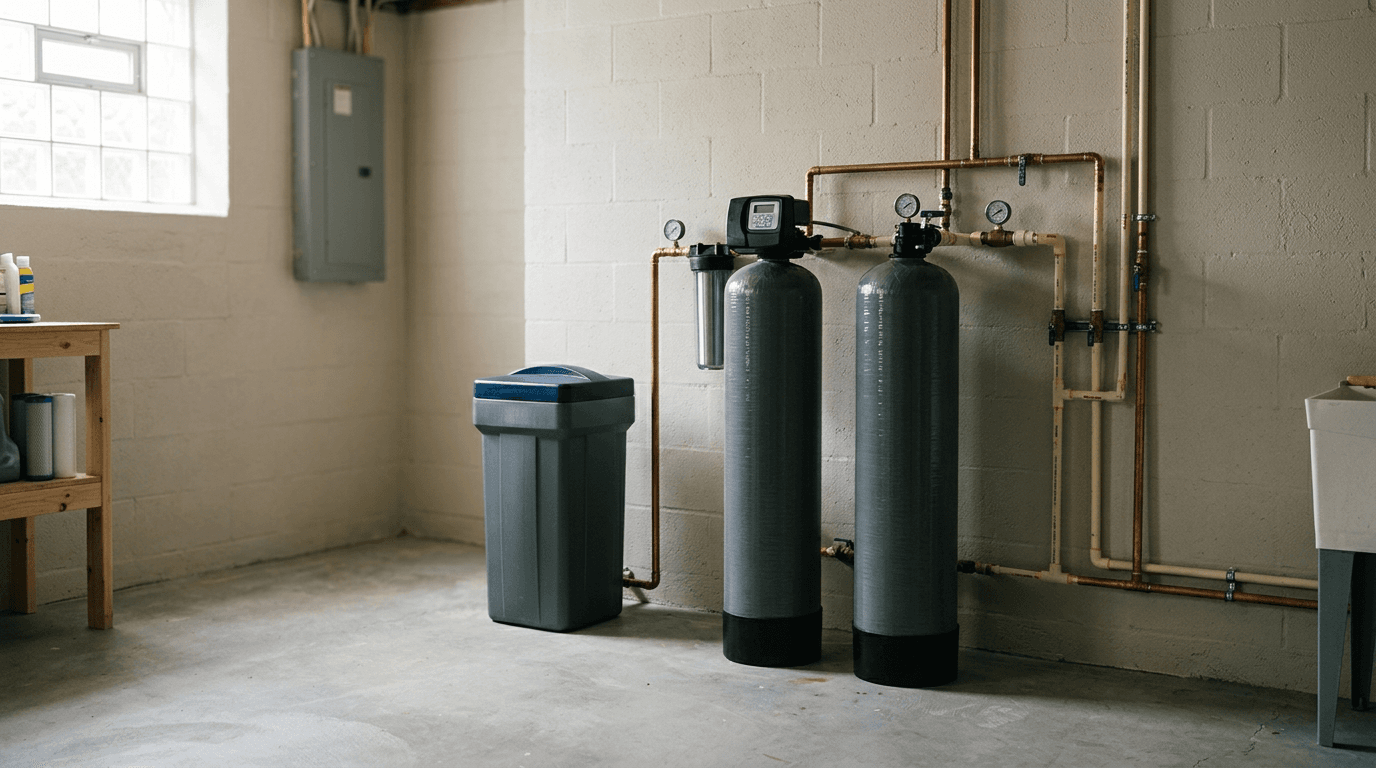
EPCOR water chemistry in the Edmonton capital region averages 165 mg/L of hardness, which translates to roughly 9.6 grains per gallon. When water that hard meets household plumbing, the dissolved calcium and magnesium rapidly precipitate onto fixtures, heating elements, and shower walls. Choosing the right water filtration and softener setup prevents that permanent scale buildup while simultaneously stripping out the municipal chlorine and chloramines that dry out skin and degrade appliance seals.
Selecting a treatment method is rarely about finding a flawless system; it is about matching the chemical removal mechanism to your specific household plumbing demands. A tankless reverse osmosis unit excels at rejecting dissolved solids at the kitchen sink, but applying that same strict filtration to an entire home's water supply would cripple your static water pressure. Understanding the specific trade-offs of each configuration prevents paying for capacity you cannot use or installing hardware that ignores your primary water complaint.
Quick Summary
A residential water treatment setup modifies municipal or well water chemistry through mechanical filtration, chemical adsorption, or ion exchange. Selecting the proper configuration depends on whether your priority is protecting household plumbing from mineral scale, removing volatile chemicals for skin health, or achieving bottled-water purity at a designated tap.
- Ion exchange softeners remove dissolved calcium to protect plumbing.
- Carbon filtration targets chlorine but leaves hardness minerals untouched.
- Point-of-use reverse osmosis provides total dissolved solid (TDS) removal for drinking.
- Combined setups merge filtration and softening for comprehensive whole-home treatment.
- Flow rate and static pressure dictate which systems a home can support.
Table of Contents
- 1. Combined water filtration and softener setups
- 2. Standalone whole-house carbon filtration
- 3. Under-sink reverse osmosis units
- 4. Tankless RO and softening combinations
- 5. Template assisted crystallization descalers
- 6. Twin-tank alternating softening units
- 7. Inline pleated sediment pre-filters
- Matching the treatment to your plumbing
- FAQ
- Recommended Reads
1. Combined water filtration and softener setups
For households seeking both chemical removal and appliance protection, pairing a granular activated carbon tank with a traditional ion-exchange system offers the most thorough whole-home coverage. Installations across Edmonton, Beaumont, Leduc, and Sherwood Park frequently utilize paired designs, like the Triton Pure package, to handle the region's specific municipal water profile in a single mechanical footprint.

These combined units stage the water flow deliberately. Incoming municipal water first passes through an up-flow carbon filter to strip out volatile organic compounds and chlorine. Removing the chlorine early is a critical mechanical step because high chlorine levels actively degrade and oxidize the polystyrene resin beads in the downstream softener. Once dechlorinated, the water enters the primary resin tank where sodium ions swap places with dissolved calcium and magnesium, outputting soft, chlorine-free water to the home's hot water tank and cold water fixtures.
Complete chemical removal, larger physical footprint
The honest limit of combining these processes into a dual-tank configuration is the physical utility space required. You must allocate floor space for the carbon tank, the softening resin tank, and the brine tank. Furthermore, these systems require a nearby floor drain capable of handling the rapid discharge flow during the backwash and regeneration cycles. If your utility room is exceptionally tight or lacks accessible drainage, forcing a combined setup into the space often violates municipal plumbing clearances and makes future maintenance on your furnace or water heater incredibly difficult.
2. Standalone whole-house carbon filtration
Homeowners who are strictly focused on skin health, reducing chemical odours, or extending the lifespan of rubber seals in their appliances often look to standalone de-chlorination tanks. This setup isolates the filtration aspect and completely bypasses the mineral management component.
Whole-house carbon filtration relies on adsorption. The system tank is packed with highly porous activated carbon media - usually derived from coconut shells. As municipal water flows through the bed, chlorine, chloramines, and certain industrial solvents are trapped inside the millions of microscopic pores on the carbon's surface. Because this is an adsorption process rather than a physical screen, the water pressure remains largely unaffected, provided the media is replaced when saturated.
Protects skin from chlorine, ignores scale buildup entirely
This configuration fails completely if your goal is stopping scale. Standalone carbon filters do absolutely nothing to reduce the 9.6 grains per gallon of calcium and magnesium found in local Edmonton water hardness and quality reports. Your shower glass will still develop white, cloudy spots, your dishwasher heating element will still scale over, and your soap will still struggle to lather. It is highly effective for chemical mitigation, but anyone expecting softer hair or easier bathroom cleaning from a standalone carbon filter will be severely disappointed.
3. Under-sink reverse osmosis units
When a homeowner wants the highest possible drinking water purity without treating the water used for flushing toilets or washing clothes, a point-of-use water softener and filtration system is deployed directly at the kitchen sink. Traditional reverse osmosis (RO) units are the standard for isolated drinking water purification.
RO systems force water across a semi-permeable membrane possessing pores sized at 0.0001 microns. Normal static line pressure pushes the water molecules through the membrane while rejecting heavy metals, fluoride, nitrates, and dissolved salts. The purified water drips slowly into a pressurized holding tank under the sink, while the rejected contaminants are flushed directly down the sink drain line via a dedicated saddle valve.
Bottled-water quality, highly localized output
Traditional RO units are inherently slow, producing purified water at a trickle. To mask this slow production, they rely entirely on the limited reserve in their storage tank. If you drain the 3-gallon tank while filling a large pasta pot, you will wait hours for it to refill. Additionally, membrane filtration wastes water by design; a standard unit sends three to four gallons of reject water down the drain for every one gallon of purified water it produces. They are strictly a single-tap solution, completely unsuited for supplying a high-flow appliance like a dishwasher or a whole-home manifold.
4. Tankless RO and softening combinations
Advanced residential setups now pair whole-house softeners with high-volume tankless RO units - such as the Triton Pure Tankless configuration - to eliminate the drawbacks of localized storage tanks. These paired water filters and softeners provide heavy-duty plumbing protection at the main line while delivering continuous, real-time purified drinking water at the kitchen tap.
Instead of relying purely on municipal line pressure to push water through the semi-permeable membrane, a tankless RO unit integrates an internal electrical booster pump. This pump aggressively drives water across multiple parallel membranes the moment you open the faucet. By mechanically elevating the pressure, the system produces purified water instantly and continuously, cutting the wastewater ratio down significantly compared to passive tank-based systems.
Practical rule: Always measure static water pressure before installing a high-restriction membrane system; if your incoming pressure sits below 40 PSI, a booster pump is functionally mandatory to prevent the membrane from prematurely blinding over.
Immediate continuous flow, requires dedicated electrical circuits
A tankless RO system relies heavily on electrical power at the point of use. Unlike a traditional passive RO that operates entirely on water pressure, a tankless unit requires a dedicated 120V electrical receptacle under your kitchen sink to run the booster pump. If your home lacks an outlet inside the lower cabinetry, installing this configuration requires an electrician to run a new circuit before the plumbing work can even begin. They also carry a notably higher initial purchase price and more expensive proprietary replacement filters.
5. Template assisted crystallization descalers
When evaluating water filtration, hard water conditioning without the use of salt or a drain line often leads homeowners to Template Assisted Crystallization (TAC) descalers. These are frequently marketed as "salt-free softeners," which is technically inaccurate; they are conditioners designed to alter how minerals behave rather than removing them.

TAC systems utilize a specialized polymer media bed covered in microscopic nucleation sites. As hard water passes through, dissolved calcium and magnesium bicarbonate are attracted to these sites and converted into insoluble, microscopic calcium carbonate crystals. Once formed, these stable crystals break off and float harmlessly through your cold water pipes without adhering to the copper or PEX walls, temporarily mitigating scale buildup without requiring a backwash cycle or brine discharge.
Preserves dissolved minerals, struggles with standing water
TAC technology remains fundamentally fragile under heat and time. The crystallization process is temporary. If the conditioned water sits in a hot water tank for an extended period, or if it is heated above 60 degrees Celsius, the crystals revert to their dissolved state and instantly form hard scale on the heating elements. Furthermore, because the minerals remain physically present in the water, a TAC conditioner will not make your soap lather better or prevent dry skin. For homes installing a water softener in Sherwood Park primarily to solve skin irritation or laundry stiffness, TAC technology is the wrong choice.
6. Twin-tank alternating softening units
High-occupancy households or properties with continuous, irregular water demands require water softener and filtration systems that never go offline for maintenance. A twin-tank alternating softener answers this demand by providing an immediate mechanical redundancy.
These systems feature a single control valve. It mounts across two separate resin tanks. When the primary tank reaches its maximum gallon capacity, it needs to regenerate. The metered valve acts instantly. It diverts the incoming water flow to the fully charged standby tank. The primary tank then cleans itself using treated, soft water from the secondary tank. The home never experiences a momentary bleed-through of hard water. This protection holds even if someone runs a load of laundry at 2:00 AM during a regeneration cycle.
Uninterrupted treated water, unnecessary for standard households
While highly efficient, a twin-tank system is massive overkill for the average three-to-four person household. A standard single-tank unit programmed to regenerate at 3:00 AM provides identical water quality with zero interruption to normal daily routines. Purchasing a twin-tank system for a standard bungalow means paying upfront for redundant hardware and committing to double the resin replacement costs a decade down the line. Unless you run a home-based salon, manage a multi-generational household, or have highly irregular shift-work hours, this level of redundancy is an unnecessary expense.
7. Inline pleated sediment pre-filters
An inline sediment filter is the most rudimentary step in any water treatment sequence, acting as a mandatory physical shield for homes on older municipal grids or private wells. As part of comprehensive water softener and filter systems, it is strictly a mechanical barrier.
These units utilize a spun polypropylene or pleated polyester cartridge, typically rated between 5 and 50 microns. Installed immediately after the main water shut-off, the filter physically catches incoming sand, rust flakes from degrading municipal pipes, and suspended silt. By trapping this abrasive particulate early, the pre-filter prevents silt from flowing into the delicate control valves of your downstream softening equipment, where it would otherwise score the mechanical pistons and cause internal bypassing.
Practical rule: Never install an opaque sediment filter housing on a main incoming line; a clear acrylic housing allows you to visually monitor the silt load and replace the cartridge before the pressure drop severely impacts your home's water flow.
Vital mechanical protection, useless against dissolved solids
An inline sediment filter addresses visible suspended solids but is entirely blind to dissolved chemistry. It will not reduce hardness by a single grain, nor will it pull chlorine out of the water. Relying on a standard 5-micron pre-filter to solve white scale on your faucets is a fundamental misunderstanding of the equipment. Additionally, if your neighbourhood experiences a sudden water main break or line flushing, the sudden influx of mud can blind a physical pre-filter in a matter of hours, instantly killing water pressure to the entire house until the physical cartridge is swapped out.
| Feature | Standalone Softener | Standalone Carbon Filter | Combined Setup | Point-of-Use RO |
|---|---|---|---|---|
| Hardness Removal | Excellent (Removes scale) | None | Excellent | Excellent (Localized) |
| Chlorine Removal | None | Excellent | Excellent | Excellent (Localized) |
| Flow Rate Impact | Minimal | Minimal | Minimal | Severe (One tap only) |
| Maintenance Requirement | Salt additions monthly | Media swap (3-5 years) | Salt + Media swaps | Filter/Membrane changes |
Matching the treatment to your plumbing
The failure mode for most homeowners is purchasing a system that solves a problem they do not actually have, or missing the bottleneck in their own plumbing.
If your primary grievance is white crust destroying your expensive shower fixtures and your water heater scaling over rapidly, standard residential water softener installations in Edmonton handle the heavy lifting perfectly. If the chemical smell of municipal chlorine is irritating your skin during hot showers, a whole-house carbon filter is the required mechanical intervention.
For families prioritizing drinking water purity for cooking and consumption without taxing the main plumbing lines, dedicated reverse osmosis system installations in Edmonton provide targeted relief at the sink. However, if you are sizing a water softener in Beaumont or treating hard water with a softener in Leduc where both heavy mineral content and chlorine are present, integrating a combined carbon and ion-exchange package is the only way to genuinely protect both your plumbing infrastructure and your skin simultaneously.
FAQ
Does a water softener remove chlorine from municipal water? No. A standard ion-exchange water softener is strictly designed to remove dissolved hardness minerals like calcium and magnesium. It has no mechanism for removing chlorine or chloramines; in fact, high levels of municipal chlorine will actually damage the softening resin over time.
Why does reverse osmosis water taste flat? Reverse osmosis forces water through a membrane that strips out nearly all total dissolved solids, including trace minerals like magnesium and calcium that naturally give groundwater its taste profile. Many modern RO systems include a remineralization cartridge as the final stage to add a small amount of calcium back in, restoring a more natural flavour.
How often should I change a whole-house carbon filter? Unlike a water softener that regenerates itself, a carbon filter absorbs chemicals until its microscopic pores are entirely full. Depending on the size of the tank and your household water volume, a backwashing carbon tank typically requires the media to be replaced every three to five years to prevent chemical bleed-through.
Can I install a whole-house reverse osmosis system? While physically possible, it is highly impractical for standard residential homes. Whole-house RO requires massive commercial-grade booster pumps, massive holding tanks to store the slow-producing water, and specific plumbing modifications because aggressive RO water will corrode standard copper piping. It is almost always more efficient to soften the whole home and isolate the RO to a single drinking tap.