7 Water Softener Benefits and Home Filtration Upgrades for 2026
If you live in the Edmonton capital region, you already know what happens when municipal water dries on a glass shower door. The chalky white residue left behind is not a cleaning failure; it is dissolved calcium and magnesium baking onto the surface. Understanding water softener benefits begins with recognizing that hard water is a physical abrasive, not just a cosmetic annoyance. Treating it changes how your home operates, from the lifespan of your water heater to the way your skin feels after a shower.
Quick Summary
The primary water softener benefits revolve around removing hard minerals that destroy plumbing and dry out skin, while filtration systems target chemical additives like chlorine. Upgrading your home's water treatment protects your infrastructure and improves daily comfort.
- Soft water prevents scale buildup in pipes and water heaters.
- Removing calcium and magnesium improves soap lather and skin hydration.
- Reverse osmosis provides bottled-quality drinking water at the sink.
- Whole-home dechlorination removes chemical tastes and odours from every tap.
- Combined systems offer comprehensive protection for both plumbing and drinking water.
Table of Contents
- Evaluating Water Treatment Priorities
- 1. Appliance Longevity and Efficiency
- 2. Skin and Hair Hydration
- 3. Plumbing Infrastructure Protection
- 4. Premium Drinking Water Quality
- 5. Culinary and Beverage Enhancement
- 6. Fabric Preservation in Laundry
- 7. Whole-Home Chlorine Removal
- System Comparison Table
- Which System Fits Your Home
- FAQ
- Recommended Reads
Evaluating Water Treatment Priorities
Before comparing specific benefits, you must define the problem you are trying to solve. Edmonton water averages 165 mg/L (9.6 grains per gallon) of hardness, which is firmly in the "hard" category. If your primary issue is scale buildup, failing appliances, and dry skin, an ion-exchange water softener is the required tool. If your concern is the taste of chlorine or the presence of trace contaminants in your drinking water, you need filtration - either a whole-home carbon tank or a point-of-use reverse osmosis system.
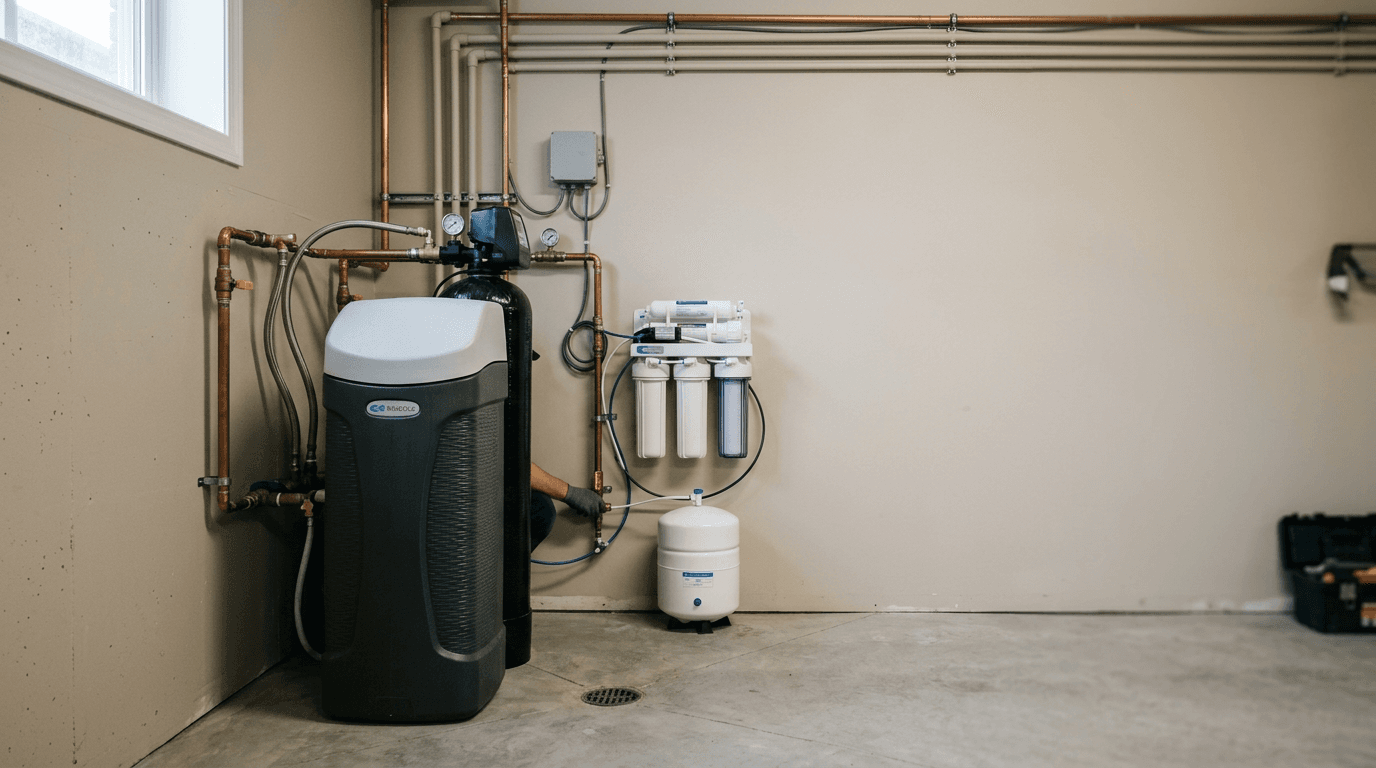
Many homeowners in Beaumont, Leduc, and Sherwood Park require both. Packages like the Triton Pure and Triton Pure Tankless combine softening for the working water and reverse osmosis for the drinking water, addressing the entire spectrum of municipal water issues.
1. Appliance Longevity and Efficiency
Water softeners are designed for homeowners who want to protect their major plumbing appliances, specifically water heaters, dishwashers, and washing machines. By removing calcium and magnesium before the water enters the home's distribution system, a softener ensures that only treated water reaches these expensive units.

The mechanism relies on ion exchange. Hard water passes through a bed of resin beads charged with sodium ions. The calcium and magnesium ions have a stronger positive charge than the sodium, so they displace the sodium and stick to the resin. The water exiting the tank is now "soft." When the resin is full, the system flushes it with a brine solution to reset the beads.
Scale is an insulator, not just a blockage
When hard water is heated, the dissolved minerals precipitate out and form scale. In a water heater, this scale coats the heating elements or the bottom of the tank. Because scale is a poor conductor of heat, the appliance must burn more energy to heat the water through the rock layer, driving up utility costs and eventually causing the heating element to burn out prematurely.
The honest limit of a water softener in this context is that it cannot reverse existing damage. If your water heater already has three inches of calcified rock at the bottom, installing a softener will prevent new scale from forming, but it will not dissolve the existing buildup. Older appliances may still fail from past abuse.
2. Skin and Hair Hydration
This benefit appeals directly to individuals suffering from dry, itchy skin, eczema, or brittle hair after showering. Hard water interacts poorly with traditional soaps and shampoos, creating a sticky precipitate rather than a rich lather.
The mechanism here is chemical interference. Calcium and magnesium react with the fatty acids in soap to form an insoluble substance commonly known as soap scum. Because the soap is busy reacting with the minerals, you have to use significantly more product to get any lather at all.
Soap scum binds to your skin
When you shower in hard water, that insoluble soap scum does not just stick to the glass door; it clings to your skin and hair. This film traps dirt and dead skin cells, clogs pores, and prevents your skin's natural oils from moisturizing the surface. Soft water eliminates this reaction, allowing soap to rinse away completely.
Practical rule: If you install a water softener, cut your soap, shampoo, and laundry detergent usage by at least half immediately. Using the same amount of soap in soft water will make it nearly impossible to rinse off.
Homeowners should understand that softened water is not a medical cure. Although it successfully eliminates the harsh environmental irritants that flare up dry skin conditions, it cannot heal underlying dermatological diseases.
3. Plumbing Infrastructure Protection
Homeowners building new houses or renovating older properties need to protect the pipes hidden behind their drywall. Hard water slowly chokes the internal diameter of plumbing lines, reducing water pressure over time.
The mechanism is continuous mineral deposition. Every time a faucet is turned off, the water sitting in the pipe leaves behind microscopic mineral deposits. Over years, this builds up like plaque in an artery, restricting flow and increasing the friction inside the pipe.
Friction destroys fixtures from the inside
Beyond the pipes themselves, hard water destroys the rubber seals, O-rings, and ceramic cartridges inside your faucets and showerheads. The abrasive nature of the minerals tears these components apart, leading to dripping faucets and seized valves that require constant replacement.
Because the softening process introduces a trace amount of sodium into the water supply, older homes require extra caution. This sodium is perfectly safe for modern PEX or copper pipes, but in legacy systems with degraded galvanized steel, the softened water can dissolve existing mineral scale that is currently sealing tiny pinhole leaks.
4. Premium Drinking Water Quality
For families who refuse to drink tap water and rely on expensive, environmentally damaging bottled water, a reverse osmosis (RO) system is the definitive solution. The benefits of reverse osmosis water center entirely on purity and safety at the point of consumption.
This filtration relies on pressure-driven separation. Incoming tap water is forced through a semi-permeable membrane with microscopic pores measuring just 0.0001 microns, which only allows pure water molecules to slip past. Harmful contaminants, including lead, fluoride, nitrates, and other dissolved solids, are filtered out and sent down the drain.
Filtration down to the molecular level
Unlike basic carbon filters that only improve taste, an RO system physically removes the dissolved solids that make up the water's chemical profile. This results in pure water that rivals or exceeds the quality of premium bottled brands, available directly from a dedicated faucet at your kitchen sink.
Slow production speeds and wastewater generation represent the main trade-offs of reverse osmosis. Standard tank-based systems operate gradually, collecting water drop by drop while venting several gallons of wastewater for every gallon of purified water. To achieve higher on-demand volume without a bulky tank, upgrading to a system like the Triton Tankless RO is necessary, though it does require an electrical connection to run its internal pump.
5. Culinary and Beverage Enhancement
Home chefs and coffee enthusiasts require a neutral base for their recipes. Municipal tap water, laden with chlorine and dissolved minerals, alters the chemical extraction process of coffee and changes the flavour of boiled foods.
By stripping away competing chemical compounds, filtration vastly improves taste. Brewing coffee with chlorinated hard water causes chlorine to react negatively with delicate bean oils, resulting in bitter off-flavours. At the same time, heavy mineral concentrations block the water from effectively extracting the rich compounds from your coffee grounds.
Chemicals mask the true flavour of food
Using pure water from an RO system ensures that the only flavours in your cup or pot are the ones you put there. Pasta boils cleaner, ice cubes freeze crystal clear without cloudy mineral centers, and coffee tastes exactly as the roaster intended.
Highly purified reverse osmosis water can occasionally taste somewhat flat to anyone used to the sharp mineral profile of hard tap water. Furthermore, certain high-end espresso machines need a minimum level of mineral content to operate safely, meaning you may have to install a remineralisation filter along your RO line.
6. Fabric Preservation in Laundry
Large families doing multiple loads of laundry a week see significant benefits from soft water. Hard water destroys clothing fibers and fades colours rapidly.
Fabric damage occurs through a combination of mineral embedding and hindered detergent performance. In the same way soap scum coats skin, it builds up in your washing machine as a sticky residue that traps grime within clothing fibres. Concurrently, abrasive calcium and magnesium crystals lodge themselves deep inside the weave of the fabric.
Hard minerals act as microscopic razors
When towels and shirts dry with hard minerals embedded in them, the fabric becomes stiff and scratchy. As the garment moves, these microscopic mineral crystals act like tiny razors, shearing the threads and causing the fabric to wear out, pill, and tear much faster than it should.
Unfortunately, soft water is incapable of reversing physical damage in garments already ruined by years of hard water laundering. While subsequent washes will gradually flush out old mineral deposits and restore some softness to stiff towels, the system cannot repair sheared textile fibres or bring back faded colours.
7. Whole-Home Chlorine Removal
For environmentally conscious residents and those sensitive to chemical odours, removing chlorine from the entire house - not just the kitchen sink - is a priority. Municipalities use chlorine or chloramines to keep water safe during transit, but once it reaches your home, the chemical has done its job.
The mechanism is catalytic carbon filtration. A whole-home dechlorination tank is installed where the water enters the house. As water flows through the carbon bed, the chlorine undergoes a chemical reaction on the surface of the carbon, converting it into harmless chloride, which has no taste or smell.
Municipal treatment chemicals outlive their usefulness
Showering in chlorinated water vaporizes the chemical, allowing you to inhale it in the enclosed space of a bathroom. A whole-home carbon tank eliminates the "swimming pool" smell from your showers and ensures every tap in the house dispenses clean-smelling water.
Practical rule: Never confuse a water softener with a water filter. A softener removes hard minerals but ignores chlorine; a carbon filter removes chlorine but ignores hard minerals. If you have both problems, you need both tanks.
The honest limit of a carbon tank is that it does not soften the water or remove heavy metals. It is strictly for chemical taste and odour reduction. Furthermore, the carbon media eventually exhausts its reactive capacity and must be re-bedded, typically every 5 to 10 years depending on water usage.
System Comparison Table
| System Type | Primary Target | Key Benefit | Honest Limitation |
|---|---|---|---|
| Water Softener | Calcium & Magnesium | Protects plumbing, appliances, and skin | Does not filter chlorine or drinking water contaminants |
| Whole-Home Carbon | Chlorine & Odours | Removes chemical smells from all showers/taps | Does not soften water or remove heavy metals |
| Reverse Osmosis (Tank) | Dissolved Solids | Bottled-quality drinking water at one sink | Slow production, takes up cabinet space |
| Tankless RO | Dissolved Solids | On-demand pure water, saves space | Requires an electrical outlet under the sink |
Which System Fits Your Home
Choosing the right setup depends entirely on your specific bottlenecks.
- If your bottleneck is failing appliances and dry skin: You need a dedicated water softener. This is the foundational treatment for Edmonton's hard water.
- If your bottleneck is the taste of your tap water and buying bottled water: Install a reverse osmosis system at the kitchen sink. If cabinet space is tight, opt for a tankless RO model.
- If your bottleneck is chemical smells in the shower: Add a whole-home dechlorination carbon tank to your setup.
- If you want complete control over your home's water: Look at combined packages like the Triton Pure or Triton Pure Tankless, which pair a high-efficiency softener with an RO system to handle both the working water and the drinking water.
FAQ
Do water softeners make the water salty?
No. The ion exchange process adds a very small amount of sodium to the water, not salt (sodium chloride). The amount of sodium in an 8-ounce glass of softened Edmonton water is roughly equivalent to the sodium in a slice of white bread.
Can I drink softened water?
Yes, it is safe to drink for most people. However, because it contains elevated sodium and does not filter out municipal chemicals, most homeowners prefer to install a reverse osmosis system at the kitchen sink for their primary drinking and cooking water.
How often do I need to add salt to a softener?
This depends on your household water usage and the system's efficiency. On average, a modern, correctly sized water softener for a family of four in Edmonton will require one bag of salt every 4 to 6 weeks.