A Complete Guide to Water Softener Maintenance and Troubleshooting
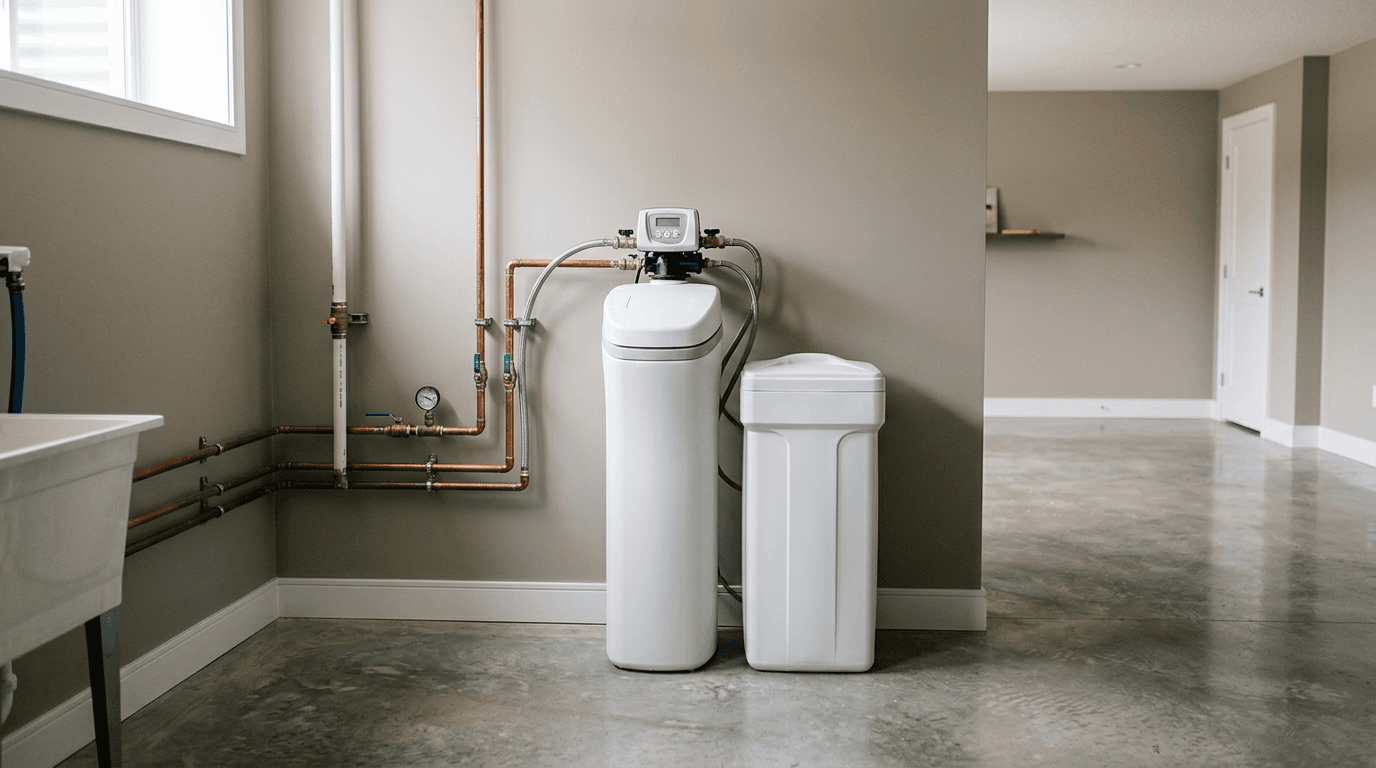
You step into the shower expecting a clean rinse, but the water feels sticky, and the glass door is suddenly clouded with white scale. That sudden return of hard water usually means your system has stopped regenerating properly. Routine water softener maintenance is the difference between a system that lasts fifteen years and one that fails in five. When a softener stops working, the resin bed fouls, appliances scale up, and the efficiency of your home's plumbing drops.
Quick Summary
Water softener maintenance involves managing the brine tank, cleaning the injector, and verifying regeneration settings to ensure continuous ion exchange. Neglecting these tasks leads to salt bridges, fouled resin, and hard water bleed-through.
- Verify hardness settings match your local water conditions.
- Keep salt levels just above the water line to prevent bridging.
- Clean the venturi valve and injector screen annually.
- Inspect O-rings and the bypass valve for wear.
- Address salt mushing immediately to restore brine flow.
Table of Contents
- 1. Check and Adjust Your Water Softener Settings
- 2. Inspect and Manage the Brine Tank
- 3. Clean the Resin Bed and Injector
- 4. Examine Key Water Softener Parts for Wear
- 5. Maintain Combined Softener and RO Systems
- Common Pitfalls and Troubleshooting
- FAQ
- Recommended Reads
1. Check and Adjust Your Water Softener Settings
The foundation of water softener maintenance is ensuring the control valve is programmed correctly for your specific water chemistry. The control head dictates when and how the system regenerates, relying on the hardness setting and the capacity of the resin bed.
In the Edmonton capital region, municipal water typically sits around 165 mg/L, or 9.6 grains per gallon (gpg). If your system is set to assume a hardness of 5 gpg, it will exhaust its softening capacity days before the scheduled regeneration. The mechanics are straightforward: the system calculates the total gallons it can soften by dividing the grain capacity of the resin by the hardness setting. When the settings are wrong, the math fails.
The mistake people actually make here is lowering the hardness setting intentionally to save on salt. While this reduces the frequency of regeneration cycles, it guarantees that hard water will bleed into the home's plumbing during the final days of the cycle. This defeats the purpose of having a softener entirely. You must test your water at the tap and input the exact grains per gallon into the control head. If you live in areas with fluctuating hardness, such as those relying on well water outside the city limits, you should test the water quarterly and adjust the water softener settings accordingly.
2. Inspect and Manage the Brine Tank
The brine tank is where the heavy lifting of regeneration begins. During a cycle, the system draws a highly concentrated saltwater solution (brine) into the resin tank to wash away the accumulated calcium and magnesium ions. If the brine tank is not functioning, the resin cannot be cleaned, and the system will output hard water.
Two primary issues occur in the brine tank: salt bridges and salt mushing. A salt bridge is a hard crust that forms across the tank, creating an empty cavern beneath it. The salt sits high and dry, while the water below remains fresh. Mushing occurs when salt recrystallizes at the bottom of the tank into a thick sludge, blocking the brine well and preventing the system from drawing the solution.
Practical rule: Keep the salt level just above the water line, never filling the tank more than two-thirds full.
Filling the brine tank to the very brim is counterproductive. Homeowners often do this to avoid checking it for six months. Compacting hundreds of pounds of salt increases bridging and mushing, especially in humid basements. To maintain the tank, let the salt level drop. Add just enough salt to cover the visible water. Once a year, allow the tank to run completely empty. Scoop out any residual sludge at the bottom. Wash the interior with warm water before refilling it.
3. Clean the Resin Bed and Injector
The resin bed is the heart of the system, consisting of millions of tiny polystyrene beads charged with sodium ions. Over time, these beads can become fouled by iron, manganese, and sediment that municipal treatment plants miss. When the beads are coated in iron, they lose their ability to exchange ions, reducing the system's capacity.
The injector (or venturi valve) is the component responsible for creating the vacuum that draws brine from the tank into the resin bed. It features a tiny nozzle and a screen that easily clogs with sediment or dirty salt. If the injector is blocked, the system will go through the motions of regeneration but will not actually pull any brine.
Ignoring the injector screen eventually overflows the brine tank. The system pushes water in but cannot draw it back out through a clog. Water rises each cycle and spills onto the floor. To prevent this, shut off the water supply. Relieve the pressure and remove the injector cap. Pull out the screen and the nozzle. Wash them in warm soapy water, and use a wooden toothpick to clear the tiny hole in the nozzle. Never use a metal needle. Scratching the plastic will ruin the vacuum effect.
4. Examine Key Water Softener Parts for Wear
A water softener is a mechanical device with moving parts, seals, and valves that degrade over time. Routine inspection of specific water softener parts prevents catastrophic leaks and ensures the system operates efficiently. The primary components to check are the bypass valve, the O-rings connecting the control head to the plumbing, and the float assembly inside the brine well.
The bypass valve allows you to isolate the softener from the main plumbing, routing water past the unit so you can perform maintenance without shutting off water to the entire house. The float assembly acts as a safety shutoff, preventing the brine tank from overflowing if the main valve fails to stop the fill cycle.
The mistake homeowners make is leaving the bypass valve untouched for years. When a valve sits in one position for a decade, mineral deposits lock it in place. When an emergency finally forces the homeowner to use it, the handles snap off or the internal seals tear, causing a massive leak. You should exercise the bypass valve every six months - turn it to the bypass position, run a faucet to verify the water is diverted, and then turn it back to the service position. This simple action keeps the seals lubricated and ensures the valve will work when you actually need it.
5. Maintain Combined Softener and RO Systems
Many homes in Edmonton, Beaumont, Leduc, and Sherwood Park utilize a combined approach to water treatment, pairing a whole-home softener with a point-of-use reverse osmosis system. Packages like the Triton Pure and Triton Pure Tankless rely on the softener to protect the delicate RO membrane from calcium scaling.

Reverse osmosis membranes force water through microscopic pores to remove dissolved solids. If hard water reaches the membrane, calcium carbonate precipitates onto the surface, blinding the pores and destroying the membrane in a matter of months. The softener acts as the ultimate pre-filter for the RO unit.
The mistake people make is treating the two systems as entirely separate entities. They will diligently change the pre-filters on their RO system but ignore a salt bridge in the softener. Once the softener fails, the RO membrane is exposed to hard water and fails shortly after. When performing water softener service, always check the TDS (Total Dissolved Solids) output of your RO system. A sudden spike in TDS at the RO faucet is often the first indicator that the water softener has stopped regenerating properly.
Common Pitfalls and Troubleshooting
When a system fails, the symptoms often overlap. Proper water softener troubleshooting requires isolating the specific mechanism that has broken down. Here are the distinct failures that look identical from the outside.
Symptom: The brine tank is full of water, but the salt level never drops.
- The real cause: A clogged injector or venturi valve. This is the most common cause of a high water level. The system pushes water into the tank to make brine but cannot create the vacuum required to draw it back out.
- The fix: Shut off the water, depressurize the system, and clean the injector nozzle and screen with warm water and a wooden toothpick.
Symptom: The water is hard, but the salt is dropping and the tank level is normal.
- The real cause: The resin bed is depleted or fouled by iron. The system is mechanically functioning and moving brine, but the resin beads can no longer hold a sodium charge.
- The fix: Apply a commercial resin cleaner (iron out) through the brine well and force a manual regeneration. If the system is over ten years old, the resin may need to be completely replaced.
Symptom: The system runs constantly, sending water down the drain.
- The real cause: A stuck piston or a failed seal inside the control head. Debris has jammed the internal piston, preventing it from advancing to the next cycle position.
- The fix: Bypass the unit immediately to stop the water waste. The control head must be disassembled, and the seal and spacer kit must be replaced. This often requires professional water softener repair.
Symptom: The brine tank is completely empty of water and salt.
- The real cause: A salt bridge has formed high in the tank, hiding the empty space below.
- The fix: Use a broom handle to gently tap the top of the salt crust until it collapses. Remove the hardened chunks, clean the tank, and refill it properly.
FAQ
How often should I add salt to my water softener?
You should check the salt level monthly. Add salt only when the level drops down to the water line, and fill it no more than two-thirds full to prevent bridging.
What type of salt is best for my system?
Evaporated salt pellets are the purest option and leave the least amount of residue in the brine tank. Solar salt contains more impurities and requires more frequent tank cleaning.
When do I need professional water softener repair?
Call a professional if the control head is leaking, the motor runs continuously without advancing cycles, or if cleaning the injector fails to resolve a brine draw issue.
How long does water softener resin last?
In municipal water applications with standard chlorine levels, standard 8% cross-link resin typically lasts 10 to 15 years before it degrades into a mushy consistency and restricts water pressure.