Alkaline Water Filter vs Reverse Osmosis: 4 Systems Compared
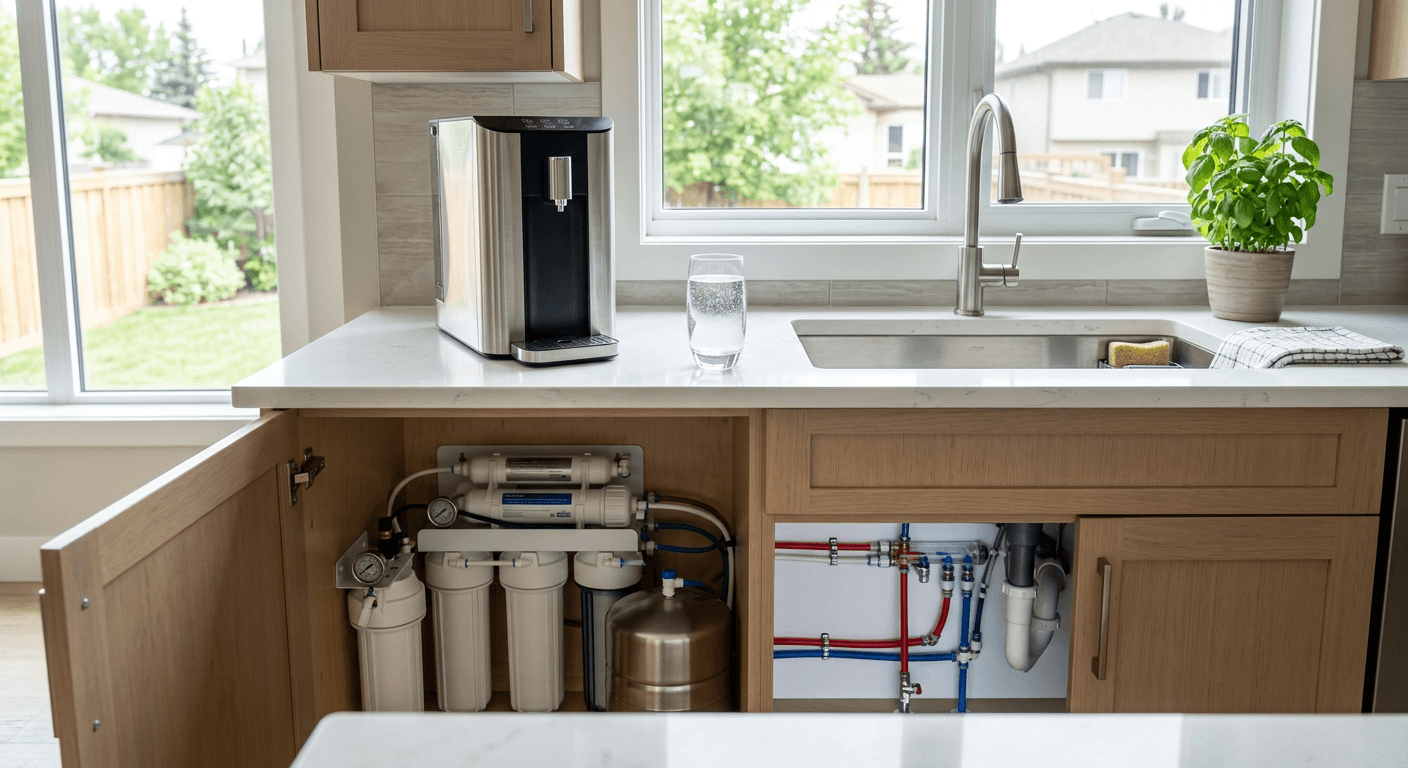
Opening the tap and watching a cloudy suspension of chalky minerals settle in your glass is a familiar morning ritual for households drawing from the North Saskatchewan River. Addressing that hard water scale alongside chlorine tastes usually forces a decision between stripping the water bare or actively altering its chemical profile. Choosing an alkaline water filter over a membrane-based purifier requires understanding what actually happens to the supply inside the casing, rather than relying on the marketing claims printed on the box.
Quick Summary
The choice between mineralization and membrane filtration dictates whether you are adding beneficial compounds to your water or stripping away all dissolved solids entirely. While reverse osmosis physically blocks microscopic contaminants through a semi-permeable barrier, alkaline and ionizing systems alter the pH and mineral content of the water you drink.
- Gravity Mineralization: Uses contact time to leach calcium and magnesium into filtered water.
- Tankless Reverse Osmosis: Relies on electric pumps to force water through fine membranes in real-time.
- Under-sink Reverse Osmosis: Uses hydrostatic tanks to store purified water for immediate high-pressure dispensing.
- Electrolysis Ionization: Separates mineral ions using electrically charged titanium plates.
Table of Contents
- How Purification Methods Dictate Your Water Quality
- 1. Santevia
- 2. Waterdrop Canada
- 3. Aquasana
- 4. Blessing Water
- Matching the System to Your Household Reality
- Recommended Reads
How Purification Methods Dictate Your Water Quality
| Product | Purification Method | Features | Pros | Cons | Target Audience |
|---|---|---|---|---|---|
| Santevia | Gravity Mineralization | Maifan stones, ceramic pre-filter | No plumbing required, adds minerals back, countertop access | Very slow flow rate, requires manual filling, leaves high TDS | Renters and individuals seeking remineralization |
| Waterdrop Canada | Tankless Reverse Osmosis | Internal pump, smart faucet, composite filters | Compact footprint, continuous supply, real-time tracking | Requires electricity, pump generates noise, regular filter costs | Households with tight under-sink cabinet space |
| Aquasana | Under-sink Reverse Osmosis | Hydrostatic tank, Claryum blocks, remineralizer | Instant pressure, no electricity needed, deep contaminant block | Large storage footprint, wastewater generation, complex tubing | Large families needing high-speed water delivery |
| Blessing Water | Electrolysis Ionization | Titanium plates, variable pH outputs | Adjustable acidity/alkalinity, preserves natural minerals, touch controls | High upfront cost, requires conductive source water, maintenance heavy | Users targeting specific pH levels for consumption |
The debate of reverse osmosis water vs alkaline water usually ignores the fundamental mechanical differences between how these devices actually operate. Evaluating these choices requires separating them into distinct purification methods based on how they alter the municipal supply.
Gravity Mineralization relies on natural downward flow. Water passes slowly through carbon and ceramic layers before sitting in a bed of stones that release alkaline minerals. It requires no water pressure but demands patience.
Tankless Reverse Osmosis uses an internal electric motor to generate intense pressure, pushing water through a membrane with pores as small as 0.0001 microns. It works instantly but requires an outlet.
Under-sink Reverse Osmosis operates purely on municipal line pressure. It slowly pushes water through a membrane and stores the purified result in a bladder tank, discarding the rejected contaminants down the drain.
Electrolysis Ionization does not act as a traditional physical barrier. Instead, it runs an electrical current through the water to separate existing mineral ions into acidic and alkaline streams.
Navigating these categories requires understanding Edmonton's municipal water characteristics, as the baseline hardness of your supply directly dictates how hard these membranes and plates will have to work.
1. Santevia
The push to replace disposable plastic bottles often leads households directly to countertop gravity dispensers. Santevia operates entirely above the counter, requiring no plumbing modifications or electrical outlets. Instead of relying on municipal line pressure, the system uses the physical weight of the water to force it through a series of specialized filtration stages.
Water first drops through a porous ceramic pre-filter designed to catch larger suspended solids, microplastics, and rust. From there, it enters a multi-stage cartridge containing activated carbon and ion-exchange resin to address chlorine taste and odour. The actual alkalization happens in the final stage. The lower reservoir contains a bed of maifan stones and tourmaline. As the filtered water sits in this chamber, it naturally leaches trace amounts of calcium, magnesium, and potassium from the stones, subtly raising the pH and altering the texture of the liquid. The mechanism relies entirely on extended contact time; water rushing past the stones would not absorb enough minerals to change the chemistry.
Gravity filtration trades speed for remineralization
Because there is no active pressure driving the process, the filtration rate is exceptionally slow. The system cannot selectively remove highly dissolved solids like sodium or heavy metals with the same efficiency as a semi-permeable membrane. If your municipal supply suffers from extreme total dissolved solids (TDS), those elements will largely remain in your glass alongside the newly added minerals.
I would hesitate to place this specific setup in a busy kitchen where five people need constant, immediate refills for cooking and drinking. The manual upkeep of carrying pitchers to refill the top reservoir quickly becomes a chore in high-volume environments.
Buy this system if you are renting an apartment and want mineralized drinking water without altering the plumbing beneath your sink.
Pros
- Operates without electricity or complex plumbing
- Actively restores beneficial minerals to the water
- Highly visible reservoirs make monitoring water levels simple
Cons
- Filtration process takes hours to process a full batch
- Requires constant manual refilling at the sink
- Fails to remove heavy concentrations of dissolved solids
2. Waterdrop Canada
A homeowner opening their sink cabinet only to find a garbage disposal occupying the entire space immediately understands the appeal of a compact footprint. Waterdrop Canada addresses this bottleneck by abandoning the bulky storage tank traditionally associated with deep purification. Instead, it processes the supply on demand using an integrated electric pump.
The mechanism centres on overcoming municipal water pressure limitations. A standard reverse osmosis membrane needs around 60 PSI to efficiently force water through its microscopic pores while washing the rejected contaminants down the drain. To achieve this instantly, the unit uses an internal motor to pressurize the water against the membrane the moment you open the dedicated smart faucet. This physical barrier strips the water of nearly all dissolved solids. Because the water does not sit in a pressurized rubber bladder waiting to be used, it avoids the stale taste sometimes associated with older tank systems.
Tankless design reclaims under-sink real estate
The reliance on active electricity dictates where and how this equipment operates. It requires a dedicated, grounded outlet directly beneath the counter. When you turn on the faucet, the internal pump engages immediately, generating a humming vibration that resonates through the cabinet base. Furthermore, processing water at high speed often results in a slightly lower flow rate at the tap compared to a fully pressurized storage tank dumping its reserves all at once.
What would make me skip this approach is living in an older home without accessible electrical wiring under the kitchen island, as hiring an electrician dramatically inflates the installation cost.
Buy this unit if deep cabinet space is your primary constraint and you have an existing electrical outlet ready to power the motor.
Pros
- Eliminates the bulky storage tank from the cabinet
- Prevents water from sitting stagnant in rubber bladders
- Internal pump optimizes the wastewater rejection ratio
Cons
- Requires dedicated electrical power under the sink
- Pump motor produces audible noise during operation
- Flow rate can feel restrictive when filling large cooking pots
3. Aquasana
Pushing highly dissolved solids out of municipal supplies requires physical separation that standard carbon blocks simply cannot achieve on their own. Aquasana relies on a traditional, hydrostatic approach to water purification, leveraging the steady pressure of the city line rather than an electric motor to force separation over time.
The system routes cold water through a sequence of pre-filters - utilizing their proprietary Claryum technology which combines activated carbon and ion exchange - to capture chlorine and larger sediment before it hits the RO membrane. This prevents the delicate membrane from fouling prematurely. As water slowly permeates the 0.0001-micron barrier, it enters a steel storage tank containing a pressurized rubber bladder. The incoming water compresses the air behind the bladder. When you open the dispensing faucet, that compressed air violently expands, pushing the stored water out at high speed for immediate access. Before reaching the glass, the water passes through a final remineralization cartridge designed to correct the slightly acidic pH of pure RO water.
Stored hydrostatic pressure ensures immediate delivery
The physical footprint of the storage tank dominates the under-sink environment. Because the system operates solely on municipal line pressure, the wastewater ratio is significantly higher than motorized units; it can send three to four gallons of reject water down the drain for every one gallon of purified water it stores.
Practical rule: Measure your cabinet depth with the garbage disposal and drain pipes included; hydrostatic tanks require vertical clearance that cannot be squeezed behind a P-trap.
I would opt for this specific setup if instant delivery speed mattered more than preserving cabinet volume, as the tank provides a sudden rush of water that motorized units struggle to match. When weighing alkaline water vs reverse osmosis, the deciding factor is often whether you prefer water stripped bare and slightly remineralized, or naturally filtered with a heavier mineral load.
Buy this system if you require rapid dispensing for large families and have the physical space to sacrifice a cabinet.
Pros
- Delivers water at high pressure immediately upon opening the tap
- Functions entirely without electrical power
- Multi-stage pre-filtration protects the core membrane from scaling
Cons
- Storage tank consumes significant under-sink cabinet space
- High wastewater generation during the slow refill cycle
- Flow rate drops drastically once the tank is depleted
4. Blessing Water
Does applying an electrical current actually change how water interacts with your body? Blessing Water bypasses physical filtration barriers entirely in favour of electrodialysis. As a distributor of Enagic Kangen machines, this category focuses on separating what is already in the water rather than blocking it mechanically.
The core mechanism happens inside a sealed electrolysis chamber containing solid titanium plates coated in medical-grade platinum. After passing through a basic carbon filter to remove chlorine and coarse sediment, the water flows over these electrically charged plates. The electrical current separates the existing mineral ions. Positively charged alkaline minerals like calcium and magnesium are drawn toward the negative plates, while acidic carbonate and sulfate ions are pulled toward the positive plates. The machine then physically splits the stream in two, dispensing the alkaline water for drinking and diverting the acidic water down the drain or into a secondary container for cleaning purposes.
Electrolysis separates rather than strictly filtering
This technology demands source water that already contains a high concentration of dissolved minerals to conduct electricity effectively. If you feed this machine completely soft or RO-purified water, the plates have no ions to separate, and the pH will not change. Comparing kangen water vs reverse osmosis reveals two entirely different chemical approaches: one blocks solids, while the other shocks them into separation. The capital cost of heavy platinum-coated plates makes this a severe financial commitment.
I would rule this out if the municipal supply in your neighbourhood was naturally soft or heavily laden with toxic heavy metals, as the machine's basic carbon pre-filter is not designed for deep contaminant removal.
Buy this unit if you specifically seek variable pH adjustments and are prepared to invest heavily in the hardware required to achieve it.
Pros
- Allows precise control over the final pH level of the water
- Preserves the natural alkaline minerals present in the city supply
- Produces acidic byproduct water useful for surface cleaning
Cons
- Requires mineral-rich source water to function properly
- Massive upfront capital cost compared to mechanical filters
- Fails to remove heavy metals or microscopic dissolved solids
Matching the System to Your Household Reality
A water ionizer vs reverse osmosis decision ultimately depends on your physical space, your budget, and what exactly you are trying to remove from the local supply. Edmonton, Beaumont, Leduc, and Sherwood Park residents face specific hard water challenges that dictate which of these categories will survive long-term in the kitchen.
If your primary bottleneck is under-sink space and a lack of electrical outlets, Gravity Mineralization offers an immediate, plumbing-free bypass. It keeps the installation on the counter and naturally alters the mineral profile, provided you have the patience to manually refill the reservoirs daily.
If you want the deep purification of a semi-permeable membrane without sacrificing the entire cabinet, Tankless Reverse Osmosis provides a modern mechanical fix. It strips out the heavy dissolved solids efficiently, though you must secure an electrical connection before committing to the purchase.
For households demanding high-speed water delivery without relying on an outlet, Under-sink Reverse Osmosis remains the structural standard. The pressurized tank guarantees a fast flow rate, making it ideal for large families constantly filling cooking pots, provided they have the space to house the bladder.
Finally, Electrolysis Ionization serves those deliberately seeking pH manipulation. It requires a heavy upfront investment and specific source water conditions, but it delivers unmatched control over the chemical balance of your drinking water.
When assessing whole-home water filtration systems to tackle scaling at the source, homeowners often pair these point-of-use kitchen units with a central softener. Utilizing packages like Triton Pure or Triton Pure Tankless ensures the heavy lifting is done at the basement main, protecting the delicate membranes and plates in your kitchen from premature failure.