best water filter for home: 4 Verified Canadian Systems to Consider
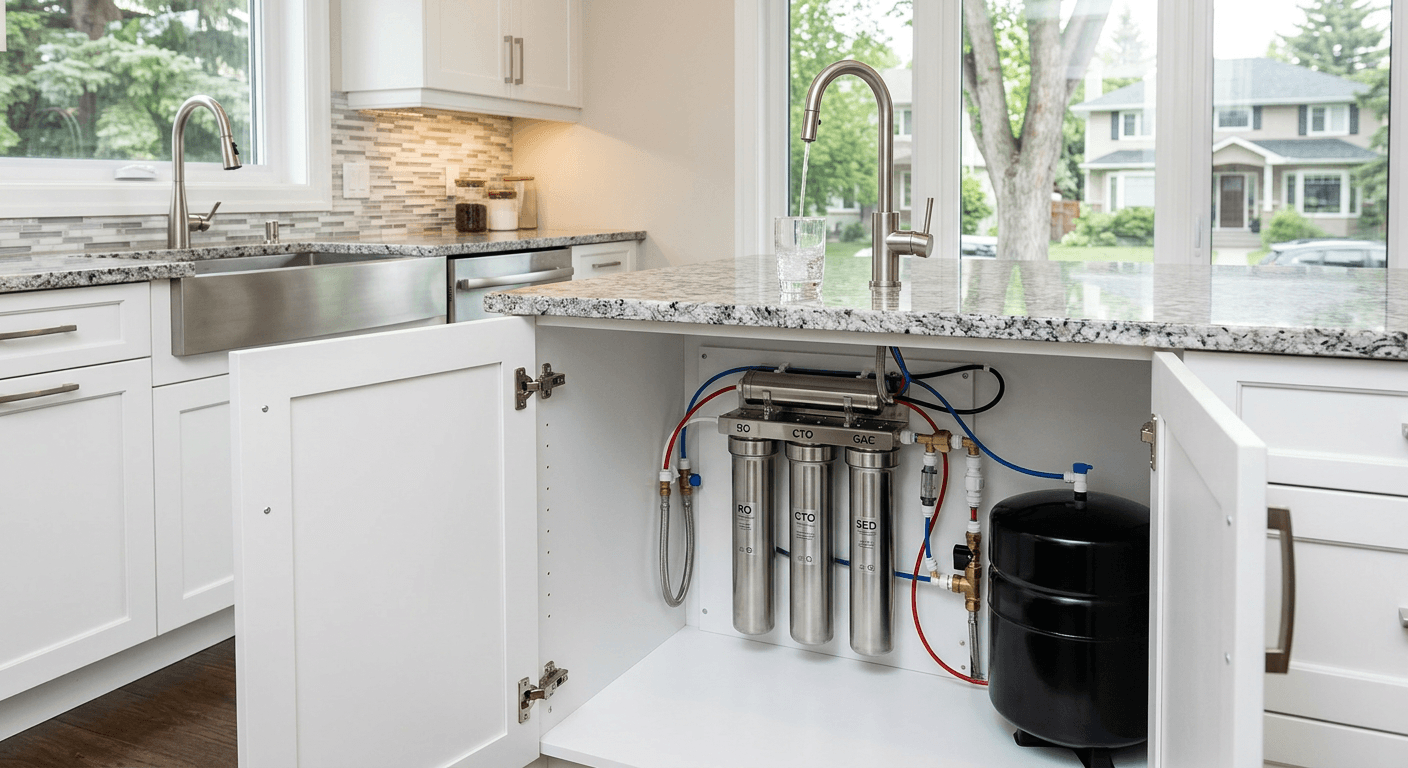
A common misconception when treating residential plumbing is assuming that a chemical taste in your morning coffee and the chalky white crust destroying your dishwasher require the exact same piece of hardware. Finding the best water filter for home installations means separating treatment for the plumbing from treatment for the palate. Cartridges that polish drinking water do nothing to protect hot water tanks from calcium scale, and heavy-duty softeners are not designed to remove trace municipal chemicals at the kitchen sink.
Quick Summary
The best water filter for home applications depends on whether you need mechanical sediment removal, gravity-fed carbon filtration, or forced-pressure reverse osmosis. Resolving household water problems requires matching the exact physical mechanism to the dissolved solids or particulates present in your specific supply line.
- Point-of-use systems address drinking water at a single tap.
- Mechanical filters trap physical debris down to specific micron ratings.
- Gravity reservoirs eliminate the need for plumbing modifications.
- Regional distribution platforms consolidate shipping for complex multi-stage installations.
Table of Contents
- Comparing the best water filter for home hardware
- Buying Guide / How to Choose
- 1. Waterdrop Filter Canada
- 2. Rainfresh
- 3. Berkey Water Filter Canada
- 4. Aquatell Canada
- Where your household fits best
- Recommended Reads
Comparing the best water filter for home hardware
| Product | Filtration Approach | Features | Pros | Cons | Target Audience |
|---|---|---|---|---|---|
| Waterdrop Filter Canada | Point-of-use reverse osmosis | 30-day returns, economy shipping | Fast deployment, automated flushing, compact profiles | Geographic shipping limits, requires under-sink power, discards waste water | High-density urban households requiring advanced membrane separation |
| Rainfresh | Point-of-use inline filtration | 50-micron reduction, 6-month cycles | Canadian manufacturing, minimal pressure drop, targeted removal | Manual cycle tracking, strict capacity limits, physical cartridge swaps | Homeowners targeting specific sediment and chlorine without dual faucets |
| Berkey Water Filter Canada | Freestanding gravity filtration | 8.5L to 17L tanks, black filter elements | Zero plumbing required, emergency ready, scalable capacity | Slow flow rates, daily manual refilling, large footprint | Renters and temporary residents unwilling to alter existing plumbing |
| Aquatell Canada | Centralized distribution | Next-day dispatch, multi-warehouse routing | Broad catalog access, rapid domestic transit, predictable delivery | Demands buyer expertise, scattered warranty paths, complex sizing | Experienced buyers who already know their exact flow rate requirements |
Buying Guide / How to Choose
Locating the best water filter Canada offers requires evaluating the distinct ways residential hardware intersects with your existing pipes. We classify these solutions along a single axis: their Filtration Approach. This framework dictates whether you are altering the pipe, adding a tap, or bypassing the plumbing entirely.
Point-of-use reverse osmosis systems represent the most aggressive intervention. These units sit directly under the sink, using line pressure to push water through a semi-permeable membrane that strips away dissolved solids. They belong in homes where municipal supplies carry high levels of hard-to-remove contaminants, but they should not be compared against basic carbon pitchers due to their installation complexity and wastewater generation.
Point-of-use inline filtration involves splicing a physical barrier directly into the existing cold water line. Rather than rejecting water, these systems rely on depth media to trap silt and absorb chemicals as water flows to the main faucet. This category suits households that want better taste without drilling secondary holes in their countertops.
Freestanding gravity filtration removes the plumbing entirely. These are countertop reservoirs that rely on static water weight, rather than municipal line pressure, to pull untreated water through dense carbon matrices. They cannot be compared to inline systems because they provide no continuous flow.
Centralized distribution is a logistics approach rather than a single technology. These platforms route various types of equipment from domestic warehouses to the buyer. This approach serves households building custom treatment setups who require immediate inventory availability.
When evaluating systems for regional conditions, such as understanding local water chemistry across Edmonton, Beaumont, Leduc, and Sherwood Park, households often face both severe mineral scaling and heavy chlorination. Identifying which approach isolates the right problem prevents buyers from installing equipment that was never engineered for their specific municipal feed.
1. Waterdrop Filter Canada
Standard orders canceled within 24 hours ship without penalties. This published policy highlights the rapid operational pace of this online retailer. Waterdrop Filter Canada operates as a direct-to-consumer supplier. They specialize in NSF-certified under-sink and countertop units. Rather than acting as a catalog for legacy brands, they push their own proprietary hardware lines. They primarily focus on tankless membrane systems. These systems fit inside confined residential cabinetry.
This platform relies heavily on the Point-of-use reverse osmosis approach. The mechanism centers on forcing municipal water through microscopic membrane pores. Because the membrane is so tight, it physically blocks dissolved solids, flushing the rejected contaminants down the drain while sending purified water to a dedicated dispensing faucet. Their tankless models use internal booster pumps to maintain pressure, effectively replacing the bulky storage tanks that older generations of this technology required.
Direct distribution alters replacement intervals
Owning proprietary equipment means you are entirely reliant on the manufacturer's specific distribution network for ongoing operation. A filter is only useful if you have a replacement cartridge on hand when the media exhausts itself. They promise free economy shipping to most areas in Canada with estimated delivery times spanning 4 to 10 business days. This means buyers must monitor their system's capacity indicators well in advance of actual failure, as local hardware stores cannot supply the necessary proprietary replacements if a cartridge blocks up suddenly over a weekend.
Practical rule: Never buy proprietary hardware without first confirming that the replacement media routinely ships to your specific postal code within a timeframe you can tolerate.
The structural limit of this platform is its geographic delivery boundary. Orders are not delivered to Canadian regions where the postal code starts with X or Y, completely ruling out northern territories from accessing their hardware or replacement filters. We would deploy this ecosystem for households in standard urban delivery zones that require advanced membrane separation, provided they have adequate under-sink electrical outlets to run the tankless pumps.
Pros
- Standard orders canceled before shipment within 24 hours incur no fees
- Offers a 30-day return policy for standard items
- Consolidates complex membrane stages into single proprietary housings
Cons
- Excludes delivery to any postal code beginning with X or Y
- Return shipping costs fall to the buyer unless the item is defective
- Proprietary designs eliminate third-party cartridge compatibility
2. Rainfresh
While centralized retailers ship finished units from broad international catalogs, Rainfresh engineers specific multi-stage units domestically as a Canadian manufacturer. They focus heavily on mechanical and absorptive filtration designed to tackle the specific profiles of lake, well, cistern, and municipally treated water across the country. Their hardware is routinely integrated into both residential and light commercial plumbing networks.
This manufacturer operates firmly in the Point-of-use inline filtration category. The mechanism relies on physical depth filtration and carbon adsorption. In their FC200 system, water is forced through a gradient media that physically traps sediment, dirt, rust, and silt down to 50 microns. As water continues through models like the UC205, certified to CSA and NSF standards, the activated carbon matrix chemically binds to chlorine molecules, stripping taste and odor from the supply before it ever breaches the tap.
Mechanical separation preserves inline water pressure
Choosing the best water filter comes down to understanding how tightly you can restrict a pipe before the resulting pressure drop ruins the user experience. Because inline systems treat every drop of cold water headed to the primary kitchen faucet, they must maintain high flow rates. By stopping particles at 50 microns, the media captures visible debris without acting as a catastrophic bottleneck. The 4-stage UCS3 under-sink system divides this labor across multiple cartridges, ensuring that heavy particulates do not prematurely blind the finer carbon stages designed for chemical reduction.
What would make us hesitate to install this is the strict manual tracking it requires. Inline cartridges, such as the one found in the UC205 model, operate on rigid 6-month lifespans. Unlike electronic units that flash when exhausted, physical barriers simply stop absorbing chemicals or slowly choke off your water pressure. You must build your own replacement schedule. We would select this hardware for homeowners who want targeted sediment and chlorine removal acting directly on their existing plumbing fixtures, avoiding the need to drill granite for a secondary spout.
Pros
- Engineers multi-stage units specifically for varied Canadian water sources
- FC200 model captures physical sediment and rust down to 50 microns
- UC205 model includes a standard 6-month filter cartridge out of the box
Cons
- Requires the user to manually track and execute 6-month replacement cycles
- Inline positioning means every cold water activation consumes filter capacity
- Does not remove dissolved mineral hardness from the main supply line
3. Berkey Water Filter Canada
The primary friction of adding high-end filtration to a finished kitchen is drilling holes through expensive countertop materials. Berkey Water Filter Canada bypasses this bottleneck entirely as an authorized Canadian dealer of stainless steel, gravity-fed purification systems. They provide a purely mechanical solution that operates independently of the home's water pressure, electrical grid, or municipal plumbing connections.
Operating within the Freestanding gravity filtration category, the mechanism is exceptionally straightforward. The user manually fills the upper chamber with untreated water. Gravity forces this water down through dense Black Berkey filter elements into a lower storage tank. Because there is no line pressure rushing the water through the media, the extended contact time allows the tortuous path of the carbon matrix to capture microscopic contaminants and absorb heavy metals before the water pools in the clean lower reservoir.
Static reservoir management demands daily attention
Finding the best water filter system for renters often means avoiding anything that requires a wrench. The Big Berkey setup costs $548.00 CAD. It offers a storage capacity of 8.5 litres (2.25 gallons). Two Black Berkey elements are included, with room to expand to four. If you require higher volume, the Imperial Berkey holds 17 litres (4.5 gallons) for $673.00 CAD. The portable Go Berkey Kit holds 950 ml for $349.00 CAD. These are static reservoirs. Sizing the tank to your household's daily consumption is essential. It is the only way to ensure clean water is ready when you walk into the kitchen.
These static storage tanks completely lack continuous line pressure. If you empty an 8.5-litre tank while cooking dinner, you cannot simply turn a handle to get more; you must manually refill the upper chamber and wait hours for the water to percolate through the elements. We generally advise against deploying this for fast-paced, high-volume cooking environments where on-demand flow is critical, but it remains an excellent, resilient choice for renters or households prioritizing off-grid capability.
Pros
- Operates entirely without municipal water pressure or electricity
- Standard Big Berkey can expand to hold four filter elements simultaneously
- Leaves underlying kitchen plumbing and countertop surfaces untouched
Cons
- Requires daily manual refilling to maintain a usable water supply
- Slow percolation rates cannot meet sudden high-volume demands
- Stainless steel housing occupies significant permanent counter space
4. Aquatell Canada
Does buying a standalone filter make sense when your entire plumbing network already shows severe signs of scaling? Aquatell Canada steps into this gap as an e-commerce platform based in London, Ontario, supplying both heavy-duty whole-house softeners and under-sink drinking water systems. Rather than manufacturing a single proprietary line, they act as a distribution hub for a wide variety of third-party residential water treatment equipment.
As a platform for Centralized distribution, their underlying mechanism is logistical rather than mechanical. They consolidate inventory from multiple manufacturers into strategic locations. When an order is placed, their system routes the fulfillment through either their Ontario or Alberta warehouses based on the destination. This hub-and-spoke model allows buyers to piece together complex, multi-stage filtration setups - combining sediment traps, softeners, and reverse osmosis - under a single shipping manifest rather than sourcing components individually across the internet.
Distributed warehousing shrinks fulfillment windows
Sourcing the best water filter systems for home applications requires rapid fulfillment, especially if a household is currently dealing with a failed system or an active leak. Because they utilize regional warehousing, any order destined for Canadian addresses ships directly from facilities in Ontario or Alberta. Most orders ship the following business day and typically arrive at their destination within 5 business days. This speed prevents projects from stalling while waiting on disparate parts to arrive from international borders.
Practical rule: When buying multi-component systems from a distributor, verify the coverage terms on hardware for each individual piece, as the distributor's return policy may differ from the manufacturer's long-term guarantee.
This model demands deep expertise from the buyer. Buying from a broad catalog of standalone components makes you entirely responsible for compatibility. You must ensure the flow rates, pipe threading, and chemical tolerances of each piece are compatible. This platform fits experienced DIY installers. It also serves buyers working directly with independent plumbers. These plumbers already know exactly which specifications a home requires.
Pros
- Routes inventory through both Ontario and Alberta warehouses for efficiency
- Most orders ship the following business day after placement
- Typical transit times land within a predictable 5-business-day window
Cons
- Leaves the responsibility of component sizing entirely to the purchaser
- Catalog breadth makes navigating warranty claims more complex
- Does not provide in-house technical installation services for buyers
Where your household fits best
Transitioning to the best drinking water filter systems requires matching the hardware to the severity of the local municipal feed. If you are a renter or live in a temporary space, Freestanding gravity filtration removes the friction of dealing with landlords or altering pipes. It provides heavy-duty carbon contact time, provided you are willing to accept the daily chore of manual refilling.
If your household requires targeted removal of dirt, rust, or chlorine but you refuse to drill into your countertop for a secondary faucet, Point-of-use inline filtration is the correct path. It intercepts the cold water line directly, preserving enough pressure to wash dishes while significantly improving the taste of tap water.
When municipal water carries heavy loads of dissolved solids that carbon cannot capture, Point-of-use reverse osmosis becomes necessary. It physically rejects contaminants, though it requires under-sink space, electrical power, and trades off a percentage of waste water to keep its membrane clean.
However, if your primary goal is comprehensive treatment across every tap - especially in communities like Edmonton, Beaumont, Leduc, or Sherwood Park where hard water destroys appliances - standalone units at the sink fall short. In these environments, buyers often turn to Centralized distribution catalogs to piece together whole-home strategies. For residents dealing with heavy scaling alongside poor drinking water taste, we generally point households toward combined solutions like the Triton Pure and Triton Pure Tankless packages to tackle both plumbing protection and drinking water purity simultaneously through a cohesive, single-installation approach.
Recommended Reads
- Contact Page | Water Triton - Reaching our local technical staff for installation questions.
- About Page | Water Triton - Understanding the background of your local water treatment team.