Beyond Water Purification Tablets: Assessing Portable and Permanent Filtration Systems
Most homeowners misjudge the difference between making water biologically safe and making it chemically clean. Dropping water purification tablets into a jug will neutralize living bacteria during a municipal boil-water advisory, but that chemical reaction leaves behind all the physical sediment, dissolved heavy metals, and industrial runoff suspended in the water. The distinction between emergency sanitization and true filtration dictates what system you actually need when a utility interruption occurs, and why relying on temporary camping gear eventually fails the demands of a modern household.
Quick Summary
Water purification requires treating both biological hazards and suspended or dissolved solids, a task that no single emergency method handles completely. While chemical treatments neutralize pathogens, they cannot remove physical contaminants, forcing a transition from portable microfilters to permanent residential membranes for long-term safety.
- Chemical disinfectants require prolonged contact times and fail in highly turbid water.
- Portable microfiltration physically excludes bacteria but allows dissolved minerals and heavy metals to pass through.
- Ceramic and hollow-fiber membranes offer different trade-offs between flow rates and field-cleaning capabilities.
- Dedicated reverse osmosis systems are required to strip dissolved solids and handle daily household volume.
- Combining a water softener with reverse osmosis prevents scale from destroying fine filtration membranes.
Table of Contents
- Where chemical disinfection falls short of true purification
- Why physical membrane structures dictate flow and longevity
- When emergency capacity fails residential volume demands
- How dedicated home purification removes dissolved solids
- Comparison Table: Matching membrane types to contamination risks
- Why seasonal turbidity alters filtration requirements
- FAQ
- Recommended Reads
Where chemical disinfection falls short of true purification
Chemical water treatment is a biocidal process, not a filtration process. Halogen-based agents like iodine and chlorine dioxide operate by penetrating the cell walls of microorganisms and disrupting their proteins. However, this mechanism is highly sensitive to the physical state of the raw water.
When water contains high levels of suspended sediment or glacial flour, those microscopic particles act as physical shields for bacteria and protozoa. The chemical agent binds to the organic matter in the sediment rather than the pathogens, rapidly depleting the active concentration. Furthermore, cold water severely retards the chemical reaction. While a standard chlorine dioxide treatment might neutralize bacteria in 15 minutes at room temperature, destroying a hard-shelled protozoan like Cryptosporidium in near-freezing water can take up to four hours of contact time.
Beyond biological limitations, chemical agents do absolutely nothing to remove dissolved heavy metals, agricultural chemicals, or microplastics. The water remains exactly as chemically contaminated as it was when you drew it - it is simply sterile.
Practical rule: Never rely on chemical disinfection agents to treat highly turbid water without passing it through a microfilter first; suspended sediment heavily shields pathogens from halogen treatments.
Why physical membrane structures dictate flow and longevity
To physically extract contaminants rather than merely neutralizing them, you must force the water through a barrier with pores smaller than the target hazard. A portable water filter system relies on absolute pore sizing, typically around 0.2 microns, to mechanically block bacteria and protozoan cysts from passing through.
How that membrane is structured determines both how fast the water flows and how the unit fails. Depth filtration, often utilized in a rugged hiking water filter, forces water through a thick, tortuous path. For instance, the thick ceramic element utilized in an MSR water filter is designed to handle severe abrasion. When the microscopic pores clog with silt, the user physically scrubs away the outermost layer of the ceramic, exposing a fresh, unclogged matrix underneath. This makes ceramic exceptionally reliable in dirty water, though the flow rate is inherently slow due to the thickness of the material.
Conversely, surface filtration relies on massive surface area rather than depth. The tightly bundled hollow-fiber tubes commonly found in a Katadyn water filter provide thousands of microscopic channels for water to pass through simultaneously. This allows for a much faster initial flow rate with significantly less pumping effort. However, because the fibers are thin, they cannot be scrubbed. When a hollow-fiber membrane clogs, it requires aggressive backflushing - forcing clean water backward through the pores - to dislodge the trapped sediment. If the sediment contains sticky organic compounds or heavy clay, backflushing often fails to restore the original flow rate, rendering the cartridge useless.
When emergency capacity fails residential volume demands
Portable microfiltration is engineered for brief, low-volume survival scenarios. The fundamental limit of any manual system is the physical exhaustion of the user and the rapid degradation of the small filter media.
Generating one litre of clean water through a hand pump requires roughly 60 to 80 manual strokes. Supplying a family of four with their daily requirement for drinking, cooking, and light hygiene demands processing over 15 litres a day. Over a 72-hour utility outage, the sheer physical labour of pumping water becomes a severe bottleneck. Gravity-fed survival bags eliminate the pumping effort, but they process water at an agonizingly slow drip rate once the initial head pressure drops and the membrane begins to load with sediment.
Furthermore, the small surface area of emergency cartridges limits their total lifespan. A membrane rated for 1,000 litres in pristine alpine conditions may permanently clog after processing just 40 litres of turbid municipal water stirred up by a main break. Relying on portable gear to bridge a multi-day infrastructure failure frequently leaves homeowners with a fouled filter and no secondary backup.
How dedicated home purification removes dissolved solids
When utility interruptions span multiple days, or when the goal is a permanent upgrade to daily drinking water, manual microfiltration must be replaced by automated, sub-micron purification. Evaluating residential reverse osmosis installations in Edmonton reveals the stark mechanical difference between emergency microfilters and dedicated separation technology.

Reverse osmosis (RO) utilizes a semi-permeable membrane with a pore size of 0.0001 microns - a barrier so tight it filters at the molecular level. Unlike a portable 0.2-micron filter that only stops physical particles and bacteria, an RO membrane strips out dissolved solids. This includes heavy metals like lead, chemical salts, fluoride, and pharmaceutical runoff. Because the pores are so fine, RO systems operate via cross-flow filtration rather than dead-end filtration. The household water pressure sweeps the concentrated contaminants across the membrane and flushes them down the drain as "reject water," preventing the microscopic pores from instantly blinding over.
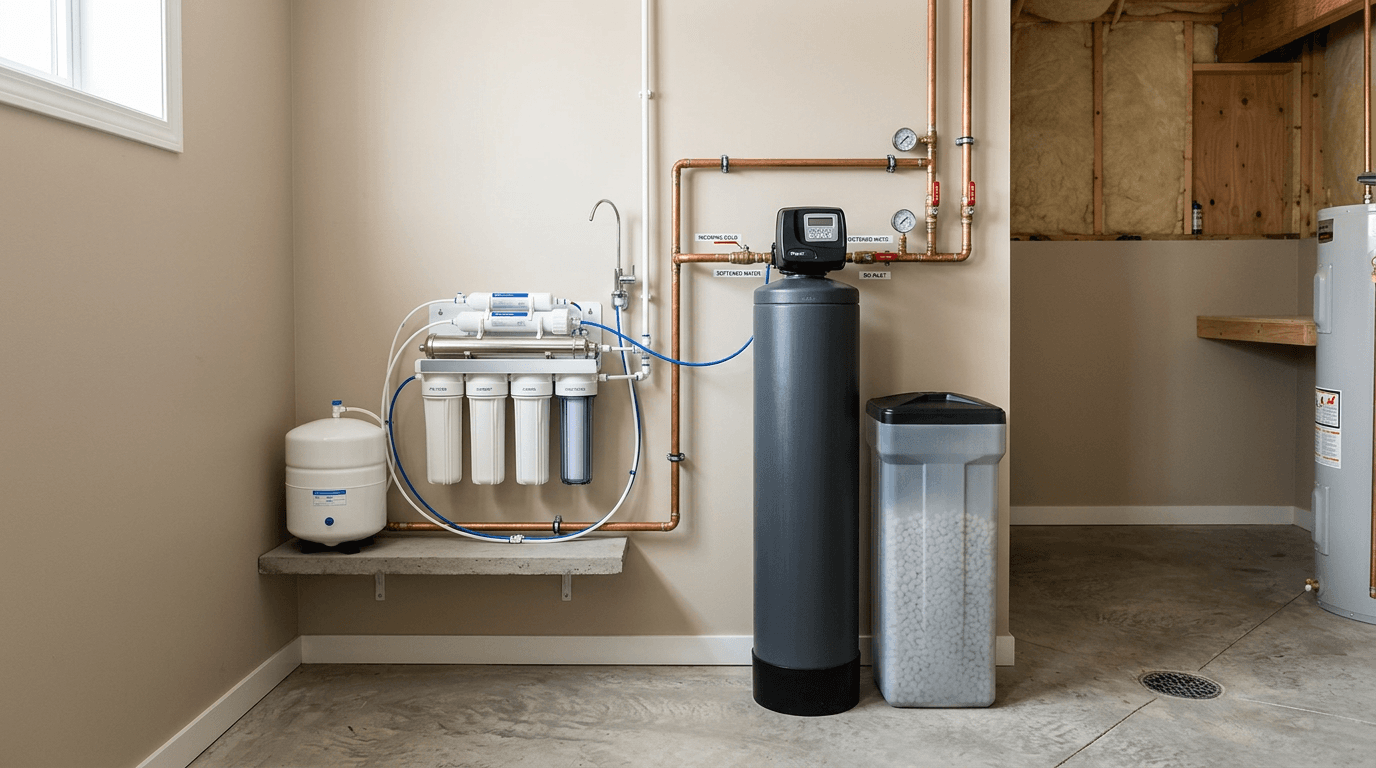
However, this extreme level of filtration demands specific pre-treatment. Hard water severely degrades sensitive RO membranes. Calcium and magnesium ions precipitate onto the semi-permeable materials, causing irreversible scale buildup that chokes the flow. To prevent this, whole-home water softeners are deployed ahead of the drinking water system. For residents managing the heavily mineralized municipal water in Edmonton, Beaumont, Leduc, and Sherwood Park, pairing these two systems is the standard engineering approach.
The Triton Pure and Triton Pure Tankless packages integrate whole-home softening with localized reverse osmosis. The softener unit first exchanges the hard minerals out of the main supply. This softened water then feeds the under-sink RO manifold, allowing the delicate reverse osmosis membrane to operate efficiently for years without scaling. Homeowners secure highly purified drinking water at the kitchen tap while simultaneously protecting their plumbing infrastructure and appliances from calcium damage.
Comparison Table: Matching membrane types to contamination risks
| Purification Method | Primary Mechanism | Target Contaminants | Critical Limitation |
|---|---|---|---|
| Chemical Tablets | Halogen oxidation | Bacteria, viruses | Ineffective on sediment, heavy metals, and slow in cold water |
| Ceramic Pump Filter | Physical depth filtration (0.2 micron) | Bacteria, protozoa, suspended silt | Slow flow rate, requires manual scrubbing, ignores dissolved chemicals |
| Hollow-Fiber Gravity | Physical surface filtration (0.1 micron) | Bacteria, protozoa | Prone to permanent fouling from sticky clay, requires vigorous backflushing |
| Reverse Osmosis (RO) | Semi-permeable cross-flow (0.0001 micron) | Dissolved metals, salts, fluoride, bacteria | Requires household water pressure and specific pre-treatment for hard minerals |
Why seasonal turbidity alters filtration requirements
The efficiency of any filtration system is entirely dependent on the raw water profile entering it. Water supplies drawn from major surface sources, such as the North Saskatchewan River, undergo massive turbidity spikes during the spring thaw and heavy rainfall events. This raw water profile, which dictates the Edmonton municipal water hardness and quality guidelines, forces city treatment plants to heavily adjust their chemical dosing throughout the year.
During high-turbidity events, treatment facilities increase the use of chloramines - a stable compound of chlorine and ammonia - to ensure disinfection persists throughout the vast distribution network. While effective for sanitation, chloramines are notoriously difficult to remove at the tap. Standard carbon block filters that easily trap free chlorine are quickly exhausted by chloramines, requiring specialized catalytic carbon media to break the chemical bond.
This seasonal shift heavily impacts suburban networks as well. When designing water softening solutions in Leduc, technicians must account for both the steady base hardness of the water and the seasonal spikes in sediment that bypass aging municipal infrastructure. If fine sediment reaches a softener's resin bed, it coats the microscopic beads, drastically reducing their ability to pull calcium out of the water.
Similarly, maintaining water softener installations in Beaumont requires dedicated sediment pre-filtration. A 5-micron spun-polypropylene pre-filter acts as the sacrificial barrier, catching the physical silt before it can foul the softening resin or reach the delicate reverse osmosis membrane downstream. Without this layered approach, the varying seasonal quality of surface water will eventually overwhelm any single-stage treatment.
Practical rule: Always match your pre-filtration micron rating to the specific flow requirements of your main system; a pre-filter that is too tight will cause a severe pressure drop, starving an RO system of the driving force it needs to function.
FAQ
How long do purification chemicals take to work?
Standard chlorine dioxide or iodine treatments typically require 15 to 30 minutes at room temperature to neutralize common bacteria. However, eliminating hard-shelled protozoa like Cryptosporidium in cold water can demand up to four hours of continuous contact time.
Can a portable microfilter remove heavy metals?
No. Portable microfilters utilize absolute pore sizes around 0.1 to 0.2 microns, which successfully block physical bacteria and sediment. Dissolved heavy metals, like lead or copper, exist at the molecular level and pass straight through standard microfiltration membranes.
What pore size is required for reliable bacteria removal?
To physically exclude bacteria from a water supply, a filter membrane must feature an absolute pore rating of 0.2 microns or smaller. Viruses are much smaller and require either chemical treatment, ultraviolet light, or reverse osmosis for physical removal.
Does reverse osmosis remove natural minerals from the water?
Yes. Because a reverse osmosis membrane filters down to 0.0001 microns, it strips virtually all dissolved solids from the water, including natural calcium and magnesium. This results in highly purified, blank-slate drinking water.
How often should reverse osmosis membranes be replaced?
With proper pre-treatment - specifically feeding the system softened water to prevent calcium scaling - a quality residential RO membrane typically lasts between three and five years. The carbon and sediment pre-filters protecting the membrane should be swapped annually.