Choosing Between Home Water Purification Systems: A 2026 Guide
You open the dishwasher to find a persistent chalky white crust coating the heating element and dulling the glassware, and filling a glass at the kitchen tap releases the distinct, sharp odour of a public swimming pool. These are not signs of broken appliances; they are the physical realities of running untreated municipal water through a modern residential plumbing system. Deciding which water purification systems actually resolve these distinct issues requires looking past marketing claims to understand the underlying chemistry of your municipal supply.
Quick Summary
Water purification in residential plumbing separates into whole-home physical filtration, ion exchange softening, and point-of-use membrane purification. Matching the correct equipment to specific municipal water chemistry prevents premature appliance failure, eliminates aesthetic water issues, and protects the lifespan of the treatment equipment itself.
- Whole-home carbon filtration intercepts chlorine before it can degrade indoor air quality and skin health.
- Ion exchange softening is mandatory for hard water environments to prevent irreversible scaling on pipes and water heaters.
- Point-of-use reverse osmosis provides targeted reduction of dissolved solids for drinking water.
- Combining these methods prevents hard water from destroying sensitive filtration membranes.
- Relying on a single standalone filter for complex municipal water issues usually results in rapid media exhaustion.
Table of Contents
- Why municipal chemistry dictates home treatment needs
- How whole-home carbon filtration neutralizes chemical additives
- When point-of-use reverse osmosis becomes necessary
- Why standalone types of water filtration systems fail in hard water
- Combining treatments with Triton Pure and Triton Pure Tankless
- Assessing failure modes in home water systems
- Comparison table of residential filtration technologies
- FAQ
- Recommended Reads
Why municipal chemistry dictates home treatment needs
The first step in any large-scale water treatment process is ensuring the supply is biologically safe as it travels through miles of underground infrastructure. For communities drawing from the North Saskatchewan River - including Edmonton, Beaumont, Leduc, and Sherwood Park - this involves deliberate chemical dosing. Municipal facilities add chlorine or chloramines to disinfect the water and protect public health.
However, once that water reaches your property line, those chemical additives have finished their job. Left untreated inside the home, chlorine attacks rubber seals in plumbing fixtures, dries out human skin and hair, and creates unpleasant tastes and odours. Simultaneously, the natural geology of the river basin dictates the physical makeup of the water. The Edmonton capital region deals with an average hardness of 165 mg/L, or roughly 9.6 grains per gallon. This hardness consists of dissolved calcium and magnesium.
Understanding this baseline is critical because treating chemical additives requires an entirely different mechanical approach than treating dissolved rock. Installing a carbon filter will do absolutely nothing to stop scale buildup, and a standard water softener will not remove the smell of chlorine. You must separate the aesthetic and chemical issues from the hard mineral issues to build a functional system.
How whole-home carbon filtration neutralizes chemical additives
To strip chlorine and its byproducts from the water supply before they enter the showerheads and appliances, residential systems rely on activated carbon. This is a highly porous media that works through adsorption. As water flows through the carbon bed, the chemical molecules are attracted to and trapped within the microscopic pores of the carbon surface.
There are two primary ways activated carbon is deployed. The first is through a point-of-entry backwashing carbon tank, which looks identical to a water softener but contains granular activated carbon (GAC) or catalytic carbon. A backwashing tank regularly fluffs the media, preventing the water from carving permanent channels through the carbon bed and bypassing the treatment.
The second method relies on cartridge-based carbon block filters. These force water through a solid block of compressed carbon. While highly effective at chemical reduction, large home setups relying purely on carbon blocks often suffer from pressure drops as the block becomes loaded with sediment.
Practical rule: If you live in a municipality that has switched from standard chlorine to chloramines for disinfection, standard GAC media will exhaust rapidly. You must verify that the whole-home carbon unit uses catalytic carbon, which has the specific surface reactivity required to break the ammonia-chlorine bond in chloramines.
Matching the correct carbon media to the local water chemistry ensures that you are not replacing exhausted filter cartridges every three months. You can read more about how local mineral profiles impact these choices in the Edmonton Water Hardness & Quality Guide | Water Triton.
When point-of-use reverse osmosis becomes necessary
While whole-home carbon improves the aesthetic quality and feel of the water, it does not physically remove dissolved inorganic solids. If you want bottled-water-calibre drinking water at the kitchen sink, a dedicated water purifier operating on the principle of reverse osmosis (RO) is the standard.

Reverse osmosis works by forcing municipal water through a semi-permeable membrane with pores as small as 0.0001 microns. This pressure-driven process separates the feed water into two streams: the permeate (the highly purified drinking water that goes to your faucet) and the reject water (the brine carrying the dissolved solids down the drain).
An RO membrane successfully rejects heavy metals, fluoride, lead, and total dissolved solids (TDS) that slip straight through standard carbon filters. Because the process is relatively slow - often producing water drop by drop - these systems typically include a small pressurized storage tank to hold the clean water until you open the dedicated faucet. For those analyzing the mechanics of an installation under the sink, the Reverse Osmosis System Installation Edmonton | Water Triton page outlines the physical space requirements and drainage connections needed.
Why standalone types of water filtration systems fail in hard water
A frequent mistake homeowners make is attempting to install advanced filtration equipment without first addressing the 165 mg/L hardness baseline. When you push hard water through various types of water filtration systems, the dissolved calcium and magnesium precipitate out of the water as solid scale.
If you feed hard water directly into an under-sink reverse osmosis system, the microscopic pores of the thin-film composite membrane will rapidly calcify. The system will stop producing water entirely, forcing a costly membrane replacement far ahead of its intended lifespan.
Similarly, hard water drastically reduces the efficiency of whole-home carbon tanks. The calcium coats the porous surface of the carbon granules, physically blocking the chlorine from reaching the adsorption sites. The water may test free of hardness (if it is not being softened), but the chlorine smell will return quickly because the carbon media has been blinded by scale. Filtration and purification must be preceded by mechanical softening in hard water zones.
Combining treatments with Triton Pure and Triton Pure Tankless
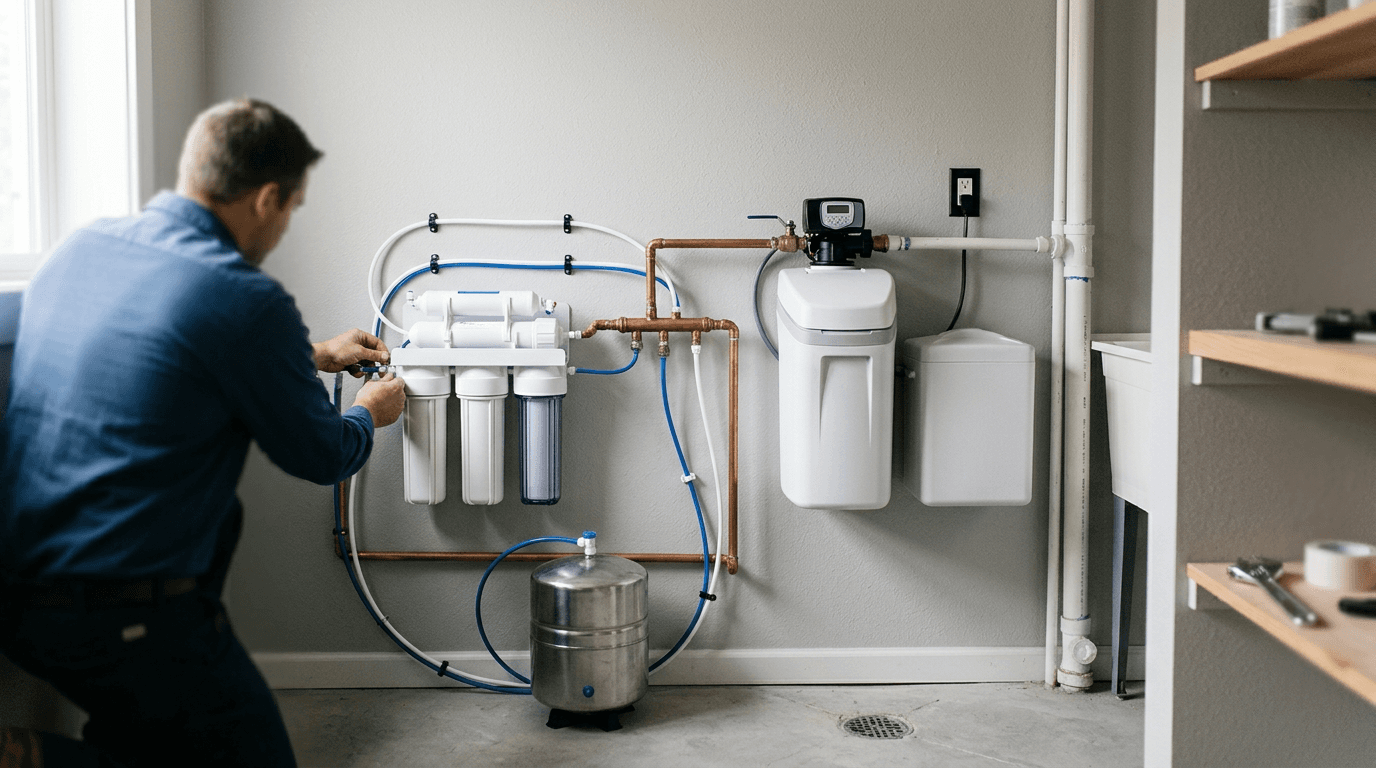
To address both the hard minerals and the chemical treatment byproducts simultaneously, the most stable residential approach is a combined sequence. Water entering the home first passes through a robust whole-home treatment phase, followed by targeted point-of-use purification for drinking.
The Triton Pure and Triton Pure Tankless packages are engineered exactly for this sequencing. The initial stage utilizes a dedicated ion exchange water softening tank to swap scale-causing calcium and magnesium for harmless sodium ions. By softening the water immediately at the point of entry, all subsequent plumbing, appliances, and delicate filtration membranes are protected from calcification.
Once the water is softened, it feeds into the reverse osmosis stage at the kitchen sink. The distinction between the two packages lies in how the purified water is delivered. A traditional RO setup uses a pressurized storage tank, which takes up space under the counter. The Triton Pure Tankless package relies on a high-flow internal pump to push water through a massive RO membrane on demand, eliminating the need for a storage tank and freeing up valuable cabinet space. Sizing the right combination depends heavily on household flow rates, which factors into the overall Water Softener Cost in Edmonton (2026 Prices) | Water Triton.
Assessing failure modes in home water systems
Even robust home water systems experience predictable failure modes if maintenance schedules are ignored or if municipal chemistry changes abruptly. Diagnosing these failures early prevents damage from cascading down the line.
Resin bead oxidation
Water softeners rely on millions of microscopic, negatively charged polystyrene resin beads to capture hard minerals. However, these beads are highly susceptible to oxidation from municipal chlorine. Over time, high chlorine levels break down the cross-linking structure of the resin. The beads turn to mush, severely dropping the water pressure in the home and allowing hard water to pass through. If you notice a sudden, severe drop in whole-home water pressure and a return of hard water scale, the resin bed has likely failed due to chlorine exposure.
Membrane fouling
In a reverse osmosis system, the pre-filters (usually a sediment filter and a carbon block) are designed to protect the delicate RO membrane. If you fail to change these pre-filters annually, chlorine will reach the thin-film composite membrane and literally burn holes in it.
Practical rule: If your reverse osmosis system is filling its storage tank significantly faster than it used to, or if the water suddenly tastes identical to tap water, your membrane has been breached by chlorine. You must replace the membrane and immediately change the pre-filters that failed to protect it.
Carbon bed channeling
In whole-home carbon tanks that lack an automatic backwash valve, water will eventually carve the path of least resistance through the carbon granules. This is known as channeling. The water flows through these carved tunnels so quickly that it never makes contact with the carbon, rendering the system useless. This is common in older, upflow-only carbon tanks in growing communities where fluctuating municipal pressures strain the equipment. Recognizing these limits is vital for homeowners relying on a Water Softener Beaumont, AB | Water Triton or similar regional installations where municipal water characteristics shift seasonally.
Comparison table of residential filtration technologies
| Technology | Primary Target | Household Placement | Maintenance Interval | Hard Water Tolerance |
|---|---|---|---|---|
| Ion Exchange Softener | Calcium, Magnesium | Point-of-Entry (Whole Home) | Add salt monthly, resin lasts 10-15 years | High (Designed for it) |
| Catalytic Carbon Tank | Chlorine, Chloramines | Point-of-Entry (Whole Home) | Replace media every 5-7 years | Low (Media blinds with scale) |
| Reverse Osmosis (RO) | Dissolved Solids, Heavy Metals | Point-of-Use (Under Sink) | Pre-filters annually, membrane 3-5 years | Very Low (Requires pre-softened water) |
| Carbon Block Filter | Chlorine Taste/Odour | Point-of-Use (Under Sink) | Replace cartridge every 6-12 months | Low (Subject to scaling) |
FAQ
Why does my softened water feel slippery?
Softened water removes the calcium and magnesium that normally react with soap to form a sticky curd on your skin. What you are feeling is your body's natural oils and the soap itself, which now lathers properly and rinses cleanly without leaving a layer of mineral friction behind.
Can a whole-home filter make my water safe to drink during a boil water advisory?
No. Standard carbon filters and water softeners do not remove biological pathogens like bacteria or viruses. During a boil water advisory, only systems equipped with specific ultraviolet (UV) sterilization or certain absolute-micron purification membranes can ensure biological safety.
Does reverse osmosis remove beneficial minerals from the water?
Yes, the reverse osmosis process is indiscriminate and removes nearly all dissolved solids, including trace amounts of calcium and magnesium. However, humans receive the vast majority of their required dietary minerals from food, not from drinking water.
How loud is a tankless reverse osmosis system?
Tankless RO systems contain a high-pressure electric booster pump to force water through the membrane on demand. When the faucet is running, you will hear a distinct hum from beneath the sink, comparable to the sound of a modern dishwasher operating.
Why is my water pressure dropping after installing a whole-home system?
Pressure drops are usually caused by exhausted cartridge filters that have filled with municipal sediment, or by undersized equipment that cannot handle your home's peak flow rate. Plumbed-in equipment must be sized to match the maximum gallons-per-minute demand of your household fixtures.