How a High Efficiency Water Softener Changes the Math on Hard Water
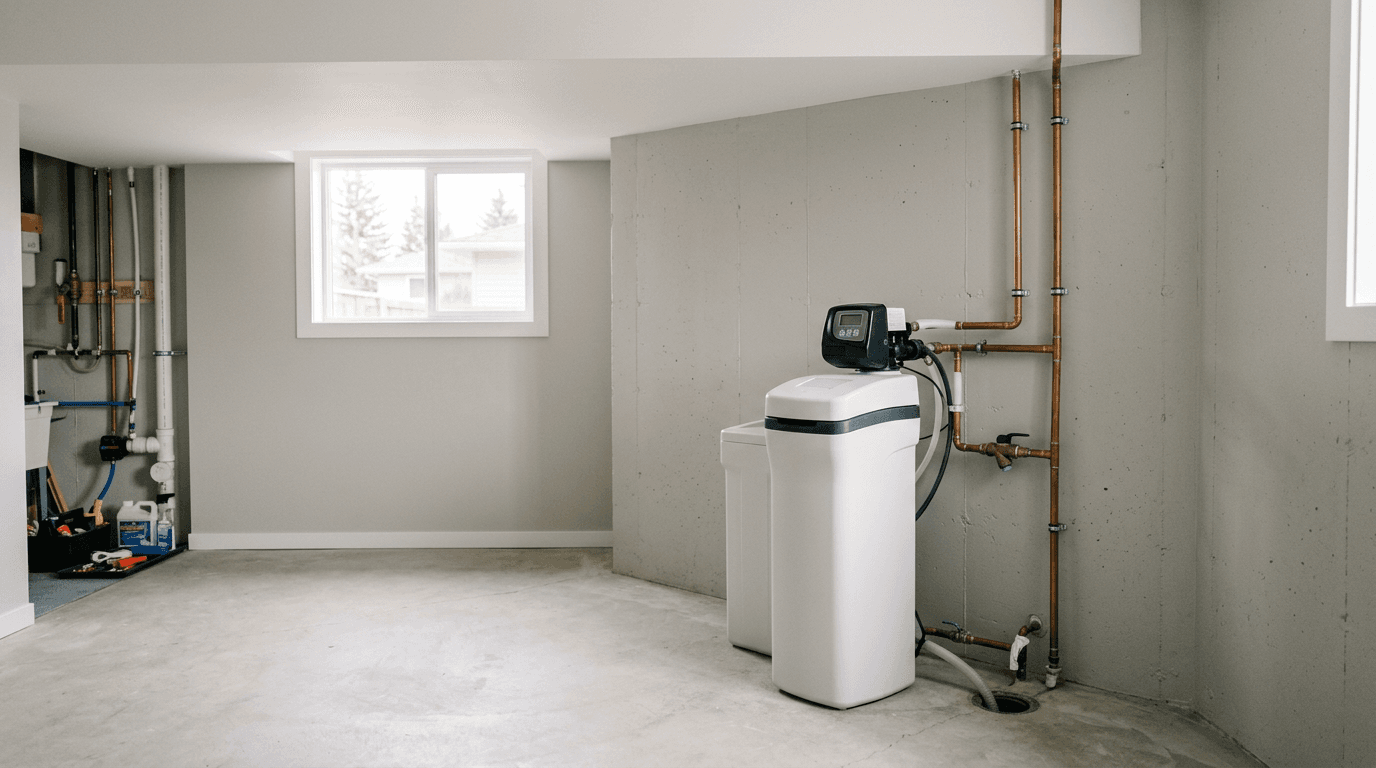
A homeowner inspecting their brine tank often assumes that pouring in fewer bags of salt means they bought an efficient system. In reality, a tank that sits full of dry salt while the house continues to build white scale on the fixtures and appliances is failing, not saving money. Upgrading to a high efficiency water softener shifts the focus from simply restricting salt consumption to calculating exactly how much resin capacity has been exhausted, ensuring the system only regenerates when mechanically necessary.
Quick Summary
A high-efficiency softening system uses digital metering, proportional brining, and advanced flow dynamics to minimize the salt and water required to remove hardness minerals. Rather than operating on a fixed timer, these systems measure exact household consumption to eliminate waste.
- Digital turbine meters track exact water flow to trigger regeneration only when capacity is depleted.
- Upflow brining targets the least exhausted resin first, reducing the total sodium required per cycle.
- Dynamic reserve calculations adapt to your daily usage, preventing the premature flushing of usable resin.
- Paired filtration protects the resin bed from chlorine degradation, maintaining efficiency over the system's lifespan.
Table of Contents
- Why the typical high efficiency water softener targets salt before water
- What triggers water softener regeneration dictates your monthly costs
- Dialing in water softener settings stops the invisible waste
- A water softener not using salt usually points to a mechanical failure
- How modern residential water softeners measure up
- Why a water softener system with salt requires paired filtration
- FAQ
- Recommended Reads
Why the typical high efficiency water softener targets salt before water
Water softening relies on a mechanical process called ion exchange. Inside the primary tank sits a bed of negatively charged resin beads, which are initially coated with positively charged sodium ions. When hard water flows into the tank, calcium and magnesium ions - which carry a stronger positive charge than sodium - pull themselves onto the resin beads, displacing the sodium into the water supply. Over time, the entire resin bed becomes saturated with hardness minerals and loses its ability to soften the water.
Efficiency is defined by how the system handles this saturation point. Older technology flushed the entire bed with heavy doses of salt on a fixed schedule, regardless of whether the household actually used enough water to deplete the resin. This brute-force approach guarantees soft water but wastes massive amounts of salt and rinse water. Modern designs focus entirely on the ratio of salt used to grains of hardness removed, aiming to strip the maximum amount of calcium off the resin with the absolute minimum amount of sodium.
This distinction is critical when dealing with specific municipal water profiles. By understanding the local Edmonton water hardness profile, which averages 165 mg/L (approximately 9.6 grains per gallon), the mechanical demands on a softening system become clear. Treating that specific concentration of calcium requires precise brine control. High-efficiency units achieve this through a process called proportional brining. Instead of mixing a full tank of brine for every cycle, the system calculates the exact percentage of the resin bed that was exhausted and creates only enough brine to treat that specific portion.
What triggers water softener regeneration dictates your monthly costs
The mechanism that tells the system when to clean itself is the dividing line between standard and high-efficiency hardware. The traditional approach uses a time-clock valve, which initiates water softener regeneration based on a simple calendar wheel - typically every three or four days. If you leave town for the weekend, a time-clock system will still regenerate on its scheduled night, wasting salt and hundreds of litres of water to clean a resin bed that is already pristine.

Modern systems replace the mechanical clock with a digital turbine meter housed inside the control valve. This meter spins as water flows into the house, tracking consumption down to the litre. The control head calculates the total capacity of the resin bed based on the programmed water hardness and counts down precisely as water is used. When the capacity nears zero, the system queues a regeneration cycle for the middle of the night.
Practical rule: Never size a system to regenerate more frequently than every three days; the mechanical wear on the control valve and the sheer volume of rinse water required will erase any savings from a smaller resin tank.
This metered approach introduces a variable called reserve capacity. Because the system delays regeneration until 2:00 AM to avoid interrupting household water use, it needs a buffer of soft water to get you through the evening. Standard metered systems use a fixed reserve - setting aside a large portion of the tank's total volume - meaning they flush perfectly good resin every cycle. High-efficiency algorithms calculate a dynamic reserve based on a rolling average of your actual daily usage. If your household consumption drops, the system shrinks the reserve automatically, stretching the time between cycles and cutting the long-term operational expense associated with installing a properly sized water softening unit.
Dialing in water softener settings stops the invisible waste
The hardware alone does not guarantee efficiency; the programming dictates the performance. When an installer sets up a new system, they must input the incoming hardness, the iron concentration, and the desired salt dose. These water softener settings determine the operational curve of the resin bed, and getting them wrong results in thousands of litres of wasted water annually.
The relationship between salt dosage and resin capacity is not linear. If a cubic foot of resin is regenerated with 15 pounds of salt, it might yield 30,000 grains of capacity. However, regenerating that same cubic foot of resin with only 6 pounds of salt might yield 20,000 grains of capacity. While the higher salt dose provides more total capacity, the lower salt dose is vastly more efficient per pound of salt used. Programming a system to operate on this high-efficiency curve means the unit will regenerate slightly more often, but it will consume significantly less salt over the course of a year.
Installers must also configure the backwash and rinse durations. The backwash phase reverses the flow of water to lift and separate the resin beads, flushing out trapped sediment. If this phase is programmed to run for ten minutes when the local water supply is relatively clear of particulates, the system is dumping clean water down the drain. Tuning these cycle times to the specific sediment load of the municipal supply prevents invisible waste and heavily influences the overall analyzing long-term water softener costs.
A water softener not using salt usually points to a mechanical failure
Homeowners are often thrilled to check their brine tank after six months and find it still completely full, assuming their new digital system is simply performing flawlessly. However, a water softener not using salt is rarely a sign of exceptional efficiency; it is almost always the primary symptom of a mechanical failure. If the system is counting down gallons and cycling water but the salt level never drops, the ion exchange process has ceased, and hard water is passing untreated into the home.
The most common cause of this failure is a salt bridge. Mechanical rooms are frequently humid environments. When lower-tier rock salt or pellets containing heavy binding agents are loaded to the top of the tank, the moisture causes the salt chunks to fuse together. As the water at the bottom of the tank dissolves the salt underneath, a hollow cavern forms. The system attempts to draw brine, but it only pulls fresh water because the solid crust of salt is suspended above the water line.
Practical rule: Keep the brine tank only half full if you live in a humid environment or have a low water consumption rate, as letting salt sit for months promotes the solid blockages that prevent brine draw.
The second major failure point is the injector venturi. This is a microscopic nozzle inside the control valve that relies on the Venturi effect to create a vacuum, which in turn sucks the brine solution out of the tank and into the resin bed. Because the nozzle aperture is incredibly small, a single speck of dirt from the municipal lines or sediment from cheap salt can plug it entirely. When the injector is blocked, the system will execute its entire regeneration sequence without pulling a single drop of brine, leaving the resin bed completely exhausted.
How modern residential water softeners measure up
Understanding the differences in system architecture clarifies why certain models achieve higher efficiency ratings. The primary distinction among residential water softeners lies in how they drive the brine solution through the resin bed during the regeneration cycle.
Standard systems use downflow brining. In this configuration, the heavy salt solution is pushed into the top of the resin tank and flows downward. The problem with this approach is that the resin at the top of the tank is the most exhausted, as it takes the initial hit from the incoming hard water. The brine loses its driving force as it strips the heavy calcium from the top layer, meaning the resin at the bottom of the tank receives a severely diluted brine solution. Since the bottom layer dictates the final softness of the water leaving the tank, a downflow system requires a heavy, wasteful salt dose to ensure the bottom beads are adequately cleaned.
High-efficiency systems utilize upflow brining. The brine is injected into the bottom of the tank, pushing upward through the least exhausted resin first. This polishes the bottom layer to a pristine state using the strongest concentration of brine, before carrying the displaced hardness up and out the drain.
Efficiency Comparison
| System Architecture | Regeneration Trigger | Brine Flow Direction | Typical Salt Efficiency (Grains / lb) |
|---|---|---|---|
| Time-Clock Standard | Fixed Day Schedule | Downflow (Top to Bottom) | 2,000 - 2,500 |
| Metered Standard | Gallons Consumed | Downflow (Top to Bottom) | 3,000 - 3,500 |
| High Efficiency Upflow | Dynamic Reserve Algorithm | Upflow (Bottom to Top) | 4,000+ |
Why a water softener system with salt requires paired filtration
Focusing solely on the mechanics of hardness removal ignores the chemical realities of municipal water supplies. A water softener system with salt is engineered specifically to handle calcium and magnesium, but it is highly vulnerable to the oxidizing agents used for city water disinfection. Chlorine and chloramines aggressively attack the divinylbenzene cross-linkages that hold the microscopic resin beads together.
Over several years of exposure to municipal chlorine, these structural bonds break down. The once-rigid resin beads swell, turn porous, and eventually fracture into a highly restrictive mush. This degradation causes severe water pressure drops throughout the house and destroys the efficiency curve of the system, as the fractured resin can no longer hold a proper sodium charge. To protect the investment and maintain the programmed efficiency, the chlorine must be removed before the water reaches the softening resin.
This operational requirement drives the necessity of combined treatment frameworks. By placing a whole-home carbon filtration tank ahead of the softener, the resin bed is shielded from oxidation, effectively doubling its functional lifespan. For homeowners requiring comprehensive solutions across the service areas of Edmonton, Beaumont, Leduc, and Sherwood Park, packages like the Triton Pure and Triton Pure Tankless systems integrate this necessary pre-filtration alongside high-efficiency softening. Furthermore, because softening does not remove dissolved solids or improve drinking water taste, integrating an under-sink reverse osmosis system provides the final purification step for kitchen taps, ensuring the heavy lifting of hardness removal is handled in the mechanical room while dedicated drinking water quality is managed at the point of use. Addressing both the chemical and physical characteristics of the local water supply guarantees the equipment operates exactly as designed, stopping the silent waste that older systems force homeowners to accept.
FAQ
What is proportional brining in a high-efficiency system?
Proportional brining is a digital calculation where the control valve determines exactly how much of the resin bed's capacity was exhausted since the last cycle. Instead of mixing a full tank of brine, it creates only the exact volume of salt solution required to regenerate that specific depleted percentage, drastically reducing salt waste.
Why does my new softener regenerate at 2:00 AM?
Regeneration cycles require significant water pressure and bypass the softening tank while active. Systems are programmed for 2:00 AM by default because household water consumption is typically at its lowest, preventing hard water from being drawn into the plumbing or water heater during the 90-minute cleaning cycle.
Can I use potassium chloride instead of sodium chloride?
Yes, potassium chloride can be used as a regenerant for those looking to eliminate sodium entirely from the ion exchange process. However, potassium is less efficient mechanically, meaning you must program the system to use a noticeably larger amount of regenerant per cycle to achieve the same softening capacity.
How often should the brine tank be cleaned?
If you use high-purity evaporated salt pellets, the tank only requires cleaning every three to four years. If you use cheaper rock salt or solar salt, insoluble dirt and binders will accumulate at the bottom, requiring an annual cleaning to prevent the injector venturi from clogging.