How Does a Reverse Osmosis Water Filter Work?
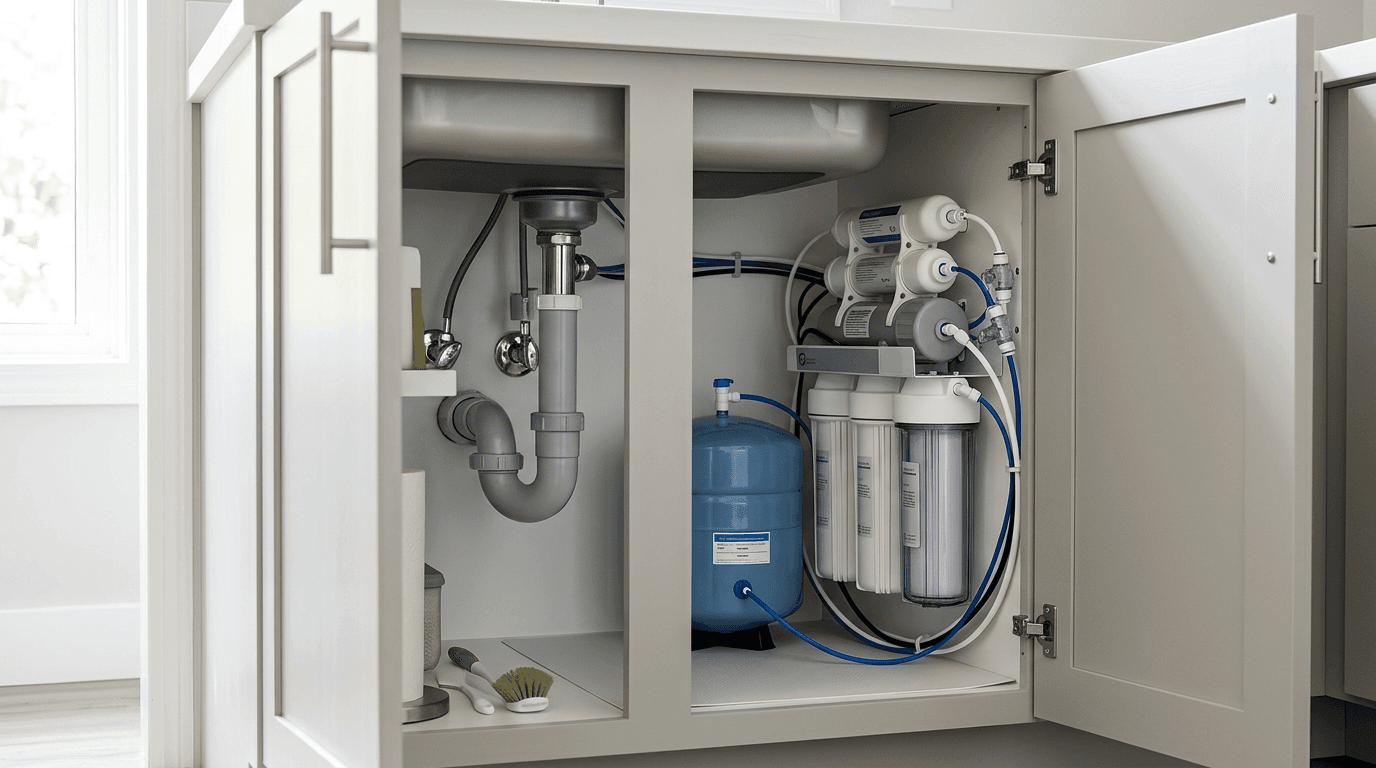
Most homeowners assume their tap water is entirely clean just because it looks clear as it fills a glass. The reality only becomes apparent when hard white scale crusts the base of the kettle, or when a sudden chlorine smell makes your morning coffee taste distinctly metallic. The municipal water system delivers treated water, but treating water for safe city-wide transit is not the same as purifying it for consumption. To understand how to achieve truly clean drinking water, you have to look at the mechanics of residential filtration. If you have ever wondered how does a reverse osmosis water filter work, the answer lies in applying high pressure against a microscopic barrier to force impurities behind. Understanding how reverse osmosis works changes how you evaluate the plumbing in your home, shifting the focus from simply moving water to actively stripping it of dissolved solids, heavy metals, and chemical additives.
Quick Summary
A reverse osmosis system uses household water pressure to push tap water through a semi-permeable membrane that captures microscopic impurities. By forcing water against its natural flow, the system separates pure water from dissolved solids, flushing the contaminants down the drain.
- Pre-filters capture larger sediment and chlorine before they can damage the delicate membrane.
- The membrane itself filters out dissolved contaminants down to 0.0001 microns.
- A pressurized storage tank holds the purified water until a dedicated faucet is opened.
- Post-filters provide a final polish, ensuring the water tastes fresh and clean.
Table of Contents
- The Natural Mechanism: How Does Osmosis Work?
- Step-by-Step: The Stages of Purification
- What Exactly Does Reverse Osmosis Do to Water?
- Integrating Whole-Home Solutions
- Common Pitfalls & Troubleshooting
- FAQ
- Recommended Reads
The Natural Mechanism: How Does Osmosis Work?
Before exploring the filtration equipment under your sink, it is necessary to establish how does osmosis work in the natural world. Osmosis is a passive biological and chemical process where a solvent, like water, naturally moves across a semi-permeable membrane. It flows from an area of low solute concentration to an area of high solute concentration. In plant roots or human cells, this equalizes the concentration on both sides of the barrier without requiring any external energy. The water simply wants to dilute the heavier concentration of minerals or salts.
Reverse osmosis actively fights this natural tendency. By applying mechanical pressure to the highly concentrated side - your municipal tap water - the system forces the water molecules back through the semi-permeable membrane, leaving the dissolved solids behind. The membrane pores are microscopic, allowing only the water molecules to pass while rejecting heavy metals, fluoride, chlorine byproducts, and sodium. Because this process resists natural osmotic pressure, it requires steady, robust water pressure from your home's plumbing to function efficiently.
Step-by-Step: The Stages of Purification
A standard system is not a single filter but a multi-stage water treatment plant scaled down to fit under a kitchen counter. Understanding each stage reveals why these systems require sequential maintenance.

1. The Sediment Pre-filtration Stage
The journey begins when cold tap water enters the system and hits the sediment pre-filter. This stage acts as a physical net, designed to catch macroscopic debris. In regions with varying infrastructure, municipal water often carries microscopic sand, silt, pipe scale, and rust.
If these larger particles were allowed to reach the reverse osmosis membrane, they would physically tear the delicate material or immediately clog its microscopic pores, rendering the primary filter useless within weeks. The sediment filter typically catches particles down to 5 microns in size. The most common mistake homeowners make here is assuming that municipal water is free of physical debris; they ignore the sediment filter until it becomes so heavily soiled that it drops the water pressure entering the subsequent stages. When feed pressure drops, the entire reverse osmosis process grinds to a halt.
2. The Carbon Filtration Stage
Once the water is free of physical sediment, it moves into the carbon pre-filter block. This stage is chemical rather than purely physical. Activated carbon is highly porous and utilizes a process called adsorption to trap volatile organic compounds (VOCs), chloramines, and chlorine.
Municipalities use chlorine to keep water sanitary as it travels through city pipes, but chlorine is highly destructive to the thin-film composite (TFC) material used in reverse osmosis membranes. Prolonged exposure to chlorinated water will physically burn holes through the membrane, destroying its ability to reject microscopic dissolved solids. The mistake made at this stage is failing to replace the carbon block on schedule. A carbon block does not necessarily look dirty when its adsorption capacity is exhausted; once it stops catching chlorine, the system's core membrane takes irreversible damage. Reading an Edmonton Water Hardness & Quality Guide helps clarify why local chlorine levels make this step so crucial.
3. The Reverse Osmosis Membrane
This is the core of the system. Water, now free of sediment and chlorine, is pushed against the semi-permeable membrane. The pores in this TFC membrane are incredibly small - roughly 0.0001 microns. This is where the actual separation occurs.
As the household water pressure forces the water against the membrane, pure water molecules are squeezed through. The contaminants - ranging from lead and arsenic to sodium and calcium - cannot pass through the microscopic pores. Instead of acting like a sponge that fills up, the membrane acts like a windshield wiper. The rejected contaminants are constantly washed away by a secondary stream of water and flushed down the drain line.
Practical rule: Always check your home's incoming water pressure before installing a system; an RO membrane requires a minimum of 40 PSI, but operates optimally between 60 and 80 PSI, to successfully overcome natural osmotic pressure.
4. Storage and Final Polish
Because forcing water through a 0.0001-micron barrier is a slow, methodical process, the system produces clean water drop by drop. If you had to wait for it in real-time, filling a single glass would take several minutes.
To solve this, traditional systems route the purified water into a pressurized storage tank. Inside the tank is a butyl bladder surrounded by a pocket of pressurized air. As the tank fills, the air compresses, creating the pressure needed to shoot the water up to your faucet when you finally open it. A common failure mode here is a ruptured or depressurized bladder, which leaves the tank full of water but unable to dispense it.
Just before the water reaches your glass, it passes through a final post-carbon filter. Because water sitting in a rubber bladder can sometimes pick up a flat or slightly stale taste, this final polishing filter ensures the water is crisp. For homes tight on space, newer Tankless Reverse Osmosis Edmonton systems use internal booster pumps to push water through highly efficient membranes on demand, eliminating the need for a storage tank entirely.
What Exactly Does Reverse Osmosis Do to Water?
Understanding what does reverse osmosis do to water requires looking at the total dissolved solids (TDS) rating. Tap water carries a payload of invisible minerals, salts, and chemical byproducts. Reverse osmosis acts as a comprehensive stripping mechanism.
It filters out almost all dissolved impurities by forcing water through a semi-permeable membrane. This process removes heavy metals that may leach from aging infrastructure, industrial runoff components, and the naturally occurring calcium and magnesium that make water hard. The result is what is reverse osmosis water: a heavily purified solvent that is remarkably close to pure H2O.
Because it removes almost everything, the resulting water has a noticeably different mouthfeel and taste. It lacks the chalky texture of hard water and the chemical astringency of chlorinated water. Some purists note that it can taste somewhat "flat" because the beneficial minerals have been removed along with the harmful ones. To counter this, many modern systems integrate a remineralization stage just before the faucet, adding trace amounts of calcium and magnesium back into the water strictly for flavor and pH balance.
Integrating Whole-Home Solutions
While an RO system is exceptional at producing drinking water at a single point of use, it is sensitive to extremely hard water. If the incoming water is heavy with calcium and magnesium, these hard minerals can prematurely scale and choke the RO membrane, drastically reducing its lifespan.
In regions with notoriously hard municipal water - such as Edmonton, Beaumont, Leduc, and Sherwood Park - practitioners almost always recommend treating the water before it reaches the drinking water system. Using a dedicated water softener to remove the hardness at the point of entry protects the entire home's plumbing and ensures the RO membrane under the sink only has to deal with trace contaminants rather than heavy mineral scale. Packages like the Triton Pure and Triton Pure Tankless combine a high-efficiency whole-home softener with a dedicated under-sink RO unit, ensuring that the heavy lifting of scale prevention is handled in the utility room, allowing the RO membrane to operate efficiently for years. If you are researching a Water Softener Sherwood Park, AB solution, pairing it with reverse osmosis is the standard for total home water management.
Common Pitfalls & Troubleshooting
Even robust purification systems encounter issues if misunderstood or poorly maintained. These are the most frequent failures that look identical from the outside but require completely different interventions.
Symptom: A drastic drop in water flow at the faucet.
- The false assumption: Most homeowners assume the main membrane is destroyed.
- The real cause: Often, the air charge in the storage tank has depleted. The tank is completely full of water, but there is no internal air pressure to push it up to the faucet.
- The fix: Empty the tank completely, locate the Schrader valve on the tank body, and use a bicycle pump to restore the empty tank pressure to roughly 7 PSI. If it will not hold air, the internal bladder is ruptured, and the tank must be replaced.
Symptom: The system runs constantly, and water continuously flows down the drain.
- The false assumption: The system is just producing a lot of water.
- The real cause: The automatic shut-off (ASO) valve has failed. This mechanical valve is supposed to sense when the storage tank reaches roughly two-thirds of the incoming line pressure and shut off the feed water. When it fails, water bypasses the membrane and dumps straight down the drain indefinitely.
- The fix: Replace the ASO valve. It is a simple, inexpensive plastic block with four tube connections located near the membrane housing.
Symptom: Water has a strange, stale taste after months of perfect performance.
- The false assumption: The municipal water quality has suddenly worsened.
- The real cause: The final polishing filter (post-carbon) has expired, or the pre-filters have bypassed chlorine, which has slowly oxidized the membrane.
- The fix: Start by replacing the small post-carbon inline filter. If the taste persists and a TDS meter shows high dissolved solids in the purified water, the main RO membrane has been compromised and requires replacement. Scheduling a Reverse Osmosis System Installation Edmonton evaluation can determine the exact point of failure.
FAQ
Does a reverse osmosis system waste a lot of water?
It uses water to make water. The process requires a flush stream to wash away the rejected contaminants so the membrane does not immediately clog. Traditional systems send about three to four gallons to the drain for every one gallon of purified water produced. However, because this is only used for drinking and cooking (typically 2-3 gallons a day), the total household impact is negligible compared to showering or flushing toilets.
Will this system remove completely healthy minerals?
Yes. The membrane does not distinguish between a harmful lead molecule and a harmless calcium molecule; it strips both. If you prefer mineralized water for taste, you can easily install an alkaline remineralization cartridge as the final stage to add trace amounts of beneficial calcium back into the water.
How often do I actually need to change the filters?
Pre-filters (sediment and carbon) must be changed every 6 to 12 months. This protects the core membrane. If the pre-filters are maintained strictly, the main reverse osmosis membrane will typically last 2 to 3 years depending on the incoming water hardness.
Can I run the system if my home has low water pressure?
Reverse osmosis relies on pressure to overcome natural osmotic forces. If your home's water pressure is below 40 PSI, the system will barely produce water and will send an excessive amount to the drain. In these cases, you must add an electric booster pump to force the water through the membrane efficiently.