How to choose between a whole house reverse osmosis system and targeted treatment
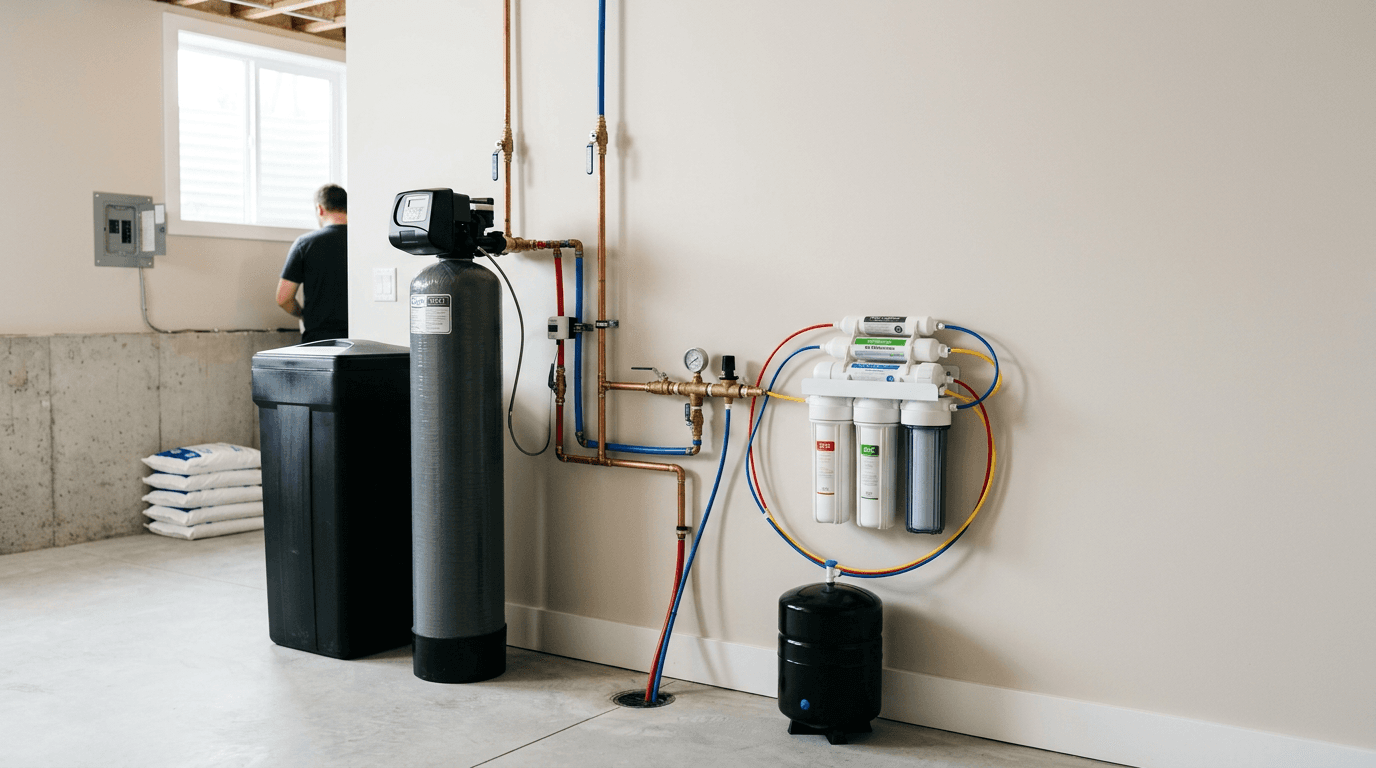
Many homeowners assume that if their tap water scales up the kettle and smells strongly of municipal chlorine, the ultimate fix is installing a whole house reverse osmosis system. The logic seems sound: if reverse osmosis produces the purest drinking water at the sink, applying it to the entire property should solve every water issue at once. But treating the water flushing your toilets to the same microscopic purity as your drinking glass is not just an expensive overkill. On municipal supplies drawn from the North Saskatchewan River, highly purified water becomes aggressively "hungry," actively leaching copper and degrading standard residential plumbing over time. The goal of residential water treatment is not to render every drop sterile; it is to match the water's chemistry to the job it has to do in your home.
Quick Summary
Selecting the right water treatment strategy requires separating what your plumbing requires from what your family drinks. While comprehensive purification sounds appealing, matching specific technologies to their intended applications - like dedicated softening for appliances and targeted filtration for consumption - delivers superior water quality without accelerating pipe corrosion.
- Municipal water hardness demands point-of-entry softening, not full-spectrum purification.
- Reverse osmosis strips necessary minerals, making it ideal for drinking but corrosive to standard copper plumbing if applied property-wide.
- Combining a whole-home softening unit with a targeted under-sink filtration station is the most efficient configuration for municipal homes.
- Rural well water profiles dictate entirely different filtration sequences, often requiring dedicated iron or sulfur removal prior to softening.
Table of Contents
- Why property-wide reverse osmosis aggressively degrades standard plumbing
- Where a dedicated water softening configuration actually protects the property
- How targeted drinking stations beat property-wide purification
- When rural acreage properties demand different filtration rules
- Why combining distinct technologies outperforms single-tank promises
- What you must measure before altering your plumbing
- FAQ
- Recommended Reads
Why property-wide reverse osmosis aggressively degrades standard plumbing
The appeal of a reverse osmosis water filter system whole house setup is based on a misunderstanding of what pure water actually does. Reverse osmosis works by using ambient or boosted hydraulic pressure to force water through a semi-permeable membrane with pores as small as 0.0001 microns. This process strips away essentially everything - minerals, dissolved solids, heavy metals, and chlorine - leaving only pure H2O.
However, water in its purest state is hypotonic. It naturally seeks equilibrium by absorbing minerals from its environment. When you run fully purified water through standard residential plumbing, it acts as a universal solvent. It will actively strip copper from pipes and zinc from brass fittings, leading to pinhole leaks and premature fixture failure. Commercial facilities that require whole house reverse osmosis must plumb their entire buildings with specialized PEX, CPVC, or stainless steel to withstand this aggressive water chemistry.
Beyond pipe corrosion, the mechanical reality of running whole house reverse osmosis is highly inefficient. To keep the microscopic pores of the membrane from blinding (clogging) instantly, the system uses a cross-flow filtration method. A continuous stream of water washes the rejected contaminants down the drain. For every gallon of pure water produced, traditional membranes send three to four gallons to the sewer. When applied to the entire property's water usage - including lawn irrigation, toilet flushing, and laundry - the wastewater footprint and the sheer volume of water required make it economically and environmentally punishing for a residential property.
Where a dedicated water softening configuration actually protects the property
Instead of attempting to purify every drop of water, property protection requires targeting the specific contaminant causing the damage. In the Edmonton capital region, the primary threat to residential plumbing and appliances is hardness. The water drawn from the North Saskatchewan River carries an average of 165 mg/L (approximately 9.6 grains per gallon) of dissolved calcium and magnesium.

Heat accelerates the precipitation of these minerals, meaning your hot water tank, dishwasher heating elements, and shower mixing valves bear the brunt of the damage. A whole house water softener system intercepts this water at the point of entry and uses a process called ion exchange. As the hard water flows over a bed of negatively charged resin beads, the calcium and magnesium ions stick to the resin, exchanging places with sodium ions. The water that enters the home's plumbing network is now "soft." It will not form scale, it allows soaps to lather properly, and it prevents the stiff, abrasive laundry that hard water creates.
Understanding the water softener cost in Edmonton requires looking at appliance lifespans. By removing the scaling minerals at the source, a softener preserves the factory efficiency of water heaters and prevents the premature burnout of washing machines. It addresses the mechanical threat to the home without turning the water into an aggressive, pipe-leaching solvent.
How targeted drinking stations beat property-wide purification
The distinction between working water and drinking water is the most critical concept in residential water treatment. Working water washes clothes, flushes toilets, and scrubs floors; it only needs to be soft and free of sediment. Drinking water goes into your body, your coffee, and your cooking; this is where rigorous purification belongs.
This is why installing a reverse osmosis water filter for house applications directly under the kitchen sink is the industry standard approach. By shrinking the purification footprint down to a point-of-use (POU) system, you achieve bottled-water-quality drinking water exactly where you need it, without the immense waste or corrosive side effects of a whole-property system.
Practical rule: Never treat water beyond the standard required for its final use. Soften the water for the plumbing; purify the water for the glass.
An under-sink setup typically features a multi-stage process: sediment filtration to catch grit, a carbon block to remove chlorine and organic compounds, the reverse osmosis membrane to reject dissolved solids, and a final polishing filter to ensure a clean taste. Because the volume of water required for daily drinking and cooking is minimal - usually a few gallons a day - the wastewater generated by the membrane's cross-flow wash is negligible compared to a whole-home system. Residents looking for a reverse osmosis system installation in Edmonton benefit from this targeted approach, securing pristine drinking water without altering the stable chemistry of the water flowing through their walls.
When rural acreage properties demand different filtration rules
The logic changes entirely once a home leaves the municipal grid. City water is pre-treated; the municipality has already removed heavy sediment, neutralized pathogens with chlorine, and balanced the pH. Well water is raw and highly variable. A homeowner on an acreage cannot simply install a standard softener and expect clean water if their well is drawing heavy metals or sulfur.
In these environments, a whole house well water filter system must be staged sequentially based on the exact contaminants present. If a well draws high levels of ferrous (clear water) iron, sending that water directly into a water softener will permanently foul the ion-exchange resin. The iron coats the beads, blinding them and rendering the softener useless. A dedicated iron filter - often utilizing a mechanism like an air-injection oxidizer (AIO) to precipitate the iron into a solid state before catching it in a specialized media bed - must sit ahead of the softener.
Understanding specific water softener setups in Leduc acreages often reveals configurations that include ultraviolet (UV) purification for bacteria control, heavy-duty iron filtration, and high-capacity softening. While extremely high Total Dissolved Solids (TDS) in a well might occasionally justify a light-commercial whole-house RO system, this is rare, incredibly expensive, and requires a massive holding tank and re-pressurization pumps. For the vast majority of rural properties, sequential filtration targeted at specific well contaminants provides safe, high-quality water without the operational nightmare of property-wide membrane filtration.
Why combining distinct technologies outperforms single-tank promises
The water treatment market is full of "all-in-one" single-tank systems claiming to soften, filter, and purify simultaneously. These mixed-media tanks are structurally flawed. Because different filter media require different backwash rates and have varying lifespans, combining them into one cylinder means that when the carbon exhausts, you have to dump the perfectly good softening resin along with it, or tolerate compromised water.
Properly engineered solutions separate the tasks. Packages like the Triton Pure and Triton Pure Tankless address municipal water by dividing the workload into distinct, optimized stages. The process begins at the point of entry with a dedicated de-chlorination stage - usually a high-capacity catalytic carbon tank. This removes the chlorine taste and smell from every tap and prevents the chlorine from degrading the structural integrity of the softening resin that follows it.
Following the carbon, a dedicated softening tank handles the 165 mg/L hardness, protecting the home's plumbing and preparing the water for the final stage. Because the water is now soft and free of chlorine, it is the perfect feed water for the point-of-use reverse osmosis system under the sink. Hard water will quickly scale an RO membrane, and chlorine will physically eat holes in it. By staging the treatment - carbon, then softening, then RO - each component protects the next, maximizing the lifespan of the equipment and delivering the exact water chemistry needed at every fixture.
What you must measure before altering your plumbing
Water chemistry is strictly localized. What works for a newly built home on city water will fail completely on a decades-old property drawing from a well. You cannot select equipment based on a neighbor's recommendation or an online review; you must measure the physical properties of the water entering your specific mechanical room.
First, test the hardness. A simple drop-count titration test will reveal the exact grains per gallon (gpg) of calcium and magnesium in your water. This number is required to correctly size the resin capacity of a softener and to set the regeneration schedule. Setting a softener blindly leads to either hard water bleed-through (undercapacity) or excessive salt and water waste (overcapacity).
Second, test for total chlorine. Municipalities adjust their chlorine dosing throughout the year, especially during spring runoff. Knowing the baseline chlorine levels dictates the size and type of carbon block required to neutralize it before it hits your skin or your softening resin.
System Comparison: Mechanisms and Applications
| Treatment Approach | Mechanism | Best Application | Primary Failure Mode if Misapplied |
|---|---|---|---|
| Property-Wide RO | High-pressure membrane filtration | Commercial manufacturing | Leaches copper; catastrophic water waste |
| Point-of-Entry Softener | Ion-exchange resin | Municipal hard water (165 mg/L+) | Fouls quickly if fed high-iron well water |
| Point-of-Use RO | Low-pressure targeted membrane | Drinking water at the sink | Membrane scales rapidly if fed hard water |
| Well Water Filtration | Sequential oxidation/filtration | Rural properties off the grid | Mixed media tanks exhaust unevenly |
For residents exploring water softener requirements in Beaumont, the first step is a precise onsite test. Only by establishing a baseline of hardness, chlorine, and dissolved solids can you engineer a sequence of equipment that protects the property without stripping the plumbing.
FAQ
Does a water softener system remove chlorine from municipal water?
No. A standard water softener uses ion-exchange resin designed exclusively to remove calcium, magnesium, and trace amounts of clear-water iron. Removing chlorine requires a dedicated carbon filtration stage, either as a whole-house tank preceding the softener or as a specialized carbon block under the sink.
Is it safe to drink water that has passed through a softener?
Yes, but the taste and sodium content are altered. The ion-exchange process trades hardness minerals for sodium ions. While this added sodium is generally minimal (comparable to a slice of white bread per liter), many people prefer to remove it using a point-of-use reverse osmosis system for their drinking water.
How much water does an under-sink reverse osmosis unit waste?
Traditional standard-efficiency RO membranes have a waste ratio of roughly 3:1 or 4:1, meaning they send three gallons of water down the drain to wash the membrane for every one gallon of pure water produced. High-efficiency membranes or tankless systems can reduce this ratio significantly.
Will installing point-of-entry filtration drop my home's water pressure?
It can, if the equipment is undersized for your home's plumbing diameter. The pressure drop is determined by the size of the internal bypass valve and the flow rate capacity of the resin tank. Properly sizing the system to match the main incoming line ensures pressure remains constant across multiple fixtures.