How to Configure an Iron and Sediment Filter for Well Water
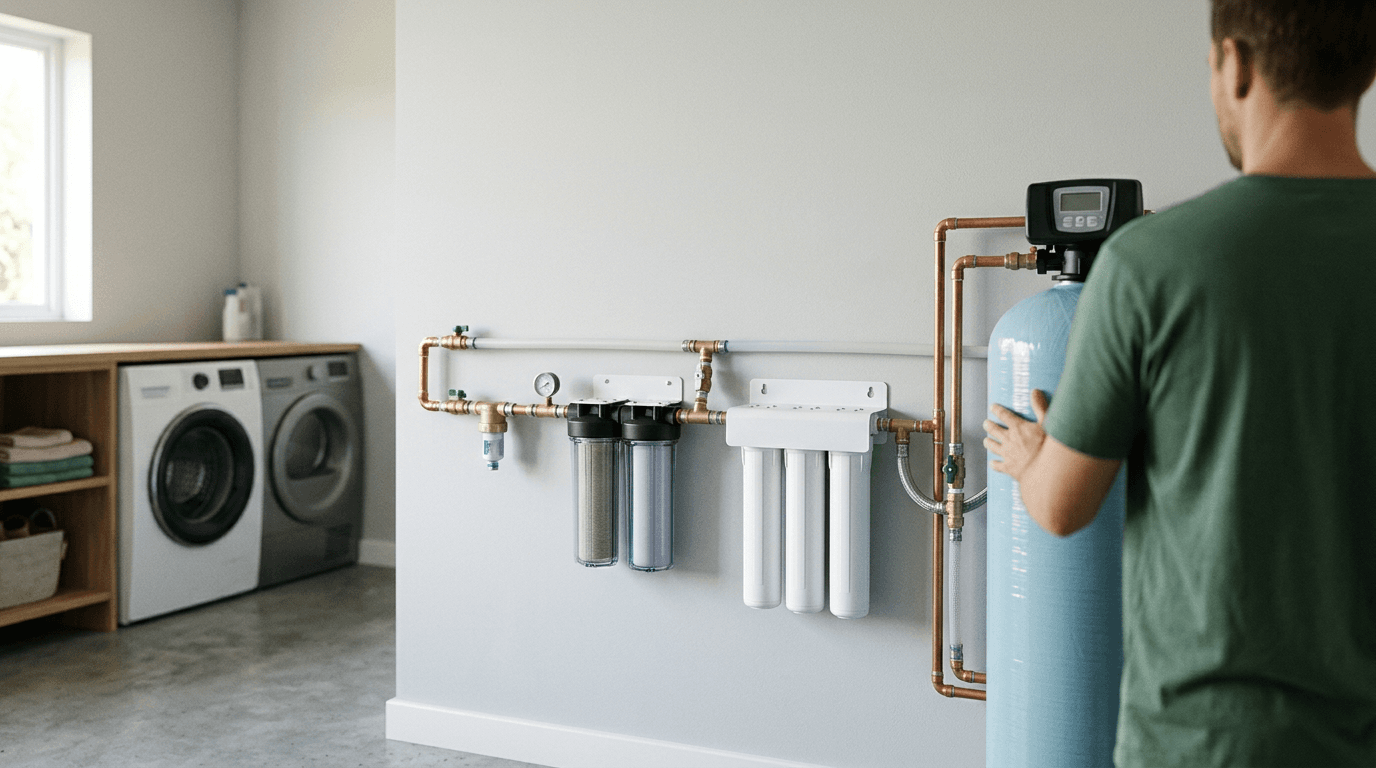
A common misconception is that if your acreage taps into a private well and the water runs red, bolting an oxidizing filter to the main line will instantly clear the supply. The reality is that without mapping the physical particulate load first, that expensive media tank will become a sludge-filled brick within a month. When you are dealing with murky, metallic-tasting water that stains fixtures and ruins laundry, the very first piece of hardware you must accurately size is a sediment filter for well water. Only once the physical dirt is trapped can you successfully strip out dissolved metals and hard minerals without destroying your equipment.
Quick Summary
Setting up a well water treatment system requires staging filtration in the exact order of your water's chemistry. You must sequence physical particulate removal, heavy metal oxidation, and hardness treatment correctly to prevent pressure loss and media fouling.
- Map exact concentrations of ferrous iron, ferric iron, and manganese before purchasing equipment.
- Trap physical sand and silt first using a staged spin-down and pleated cartridge system.
- Use dedicated air-injection oxidation for heavy metals rather than burdening a softening resin.
- Regulate calcium and magnesium last to protect household plumbing and reverse osmosis membranes.
Table of Contents
- 1. Map the Water Chemistry First
- 2. Deploy the Primary Physical Filtration
- 3. Target Dissolved Metals Through Oxidation
- 4. Treat the Remaining Hardness
- 5. Integrate Continuous Disinfection
- Common Pitfalls and Troubleshooting
- FAQ
- Recommended Reads
1. Map the Water Chemistry First
Before you cut a single pipe, you must establish a chemical baseline. Well water changes drastically depending on the depth of the aquifer and seasonal runoff, meaning the generic test strip from a hardware store is entirely insufficient for sizing permanent filtration hardware.
To build a functional treatment chain, draw a raw sample directly from the well pressure tank, bypassing any existing filters. You must measure the pH level, total dissolved solids (TDS), and the exact split between ferrous (clear-water) iron and ferric (red-water) iron. Ferrous iron is completely dissolved and invisible until exposed to oxygen, while ferric iron is already oxidized and floats as rust particles.
The mistake homeowners make at this stage is delaying the test. Taking a sample in a mason jar, leaving it in a warm vehicle for three hours, and then handing it to a lab guarantees inaccurate results. The dissolved oxygen in the jar will convert the ferrous iron to ferric iron while in transit, leading you to purchase equipment for the wrong primary contaminant.
Furthermore, testing must specifically isolate manganese levels. Manganese often presents alongside iron but requires a much higher pH to oxidize effectively. If you miss a high manganese reading, you will install an iron filter that leaves behind black, oily slime in your toilet tanks, eventually forcing you to retrofit a dedicated manganese water filter onto an already crowded plumbing wall. For accurate baselines, consulting an Edmonton Water Hardness & Quality Guide or a local equivalent will show you the regional averages your well is fighting against.
2. Deploy the Primary Physical Filtration
Once you know what is in the water, the first mechanical step is stopping physical debris from blinding the specialized media tanks downstream. Heavy media like Greensand or Katalox Light relies on a highly porous surface area to strip out metals. If you allow well silt to coat that surface, the chemical reaction stops entirely.
To prevent this, you install mechanical filtration immediately after the pressure tank. A standard setup utilizes a two-stage approach. First, a centrifugal spin-down filter drops heavy sand and large grit out of the water column using a vortex motion. Second, a pleated cartridge filter catches the finer silt and clay. Pleated cartridges are superior to melt-blown depth filters for this specific application because they offer significantly more surface area, meaning they maintain household water pressure much longer between filter changes.
Practical rule: Size your initial spin-down filter mesh at 50 microns to catch the heavy, abrasive sand, and let the 20-micron pleated cartridge handle the finer silt downstream.
The common failure mode here is using a standard carbon block as the primary pre-filter. Carbon blocks are incredibly dense, often rated at 5 microns or tighter, and are designed to absorb chemicals, not trap mud. Installing one as your first line of defence against raw well water will plug the block solid within 48 hours, dropping your household pressure to a trickle and forcing an immediate, messy filter change.
3. Target Dissolved Metals Through Oxidation
With the physical dirt removed, the system must force the invisible, dissolved metals out of solution so they can be trapped. This is done through oxidation.
Modern systems typically rely on Air Injection Oxidizing (AIO) technology. An AIO control valve deliberately draws a pocket of ambient air into the top of the media tank during its nightly regeneration cycle. As raw water enters the tank, it sprays through this compressed pocket of oxygen. The oxygen forces the ferrous iron to instantly convert into solid ferric iron rust flakes. The water then pushes down through a bed of catalytic media, which traps the newly formed rust flakes until they are backwashed down the drain.
The critical mistake practitioners see constantly is a failure to calculate the well pump's true flow rate before installing an AIO unit. Heavy catalytic media requires massive upward force to lift, clean, and settle the bed during a backwash. A standard 10-inch iron filter for well water requires at least 5 to 7 gallons per minute of sustained flow to clean itself. If your well pump only delivers 4 GPM, the media will never fully agitate. The trapped iron will cement the bed into a solid block, severely restricting household flow and destroying the tank.
4. Treat the Remaining Hardness
Only after the physical sediment and heavy metals are removed should the water reach a cation exchange resin to treat hardness. Water softeners use negatively charged resin beads to pull positively charged calcium and magnesium ions out of the water, exchanging them for sodium.

Homeowners in Edmonton, Beaumont, Leduc, and Sherwood Park typically deal with regional water chemistry averaging 165 mg/L (approximately 9.6 grains per gallon) of hardness. When combining this baseline hardness with private well runoff, the mineral load becomes aggressive enough to scale hot water tanks and destroy modern appliances rapidly.
The most expensive error made at this stage is purchasing a specialized iron water softener with the intention of skipping the oxidation tank entirely. While relying on a water softener iron removal specification is possible for trace amounts of clear-water iron (typically under 1.0 part per million), it is a disastrous strategy for heavy concentrations. Iron binds to softening resin much more tightly than calcium does. If you send 4.0 ppm of iron into a softener, it will permanently coat the resin beads. The system will lose its ability to soften the water, and you will be forced to replace the entire resin bed long before its typical lifespan ends.
Instead, keep the treatment stages separate. When addressing complex, multi-tiered water problems, installing a combined setup like the Triton Pure or Triton Pure Tankless packages ensures that the heavy metals are fully oxidized in a dedicated tank before the water reaches the softening resin. This protects the softener's lifespan and allows point-of-use reverse osmosis membranes to operate on clean, soft water for the kitchen supply. Understanding exactly what hardware is required for your specific regional mineral load is crucial when reviewing water softener costs in Edmonton.
5. Integrate Continuous Disinfection
When a well tests positive for iron bacteria, coliform, or extreme levels of dissolved metals that air cannot oxidize fast enough, you must move away from ambient air and rely on liquid water treatment chemicals.
This involves installing a chemical feed pump immediately after the pressure tank. The pump injects a precisely measured dose of sodium hypochlorite (chlorine) or hydrogen peroxide into the main water line every time the well pump kicks on. The chemical strips the electrons from the heavy metals and kills biological growth simultaneously.
However, injecting a chemical is useless without retention time. The reaction does not happen instantly. The water must flow into a large, empty retention tank, giving the chemical at least 20 minutes of contact time with the water before it reaches the media filter. The failure mode here is skipping the retention tank to save space in the utility room. If you inject chlorine and immediately send the water to a filter, the unreacted chlorine will destroy the internal components of the control valves and degrade the filtering media, while the unoxidized iron will bleed directly into the house.
Common Pitfalls and Troubleshooting
Even precisely calculated treatment chains require periodic tuning. Because filtration issues often mimic one another, you must isolate the symptom to find the correct failure point. If you are uncertain about navigating complex plumbing bypasses, arranging professional water softener installation in Edmonton ensures the diagnostic valves are positioned correctly from day one.
Severe Pressure Drop During Peak Demand
If the water drops to a trickle when two taps are opened simultaneously, the immediate suspect is a blinded pre-filter.
- The Check: Engage the bypass valve on the primary sediment housing. If household pressure instantly returns to normal, the cartridge is full.
- The Fix: Replace the filter and assess the timeframe. If a pleated cartridge is blinding in less than two weeks, you must install a 50-micron spin-down filter ahead of it to catch the heavier bulk debris.
Cold Water Is Clear, Hot Water Is Brown
When a glass of cold water looks pristine but the hot water tap runs yellow, the filtration system is working perfectly, but a secondary chemical reaction is occurring downstream.
- The Check: This is almost always an anode rod reaction inside the hot water heater. Highly conductive softened water can cause standard magnesium anode rods to react violently with trace sulfates in the well water.
- The Fix: Shut off the hot water tank, drain it slightly, and swap the factory magnesium anode rod for a powered titanium anode or an aluminum-zinc rod designed specifically for softened water environments.
Iron Bleed-Through After Heavy Usage
If the toilets stay clean during the week but develop orange rings after laundry day on the weekend, the AIO unit is being overwhelmed.
- The Check: Every AIO valve has a maximum flow rate for effective oxidation. If your washing machine, dishwasher, and shower run concurrently, the water velocity pushes ferrous iron past the air pocket too quickly for it to oxidize.
- The Fix: Reprogram the control valve to regenerate more frequently, ensuring a fresh, fully compressed pocket of air is available before heavy usage days. If checking the settings is unfamiliar, looking at specific water softener solutions in Sherwood Park, AB or your local area can provide guidelines on ideal regeneration schedules for regional water usage.
FAQ
Does a sediment filter reduce household water pressure?
All physical filters create a minor pressure drop, usually between 2 and 4 PSI when clean. However, a properly sized pleated filter matched to your main line diameter will not cause a noticeable reduction at the tap. Severe pressure loss only occurs if the micron rating is too tight for the water's silt load, or if the filter is completely saturated and past due for replacement.
Can a water softener handle iron by itself?
A standard water softener can technically remove trace amounts of ferrous (clear-water) iron, usually up to 1.0 part per million. It cannot remove ferric (red-water) iron. Relying on a softener to do the heavy lifting for iron removal will rapidly foul the resin bed, requiring intensive chemical cleanings and ultimately drastically shortening the life of the unit.
What is the difference between an iron filter and a manganese filter?
Mechanically, the hardware looks identical, but the internal media and the required water chemistry differ. Iron oxidizes relatively easily at a pH of 7.0. Manganese is far more stubborn and typically requires a pH of 8.0 or higher to drop out of solution. A dedicated manganese filter often uses a specialized media like Katalox Light and may require a chemical feed to artificially raise the water's pH before filtration.
Why does my well water smell like rotten eggs?
That sulfur smell is caused by hydrogen sulfide gas, which is a byproduct of sulfate-reducing bacteria in the well aquifer. Standard sediment filters and softeners cannot remove this gas. It must be treated through heavy aeration (an AIO filter) or continuous chlorine injection to kill the bacteria and oxidize the gas into a solid sulfate particulate.