How Whole House Water Treatment Systems Actually Work
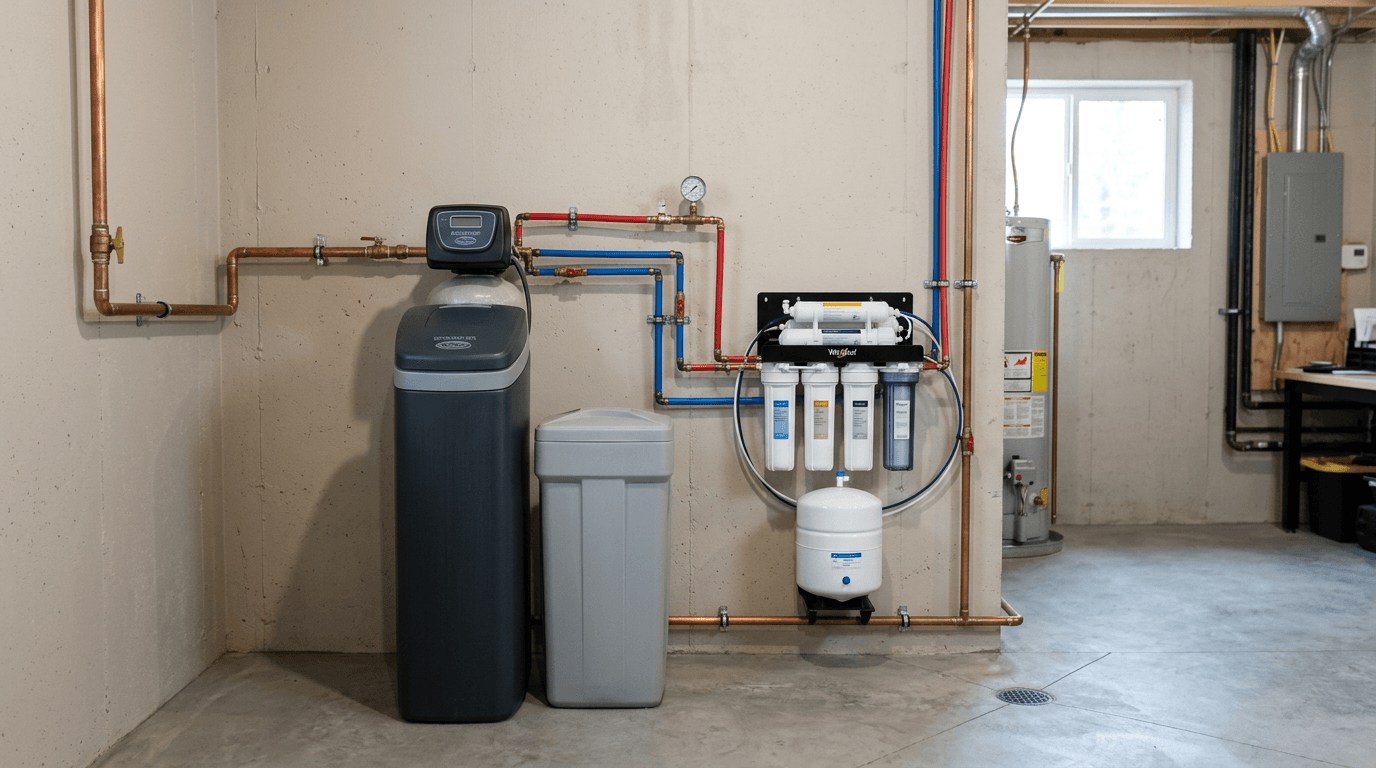
The most common misconception homeowners arrive with is that a single, massive tank in the utility room will deliver bottled-quality drinking water to every tap, showerhead, and toilet in the building. This assumption usually leads them to ask for a whole house reverse osmosis system, without realizing what that level of purification actually does to residential plumbing. Treating water for a home is not about forcing all incoming water through a single microscopic membrane; it is about separating the water your house uses from the water your family consumes, and applying the exact mechanical process required for each.
Quick Summary
A residential water treatment strategy relies on staging different mechanical and chemical processes to address specific contaminants, rather than relying on a single filter. Properly configuring a system protects your plumbing infrastructure while delivering purified water where it is actually needed.
- Reverse osmosis creates aggressive water that can destroy standard copper plumbing if applied to the entire house.
- Water softeners prevent scale buildup in pipes and appliances using ion exchange, but they do not purify water.
- Carbon filtration removes chlorine gas and chemical odours but leaves dissolved minerals entirely untouched.
- Combining a whole-home softening unit with a point-of-use reverse osmosis system is the standard engineering approach for municipal water.
Table of Contents
- Why a whole house reverse osmosis system will destroy standard plumbing
- What a whole house water softener system actually removes from your plumbing
- Where whole house water purification systems leave the job unfinished
- The mechanical sequence of whole house water treatment systems
- Why a whole house water filtration system for well water requires a different baseline
- How targeted packages replace the single-tank myth
- Comparing treatment mechanisms and their operational limits
- FAQ
- Recommended Reads
Why a whole house reverse osmosis system will destroy standard plumbing
Reverse osmosis (RO) is an extremely aggressive filtration method. It forces water through a semi-permeable membrane that is tightly woven enough to strip out dissolved solids, heavy metals, and nearly all minerals at the molecular level. The result is exceptionally pure water with a very low Total Dissolved Solids (TDS) count. However, water in its purest state is a universal solvent; it actively seeks to absorb minerals to rebalance itself.
If you install a whole house reverse osmosis system and push that aggressively pure water through standard copper plumbing, the water will slowly dissolve the pipes from the inside out. Over a matter of months, this leaching process thins the pipe walls and creates pinhole leaks throughout the property. Furthermore, generating enough RO water to supply a family's showers, laundry, and toilet flushing requires industrial-scale holding tanks, massive booster pumps to restore the water pressure lost during filtration, and an enormous amount of wastewater discharged down the drain.
This is why water treatment professionals divide residential water into two categories: "working water" and "drinking water." Working water travels through your water heater, showerheads, dishwasher, and washing machine. It needs to be free of scale-forming hardness, but it does not need to be purified to bottled-water standards. Drinking water, dispensed at the kitchen sink or the refrigerator, is what requires the heavy mechanical filtration of reverse osmosis. By restricting RO to the point of use, you avoid destroying your plumbing infrastructure while keeping system costs and wastewater discharge to an absolute minimum.
What a whole house water softener system actually removes from your plumbing
When homeowners notice white crust forming around their faucets, spots on their glassware, or stiff laundry, the issue is dissolved calcium and magnesium. These minerals are endemic to the North Saskatchewan River, which supplies municipal water to Edmonton, Beaumont, Leduc, and Sherwood Park. Because these minerals are dissolved, you cannot trap them with a standard sediment filter. They require a chemical process called ion exchange, which is exactly what a whole house water softener system facilitates.
Inside the softener's main tank is a bed of synthetic resin beads. These beads are negatively charged and pre-loaded with sodium ions. When hard water flows into the tank, the positively charged calcium and magnesium ions are drawn to the resin. Because the resin has a stronger affinity for hardness minerals than for sodium, it drops the sodium into the water and grabs the calcium and magnesium. The water exiting the tank is now "soft" and will no longer form scale inside your hot water tank or on your shower glass. To understand the baseline mineral content your system needs to handle before choosing a unit, reviewing an Edmonton Water Hardness & Quality Guide | Water Triton is a necessary first step.
Eventually, the resin beads fill up with hardness minerals and can no longer soften the water. At this point, the system triggers a regeneration cycle. It pulls a highly concentrated saltwater solution (brine) from the secondary salt tank and floods the resin bed. The overwhelming concentration of sodium forces the calcium and magnesium off the beads and flushes them down the drain, resetting the system for the next cycle.
Practical rule: Check your brine tank monthly for a "salt bridge" - a hard crust of salt that forms across the middle of the tank, leaving an empty cavern of water below it. If a bridge forms, the system cannot create brine, the resin will not regenerate, and your house will immediately revert to hard water, even though the tank looks full of salt.
Where whole house water purification systems leave the job unfinished
Many products marketed as whole house water purification systems are simply large up-flow carbon filters. These units excel at one specific job: removing chlorine, chloramines, and volatile organic compounds (VOCs) that dictate how your water tastes and smells. Municipalities inject chlorine into the water supply to kill bacteria during transit, but once the water reaches your home, that chemical has done its job and often leaves a harsh, pool-like odour.
Carbon media works through adsorption. The surface of activated carbon is highly porous, creating a massive surface area that traps chemical molecules as the water passes over it. A dedicated whole-home dechlorination unit will give you shower water that does not smell like bleach and will protect the resin beads in your water softener from chlorine degradation, which slowly turns softening resin into a useless gel.
However, a carbon tank has zero effect on dissolved minerals, heavy metals, or overall water hardness. If a vendor promises that a single "purifier" tank will soften your water, remove heavy metals, and provide bottled-quality drinking water all at once, they are overstating the physical capabilities of carbon media. A carbon filter is a critical stage in a comprehensive setup, but it is not a standalone solution for hard water or high TDS.
The mechanical sequence of whole house water treatment systems
Because different filters target different contaminants, the order in which you install whole house water treatment systems dictates whether the setup succeeds or fails. Putting a delicate membrane in front of raw, hard water guarantees a breakdown.
The correct sequence for municipal water always begins with sediment filtration. A simple pleated or spun-polypropylene filter (typically rated between 5 and 20 microns) catches sand, silt, and pipe scale before it can enter the expensive control valves of the main tanks.
The second stage is chemical reduction, typically a carbon filter or dechlorination tank. Removing the chlorine here protects the subsequent stages, as chlorine is highly destructive to both softening resin and thin-film composite RO membranes.
The third stage is the water softener. With the sediment and chlorine removed, the resin can focus entirely on exchanging calcium and magnesium ions without being fouled by debris or degraded by oxidants. For a look at how this core piece of infrastructure is priced and configured locally, reviewing Water Softeners Edmonton | Installed Pricing | Water Triton provides a clear baseline.
The final stage is point-of-use reverse osmosis, installed under the kitchen sink. Because the RO system is now being fed water that is already free of sediment, chlorine, and hardness, its delicate membrane only has to deal with removing trace dissolved solids. This dramatically extends the lifespan of the RO membrane and ensures the system operates at peak efficiency.
Why a whole house water filtration system for well water requires a different baseline
Treating municipal water is predictable because the city has already done the heavy lifting of disinfection and particulate removal. Treating private well water is entirely different. A whole house water filtration system for well water must act as a private municipal plant, handling raw, untreated groundwater that fluctuates based on rainfall, agricultural runoff, and geology.
Well water frequently contains high levels of ferrous (clear water) iron, manganese, and hydrogen sulfide gas, which causes a distinct rotten egg smell. If you run well water with heavy ferrous iron directly into a standard water softener, the iron will oxidize inside the resin bed. Over time, the iron coats the resin beads in a rust slime that prevents ion exchange, effectively suffocating the softener.
To prevent this, well water systems require dedicated oxidation and filtration stages before the water ever reaches a softener. Systems like Air Injection Oxidizing (AIO) filters introduce a pocket of air into the top of the tank. As the well water passes through the air pocket, the dissolved iron and sulfur oxidize into solid particles. The specialized media bed below then physically traps these rusted particles, backwashing them down the drain every few days. Only after the iron and sulfur are stripped out can the water safely proceed to the softening stage.
How targeted packages replace the single-tank myth
Rather than trying to force one piece of equipment to compromise on everything, modern installations split the workload. This is the engineering philosophy behind combined packages like the Triton Pure and Triton Pure Tankless setups. These packages do not attempt to push RO water through your entire plumbing infrastructure; instead, they treat the home's working water and drinking water simultaneously using dedicated hardware.

In these setups, a whole-home softening unit tackles the calcium and magnesium at the main water line. This protects the water heater, stops scale buildup on fixtures, and ensures soaps lather correctly in the shower. Once the working water is secured, a dedicated RO system is installed specifically for the kitchen.
Traditional RO units use a pressurized storage tank to hold purified water, while modern tankless variants rely on high-capacity booster pumps to produce purified water on demand, saving considerable space under the sink. Seeing how a Tankless Reverse Osmosis Edmonton | Water Triton system physically fits into modern cabinetry demonstrates why splitting the treatment workload is so much more practical than attempting whole-house purification.
Practical rule: When sizing any whole-home treatment tank, you must match the control valve's flow rate to the plumbing diameter of your home. Putting a tank with a 3/4-inch internal port onto a 1-inch main water line will create an immediate bottleneck, dropping the water pressure in your upstairs showers regardless of how clean the water is.
Comparing treatment mechanisms and their operational limits
Understanding what each system physically does prevents you from buying hardware that cannot solve your specific problem. The table below outlines the mechanical targets and limits of standard residential equipment.
| Treatment System | Mechanism | Primary Targets | What It Cannot Do |
|---|---|---|---|
| Water Softener | Ion Exchange | Calcium, Magnesium | Cannot remove chlorine, chemicals, or heavy metals. |
| Carbon Filter | Adsorption | Chlorine, Chloramines, VOCs, Odours | Cannot soften water or remove dissolved heavy metals. |
| Reverse Osmosis | Semi-Permeable Membrane | Dissolved solids, Sodium, Heavy metals | Cannot process raw hard water without scaling the membrane. |
| Iron Filter (AIO) | Oxidation & Filtration | Ferrous iron, Manganese, Hydrogen Sulfide | Cannot soften water or remove chemical additives like chlorine. |
| Sediment Filter | Physical Barrier | Sand, Silt, Pipe scale | Cannot remove dissolved minerals, gases, or chemical tastes. |
FAQ
Does a water softener make the water unsafe to drink?
No. A water softener adds a very small amount of sodium to the water during the ion exchange process. For the vast majority of people, this added sodium is well within dietary limits. However, those on strict medically supervised sodium-free diets often prefer to bypass the softener for the kitchen cold water line or install a reverse osmosis system to remove the sodium entirely.
Why does my water pressure drop when the softener is running?
Water pressure drops during regeneration because the system bypasses the main resin tank while it cleans itself, directing water through a narrower bypass valve, and simultaneously using system pressure to flush the drain line. This is why control valves are programmed to regenerate at 2:00 AM, when no one in the house is using water.
How often do reverse osmosis membranes need to be replaced?
If the RO system is fed pre-softened water, the primary membrane usually lasts between three and five years. The pre-filters (carbon and sediment blocks) inside the RO unit, however, must be changed annually to protect the membrane from chlorine damage.
Can I install a water treatment system myself?
While installing a point-of-use under-sink system is manageable for a skilled DIYer, splicing into the main municipal water line for a whole-home tank requires plumbing expertise. Incorrectly sweating copper pipes, installing the bypass valve backwards, or failing to secure the high-pressure drain line can result in catastrophic flooding. For complete setups, relying on professional Reverse Osmosis System Installation Edmonton | Water Triton ensures the warranty remains intact and the plumbing codes are met.
Do tankless reverse osmosis systems waste less water?
Yes. Traditional tank-based RO systems rely on the diminishing pressure inside the storage bladder to push water through the membrane, which becomes highly inefficient as the tank fills, sending more water down the drain. Tankless systems use an electric pump to maintain optimal, continuous pressure across the membrane, resulting in a much lower wastewater-to-pure-water ratio.