Integrating Water Conditioning Into Residential Plumbing: A Technical Guide
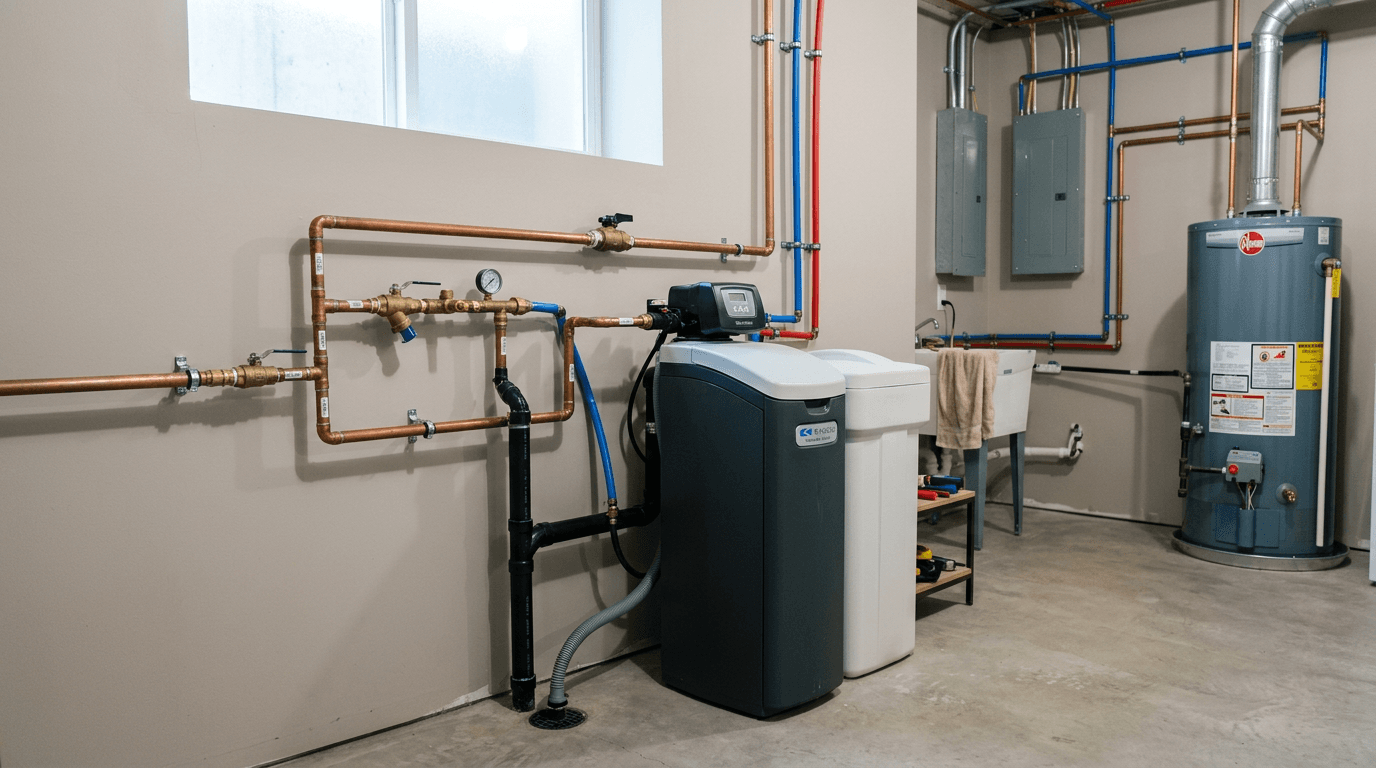
You walk into the mechanical room of a typical Edmonton home, stare at the maze of PEX and copper lines, and try to isolate exactly where the municipal feed stops and the internal distribution begins. Integrating water conditioning equipment into an existing setup is rarely as simple as cutting a pipe and gluing on a fitting. The process requires balancing flow rates, understanding drainage capacities, and successfully dividing the lines that feed outdoor hose bibs from those supplying the kitchen sink. When installed correctly, modern filtration creates a seamless barrier against hard minerals and chlorine; when integrated poorly, it restricts flow and causes catastrophic drainage failures.
Quick Summary
Properly integrating water conditioning equipment requires splitting a home's plumbing so that indoor fixtures receive treated water while outdoor lines remain untreated. The setup dictates where tanks sit, how drainage is safely routed, and whether water pressure remains stable across the house.
- Dedicated bypass valves are mandatory for safe system isolation.
- Drainage lines must feature air gaps to prevent municipal sewer backups.
- Pre-treatment with a softener significantly extends the lifespan of drinking water membranes.
- Older homes require electrical grounding checks when inserting plastic bypasses into copper lines.
Table of Contents
- What water conditioning actually changes in your pipes
- Where systems tie into residential plumbing
- Why drainage determines your installation options
- Comparing point-of-entry vs. point-of-use setups
- How package systems split the workload
- When existing pipe materials force a change in strategy
- FAQ
- Recommended Reads
What water conditioning actually changes in your pipes
Water from the North Saskatchewan River carries a heavy load of dissolved calcium and magnesium. These minerals precipitate out of the water as temperatures fluctuate, forming rigid scale inside pipes, water heaters, and dishwasher heating elements. The primary mechanism of residential water softeners is ion exchange. Inside the main mineral tank, millions of negatively charged resin beads hold onto positively charged sodium ions. As hard water flows through the bed, calcium and magnesium ions - which have a stronger positive charge - knock the sodium off the beads and take their place.
The resulting water is physically altered. It no longer contains the scaling minerals, meaning it cannot build up inside the plumbing infrastructure. This chemical shift is immediate, but it requires precise flow dynamics to work. If water travels through the resin bed too quickly, the exchange process is incomplete, allowing hard minerals to bleed through. This is why accurately sizing the tank based on the home's peak flow rate is critical.
Furthermore, treating water alters its utility. The sodium added during the exchange process is harmless for bathing and household chores, but it damages plant life and degrades soil quality over time. Consequently, softening all the water entering a property wastes resources and ruins landscaping. To review the differences in equipment sizes, homeowners can examine the pricing for installed water softeners to see how varying capacities accommodate different flow rates.
Where systems tie into residential plumbing
The physical location of the water systems dictates how invasive the plumbing work will be. The ideal tie-in point is immediately after the municipal water meter and the main shut-off valve, but before the line branches off to the water heater. However, tapping in at this exact spot is only correct if the lines feeding the exterior hose bibs have already branched off.

In many older properties, the outdoor lines branch off deep inside the house, far away from the mechanical room. Treating the entire main line in these scenarios means watering the lawn with treated water. Plumbers must often trace the exterior lines back to the utility room and re-route them so they draw from the main feed before it enters the conditioning loop. This separation is non-negotiable for a professional setup. For homes in Sherwood Park and similar surrounding areas, dealing with complex builder layouts often requires mapping the cold water lines before a single pipe is cut.
Practical rule: Always install a dedicated three-valve bypass loop before the primary treatment tank so you can isolate the unit during maintenance without cutting off the main water supply to the entire house.
This bypass allows raw municipal water to bypass the tanks entirely. If a tank develops a leak or requires servicing, the homeowner simply turns the bypass valves and restores water to the house while waiting for repairs.
Why drainage determines your installation options
Water conditioning relies entirely on its ability to clean itself. When the resin bed becomes saturated with calcium, the system initiates a regeneration cycle. It draws a concentrated brine solution from the salt tank, flushes it through the resin to forcefully strip away the calcium, and dumps the mineral-heavy wastewater down the drain. This process requires a substantial volume of water moving rapidly to a floor drain or a dedicated standpipe.
The failure mode here is cross-contamination. If the drainage tube is shoved directly into a sewer drain and sealed tight, a backup in the municipal sewer system will push raw sewage directly up the drain line and into the clean water tank.
To prevent this, plumbing codes strictly mandate an air gap. The discharge tube from the control valve must end at least two inches above the rim of the drain receptor. This physical gap of ambient air ensures that even if the floor drain overflows, the contaminated water cannot siphon backwards into the drinking water supply. If a mechanical room lacks a floor drain or a nearby drain stack, a system simply cannot be installed there without extensive renovations to add one. Drainage restrictions are the most common reason an installation has to be relocated or abandoned entirely. Checking these drain lines is a standard part of routine softener maintenance.
Comparing point-of-entry vs. point-of-use setups
Understanding how different water conditioning units sit on the plumbing line clarifies what to buy. Point-of-entry systems treat all the designated water entering the home's distribution manifold. Point-of-use systems treat water strictly at a single fixture, usually the kitchen sink.
Mixing these up results in poor water pressure or premature equipment failure. Pushing the entire home's water supply through a dense carbon block designed for a single sink will drop the house's water pressure to a trickle. Conversely, failing to install a whole-house unit when the primary goal is protecting the water heater from scale renders point-of-use filters pointless.
| System Type | Location | Primary Target | Flow Restriction Risk | Cost Profile |
|---|---|---|---|---|
| Water Softener | Point-of-Entry | Calcium, Magnesium, Scale | Low (if sized correctly) | Moderate |
| Dechlorination Tank | Point-of-Entry | Chlorine, Chloramines, Odour | Low | $1,700 (installed) |
| Reverse Osmosis | Point-of-Use | Total Dissolved Solids, Heavy Metals | High (requires separate faucet) | $1,500 - $2,000 (installed) |
| Under-sink Carbon | Point-of-Use | Chlorine taste at one sink | High | Low |
For residents wanting chemical-free water at every tap without replacing cartridges, whole-home dechlorination tanks sit at the point-of-entry. They use a large bed of granular activated carbon to remove chlorine taste and smell from the entire property, utilizing a lifetime tank warranty rather than relying on disposable plastic filters under every sink.
How package systems split the workload
A single unit rarely solves every water issue. Softeners remove scale but leave sodium and total dissolved solids in the drinking water. Reverse osmosis (RO) systems strip out heavy metals and dissolved solids to create purified drinking water, but they are highly susceptible to calcium scaling.
The technical solution is chaining them together, strategically splitting the workload. The water softener handles the heavy lifting at the point of entry, stripping out the calcium. The softened water then travels to the kitchen, where it feeds the reverse osmosis system.
Practical rule: Never feed a reverse osmosis membrane with hard, unconditioned water if a softener is available. Feeding softened water to an RO system prevents calcium scale from destroying the semi-permeable membrane, doubling or tripling its effective lifespan.
This approach is formalized in packages like the Triton Pure and Triton Pure Tankless. The standard Triton Pure package utilizes a traditional RO setup featuring a pressurized storage tank and a 75-gallon-per-day capacity. Because RO filtration is incredibly slow - processing water drop by drop - the storage tank holds the purified water until you open the faucet. The Triton Pure Tankless package upgrades the point-of-use segment to a direct-flow system. By utilizing an internal booster pump, the tankless unit forces water through a high-capacity 4-stage membrane on demand, eliminating the bulky storage tank while still relying on the whole-home softener to protect it from hard water scaling. The mechanics of reverse osmosis system installation rely heavily on this pre-treatment strategy to maintain long-term water pressure.
When existing pipe materials force a change in strategy
The water softeners plumbing connection must respect the existing materials in the house. Integrating modern systems into older residential setups reveals harsh differences between copper and cross-linked polyethylene (PEX).
Older homes are plumbed heavily with copper. Copper is highly durable but requires sweating joints with a blowtorch, which is risky in tight mechanical rooms packed with wiring and insulation. When inserting a plastic bypass valve into a rigid copper line, you break the electrical continuity. In homes built decades ago, the electrical panel is often grounded directly to the copper plumbing. Slicing out a section of copper to install a plastic filtration head severs that ground path. A jumper wire - a heavy-gauge copper wire clamped to the pipe on both sides of the new plastic equipment - must be installed to restore electrical safety. This is a frequent hurdle when retrofitting residential setups in Leduc and older municipal areas.
Newer homes primarily use PEX. PEX is flexible, easy to cut, and utilizes crimp or expansion fittings. However, PEX fittings sit inside the pipe rather than over it, which slightly reduces the internal diameter of the line. If a home water systems installer uses too many 90-degree PEX crimp elbows in a tight configuration right before the main distribution manifold, the compounding restriction causes a noticeable pressure drop when multiple showers run simultaneously. The geometry of the pipe run matters just as much as the capacity of the tank.
FAQ
Does installing a water softener reduce water pressure?
Properly sized systems do not cause a noticeable drop in household water pressure. However, undersized units or installations using highly restrictive elbows can create bottlenecks, lowering pressure when multiple fixtures are used at once.
Where is the best place to install water systems in a house?
The ideal location is in the mechanical or utility room, immediately after the main water shut-off and before the water heater, ensuring there is access to a floor drain and a standard electrical outlet.
Can water softeners plumbing be routed away from the kitchen sink?
Yes. Many homeowners prefer to keep a hard water line running specifically to the cold-water tap at the kitchen sink for drinking, while softening the hot water and the rest of the home. This requires running a dedicated, untreated line through the floor joists during installation.
What is the difference between a water conditioner and a water softener?
A water softener physically removes calcium and magnesium using ion exchange. A water conditioner alters the minerals so they do not stick to pipes, but leaves them in the water. Only a true softener will stop hard water spotting on dishes and glass.
Do I need a drain for whole-home water systems?
Yes. Any system that uses a regeneration cycle or backwashes its filter bed requires a drain to discharge the wastewater. Point-of-use cartridge filters are the only systems that operate without a drainage connection.