Reverse Osmosis vs Distilled Water: Home Drinking Water Systems Compared
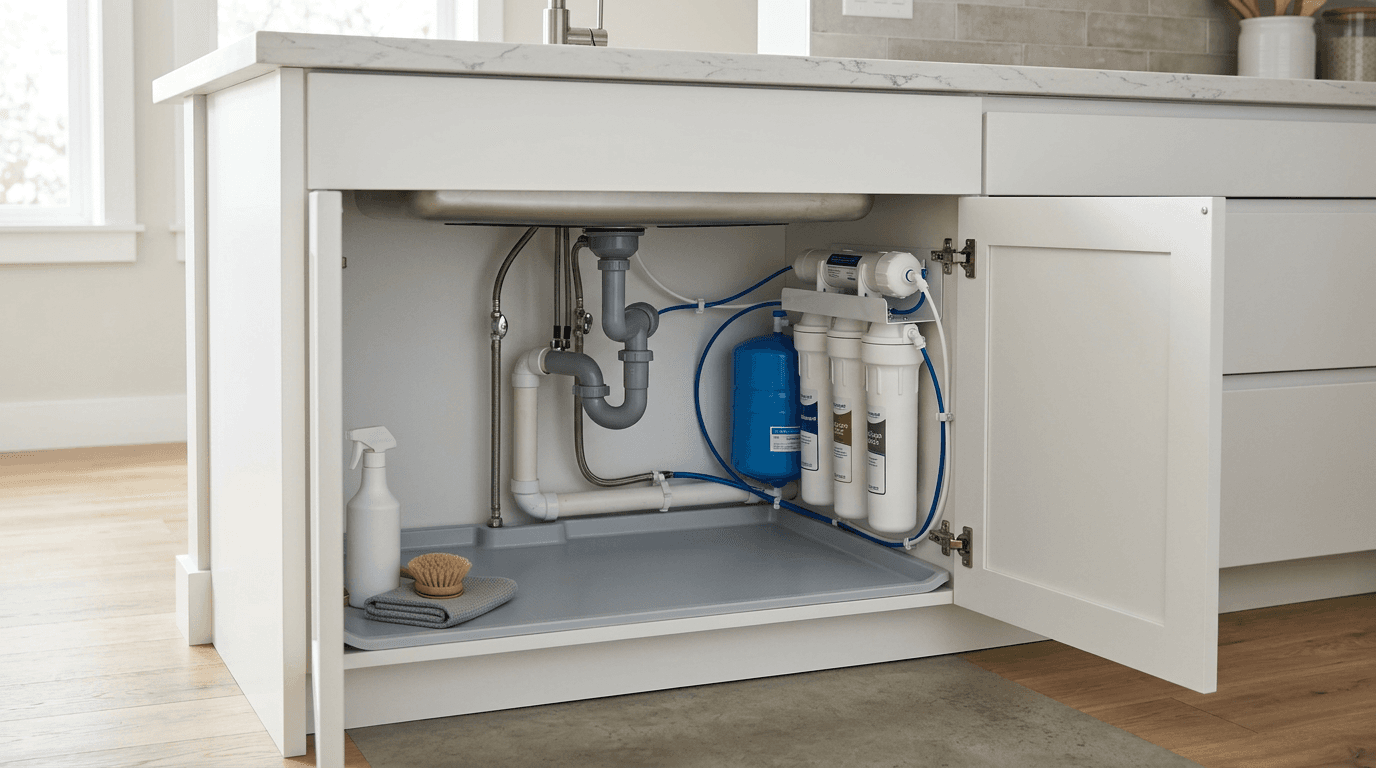
Lugging four-litre jugs of distilled water from a grocery store on a Tuesday night is the exact moment many homeowners decide to look for a permanent purification setup. When the sheer weight of bottled water outgrows the convenience, the natural next step is installing a system under the kitchen sink. Yet, buyers immediately run into a technical wall, staring at reverse osmosis membranes on one shelf and countertop distillers on another. Both promise exceptionally pure water, but they strip away contaminants using entirely different physical mechanisms. Installing the wrong one in a hard-water region guarantees fouled equipment, steep electricity bills, and constant maintenance.
Quick Summary
The difference between reverse osmosis vs distilled water comes down to the mechanism of purification. Distillation boils water into vapour and condenses it back to liquid, leaving solids behind. Reverse osmosis uses physical pressure to force water through a microscopic membrane, blocking dissolved solids while letting water molecules pass.
- Distillation relies on phase changes and consumes heavy electricity.
- Reverse osmosis relies on physical pressure and generates wastewater.
- Distillers are highly vulnerable to hard water scale on their heating elements.
- Reverse osmosis handles high daily volumes effortlessly on demand.
Table of Contents
- Reverse Osmosis vs Distilled Water: The Evaluation Criteria
- 1. Standard Countertop Water Distillers
- 2. Traditional Under-Sink Reverse Osmosis Systems
- 3. Tankless Reverse Osmosis Systems
- 4. Combined Softening and RO Solutions
- 5. Remineralizing Reverse Osmosis Units
- 6. Automatic Plumbed-In Distillers
- 7. Whole-Home Reverse Osmosis Configurations
- Matching the System to Your Bottleneck
- FAQ
- Recommended Reads
Reverse Osmosis vs Distilled Water: The Evaluation Criteria
Comparing these setups requires looking past the marketing claim of "pure water" and examining the operational realities in a residential kitchen. The systems are judged against four criteria: contaminant removal mechanics, daily production speed, ongoing utility impact, and maintenance demands in an environment dealing with hard water.
Water sourced from the North Saskatchewan River fluctuates seasonally but remains distinctly hard, loaded with calcium and magnesium. This baseline chemistry aggressively dictates how purification systems survive. Heating hard water accelerates scale buildup, while pushing it through microscopic pores risks fouling without proper pre-treatment. By running a water hardness test at your home, you can identify exactly what your incoming water chemistry looks like before deciding which purification method will endure it.
| System Type | Mechanism | Speed / Capacity | Primary Maintenance Limit |
|---|---|---|---|
| Countertop Distiller | Phase change (boiling) | Very slow (4-6 hours per batch) | Hard scale on heating element |
| Traditional RO | Membrane pressure | Moderate (storage tank dependent) | Annual filter/membrane swaps |
| Tankless RO | Direct membrane pump | High (on-demand continuous) | Electrical outlet required |
| Combined Softener + RO | Exchange resin + Membrane | High (pre-treated on-demand) | Space for dual equipment |
1. Standard Countertop Water Distillers
Countertop distillers are standalone electrical appliances designed for individuals or couples who need small batches of highly purified water without modifying their kitchen plumbing. They sit directly on the counter, requiring manual filling and a standard electrical outlet to operate.
The system works entirely on the principle of a phase change. Water sits in a stainless steel boiling chamber directly above a heating element. The element raises the water temperature until it vaporizes into steam, leaving heavy metals, minerals, and large contaminants behind in the lower basin. The steam rises into a cooling coil - usually assisted by a noisy electric fan - where it condenses back into liquid and drips into a collection glass or plastic jug. Because some volatile organic compounds (VOCs) boil at lower temperatures than water, most distillers route the final drips through a small carbon packet to capture gases that transferred with the steam.
Unmatched absolute purity that demands daily manual labour
The honest limit of this appliance is its excruciatingly slow production rate combined with intense power consumption. Producing a single four-litre jug takes roughly four to six hours, meaning large families will constantly outpace the machine. Furthermore, because it boils the raw water, calcium and magnesium rapidly bake onto the boiling chamber floor. If you live in a hard water area, you will be scrubbing the element with acidic descaler every few days. Homeowners lacking patience for daily scraping and manual jug-filling should abandon this route entirely.
2. Traditional Under-Sink Reverse Osmosis Systems
Traditional under-sink reverse osmosis units are permanently plumbed purification systems engineered for households that want pure water directly from a dedicated faucet. They are designed to fit entirely inside a standard kitchen base cabinet, hidden from sight, and run automatically whenever the tap is opened.

The system operates via cross-flow filtration driven by your home's natural plumbing pressure. Water first passes through sediment and carbon pre-filters to remove chlorine, which would otherwise chemically destroy the main membrane. The water is then pushed against a semi-permeable membrane that features pores small enough to block dissolved minerals, heavy metals, and most microscopic contaminants. Because municipal pressure pushes slowly against such fine pores, the system routes the purified water into a pressurized storage tank. When you open the counter tap, an air bladder inside the tank forces the collected water up to your glass.
Reliable high-volume filtration with a dedicated footprint
Traditional systems are incredibly reliable. However, they demand significant space and sacrifice volumetric efficiency. The standard configuration requires sacrificing at least half of the cabinet beneath your kitchen sink. This houses the storage tank and the filter manifold. Furthermore, the cross-flow mechanism inherently wastes water to clean itself; traditional units send roughly three to four litres of reject water down the drain for every one litre purified. If under-sink real estate is scarce, or if waiting for a drained tank to slowly refill over an hour is unacceptable for your cooking routines, a traditional reverse osmosis installation will frustrate you.
3. Tankless Reverse Osmosis Systems
Tankless reverse osmosis systems represent a modernized architecture for homeowners who want direct-flow purification without surrendering their lower cabinetry to a bulky holding tank. They condense the entire filtration process into a single, slim rectangular manifold that sits neatly against the cabinet wall.
Instead of relying solely on your home's municipal water pressure, these units feature an internal electrical booster pump. This pump aggressively drives incoming water through an oversized, high-capacity membrane - often rated for 400 to 600 gallons per day. Because the pressure is mechanically boosted, the membrane produces purified water fast enough to flow directly up to your faucet in real-time. There is no waiting for a tank to fill, and the boosted pressure often improves the efficiency ratio, wasting significantly less water down the drain compared to passive systems.
Continuous flow that reclaims cabinet space
Operating without a reservoir requires under-sink electricity and a higher upfront component cost. It is a strict prerequisite. Because the internal pump must engage the moment you open the tap, you need a dedicated, unswitched electrical outlet installed directly below the counter. This takes power. You will also experience a brief one-second delay and hear a mild humming noise when the pump activates. A standard tankless reverse osmosis unit is the wrong choice if your kitchen lacks accessible power under the counter and you are unwilling to hire an electrician to pull a new wire.
4. Combined Softening and RO Solutions
For residents battling severe mineral buildup across the entire house, standalone kitchen filters often fail prematurely. A combined solution addresses the home's incoming main line with a water softener, followed by a point-of-use reverse osmosis system exclusively for drinking water. This pairing is intended for homeowners seeking whole-house scale protection alongside medical-grade drinking purity.

The softener acts as a heavy-duty pre-filter for the entire property. It uses ion-exchange resin to trap abrasive calcium and magnesium ions as they enter the house, swapping them for benign sodium ions. This prevents scale from destroying water heaters and dishwashers. When this softened water eventually reaches the kitchen sink, the reverse osmosis membrane effortlessly strips out the sodium and any remaining total dissolved solids. Because the hard minerals are gone before they hit the RO unit, the delicate membrane operates in an ideal environment and lasts significantly longer.
Comprehensive protection that isolates drinking lines from utility water
This two-stage approach provides ultimate control. However, the logistical complexity of the installation itself remains a major hurdle. You are installing two major pieces of equipment. They go in entirely different parts of the house. For standard properties, comprehensive water softening systems combined with something like the Triton Pure or Triton Pure Tankless packages require ensuring your kitchen sink has a dedicated cold line that hasn't been bypassed. If your basement is fully finished with drywall ceilings, routing new dedicated plumbing from the mechanical room to the kitchen island can be prohibitively destructive and costly.
5. Remineralizing Reverse Osmosis Units
Standard reverse osmosis and distillation both create water so pure that it reads as slightly acidic, which some people perceive as tasting flat or bitter. Remineralizing RO systems are designed for coffee enthusiasts and drinkers who want the safety of membrane filtration but prefer the crisp, alkaline taste of spring water.
These systems function exactly like traditional or tankless RO units, utilizing pressurized cross-flow filtration to strip the water down to near-zero dissolved solids. The defining mechanism occurs immediately before the water exits the faucet. The pure water is routed through a specialized post-filter cartridge packed with crushed calcite, corosex, or crushed marble. As the slightly acidic pure water flows through this bed, it dissolves a controlled amount of calcium and magnesium back into the stream, raising the pH and restoring a recognizable mineral flavour profile.
Restored mineral balance for a preferred taste profile
Adding minerals back into your water introduces a rapidly depleting consumable that requires diligent tracking. Because the pure water is highly reactive, it aggressively eats away at the sacrificial media inside the cartridge. The mineral dosage is highest when the filter is brand new and slowly drops off as the media dissolves over the months. Homeowners who refuse to stick to strict filter replacement schedules will find their water slowly reverting to the flat, acidic taste they specifically paid to avoid.
6. Automatic Plumbed-In Distillers
Unlike countertop models, automatic plumbed-in distillers are permanent mechanical installations built for households demanding large volumes of distilled water without the manual labor. These heavy-duty units are typically installed in basements or utility rooms and plumbed directly into the home's water supply.
The mechanism operates a continuous boiling and condensing cycle governed by automated float switches. As raw water flows into the boiling chamber, heavy elements heat it to vapour, sending the steam through large condensing coils. The resulting liquid drops into a massive stainless steel storage reservoir - often holding 10 to 20 gallons. A secondary electrical delivery pump then pushes the stored distilled water through dedicated tubing up to the kitchen faucet or the refrigerator ice maker.
Hands-free distillation that comes with a heavy utility footprint
Operating a continuous boiler on utility water demands staggering electrical consumption and intense maintenance. Pushing municipal water through a constant heating cycle causes rapid, thick scale formation inside the boiling chamber. A homeowner must routinely shut the system down, open the chamber, and perform aggressive acid washes to strip the baked-on calcium away, or the heating elements will overheat and burn out. If you are sensitive to utility costs or despise heavy mechanical maintenance, automatic distillation will quickly become a regret.
Practical rule: Always measure the physical clearance height beneath your kitchen sink against the manufacturer's spec sheet before buying any plumbed-in system, as standard garbage disposals often block the necessary depth for storage tanks.
7. Whole-Home Reverse Osmosis Configurations
A point-of-entry (whole-home) reverse osmosis system treats every drop of water entering the property. This industrial-scale setup is reserved for rural well owners dealing with toxic contaminants, heavy sodium, or extreme dissolved solids that a standard softener cannot legally or functionally treat.
The system scales up the under-sink mechanism to massive proportions. A high-voltage repressurization pump forces incoming well water through commercial-sized membrane arrays. Because the production speed is still slower than a running shower, the purified water dumps into a massive atmospheric storage tank (often 200 to 500 gallons) sitting on the basement floor. A secondary booster pump then pulls water from this tank and pressurizes the entire household plumbing network, ensuring pure water flows from every toilet, shower, and sink.
Medical-grade water at every tap for an industrial price
Operating a whole-home system exposes your property to the extreme aggressiveness of the final product and requires a prohibitive footprint. Completely pure, mineral-free water is colloquially known as "hungry water" - it acts as a solvent and will aggressively leach copper out of standard plumbing pipes, causing pinhole leaks. A whole-home RO system absolutely requires that the house be plumbed entirely in PEX or specialized plastics. For a typical municipal property, installing one of these systems is a gross misallocation of resources that creates immediate plumbing risks.
Matching the System to Your Bottleneck
Choosing between these methods requires isolating exactly what frustrates you about your current setup.
If your bottleneck is kitchen storage space and you hate waiting for tanks to refill, take a tankless reverse osmosis system. It hides quietly against the cabinet wall and delivers immediate flow.
If your bottleneck is renting an apartment where altering the plumbing underneath the sink violates your lease, take a countertop distiller. It plugs into the wall and travels with you when you move, provided you can tolerate the slow batches.
If your bottleneck is aggressive hard water scale ruining your appliances while also wanting pure drinking water, choose a combined softener and reverse osmosis package. Installing a water softener in an area like Beaumont or Leduc protects the plumbing, allowing the under-sink membrane to focus purely on drinking quality without prematurely clogging.
FAQ
Is reverse osmosis water the same as distilled water?
No, they are different products created by entirely different physical processes. Distilled water is created by boiling water into steam and catching the condensation, leaving solids behind. Reverse osmosis water is created by forcing water under pressure through a microscopic membrane that blocks dissolved solids.
Is reverse osmosis distilled water?
Reverse osmosis is not distilled water. While both methods produce highly purified water with very low total dissolved solids, reverse osmosis relies on physical filtration through membrane pores, whereas distillation relies on a thermal phase change.
Is distilled water reverse osmosis?
Distilled water is not reverse osmosis. A distiller uses a heating element to vaporize liquid, which inherently requires heavy electricity and time. Reverse osmosis systems do not use heat at all; they rely on water pressure to physically push molecules through a filter.
Can you hook a distiller up under the sink?
Standard countertop distillers cannot be plumbed under a sink because they require manual filling and give off significant heat while boiling, which would warp cabinetry and create a fire hazard.