Reverse Osmosis vs Distilled Water: Which Method Fits Your Kitchen
A common misconception among homeowners is that achieving an empty glass - water stripped of every mineral, chemical, and suspended solid - is a uniform process with identical results. But the route a system takes to remove those impurities dictates exactly how much water you get, how much energy you spend, and whether you can fill a pasta pot on demand or have to wait four hours for a single pitcher. When comparing reverse osmosis vs distilled water, you are not just choosing between two types of filtration. You are choosing between physical separation driven by household plumbing pressure and a phase change driven by intense electrical heat. The mechanics behind these two methods determine their maintenance schedules, their vulnerability to hard water, and ultimately their practicality for a busy household.
Quick Summary
Reverse osmosis and distillation are both highly effective purification methods, but they rely on entirely different physical principles to remove contaminants from drinking water.
- Reverse osmosis uses water pressure to force liquid through a semi-permeable membrane, separating pure water from dissolved solids instantly.
- Distillation boils water into vapour and condenses it back into a liquid, leaving heavy solids behind in a boiling chamber.
- Phase change systems struggle to provide adequate volume for families, often taking hours to produce a few litres.
- Edmonton's hard water severely impacts both systems if left untreated, causing scaling in distillers and fouling in membranes.
Table of Contents
- Why boiling creates a timeline bottleneck for families
- How mechanical pressure delivers continuous volume
- Where volatile organic compounds bypass phase changes
- What Edmonton's river chemistry does to naked heating elements
- Why sequence matters when building a comprehensive solution
- Comparison Table: Phase change versus mechanical separation
- Who should skip the countertop boiling chamber completely
- FAQ
- Recommended Reads
Why boiling creates a timeline bottleneck for families
Homeowners frequently ask: is reverse osmosis water the same as distilled water? While both processes yield an exceptionally clean glass of liquid, the resulting pure water is achieved through completely different physical pathways. Distillation is a thermal process. A countertop home water distiller contains a heating element, a boiling chamber, and a set of cooling coils. When you turn the unit on, the element heats the water to 100 degrees Celsius, forcing it to undergo a phase change from a liquid to a vapour.
Because heavy metals, salts, and minerals like calcium have boiling points far higher than water, they remain trapped in the boiling chamber. The pure water vapour rises into the cooling coils, where a fan drops the temperature, forcing the vapour to condense back into liquid drops that drip slowly into a collection jug.
The primary failure mode of this mechanism is the timeline. The latent heat of vaporization - the amount of energy required to turn liquid water into gas - is substantial. A standard residential countertop unit typically takes four to six hours to process a single four-litre batch. For a large household filling multiple water bottles, cooking pasta, and running coffee makers, this batch-processing method creates a constant bottleneck. You are forced to manually refill the boiling chamber, start the cycle, and wait hours before you have usable water again.
How mechanical pressure delivers continuous volume
When observing the final product in a storage tank, you might wonder, is reverse osmosis distilled water? It is not; it is water that has been mechanically separated from its contaminants, not evaporated and re-condensed. Reverse osmosis relies on a Thin Film Composite (TFC) membrane containing microscopic pores roughly 0.0001 microns in size.

Instead of heat, this process uses the natural hydraulic pressure of your home's plumbing. Normal water naturally wants to flow from an area of low solute concentration to high solute concentration - a process called osmosis. The system reverses this by applying 40 to 60 pounds per square inch (psi) of line pressure, forcing the water through the membrane against its natural osmotic flow. The clean water molecules pass through the microscopic pores, while the larger dissolved solids, heavy metals, and salts are blocked.
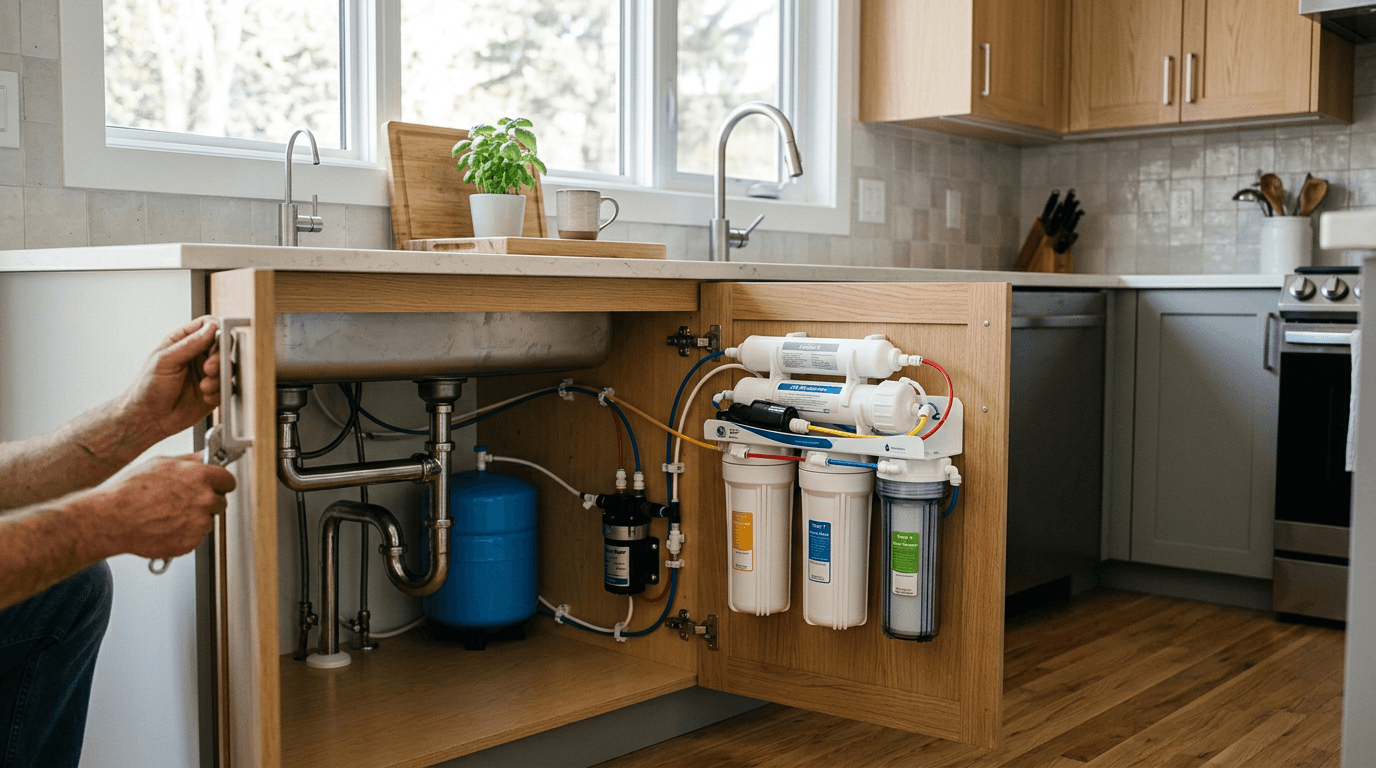
Because this is a continuous physical separation rather than a batch phase change, the system constantly produces water as long as there is line pressure. To ensure immediate availability at the kitchen sink, residential units route the processed water into a pneumatic storage tank beneath the counter. When you open the dedicated faucet, the air pressure in the tank pushes the water out instantly. Advanced iterations bypass the storage tank entirely, using a high-capacity internal booster pump to push water through the membrane on demand.
Where volatile organic compounds bypass phase changes
The reliance on boiling temperatures exposes a significant vulnerability in basic distillation. While heavy minerals are left behind in the boiling chamber, Volatile Organic Compounds (VOCs) - which include certain industrial chemicals, pesticides, and the chlorine or chloramines used in municipal water treatment - often have boiling points lower than that of water.
If you place chlorinated tap water into a distiller that lacks a specialized carbon vent or a high-quality post-filter, the VOCs will vaporize before the water does. They travel up into the cooling coils, condense alongside the water vapour, and drip directly into the final collection jug. The resulting liquid may be free of heavy metals, but it retains the chemical taste and odour of the municipal disinfection process.
Reverse osmosis systems manage this vulnerability through sequenced pre-filtration. Before the water ever reaches the delicate semi-permeable membrane, it passes through an extruded carbon block. Carbon relies on adsorption - a chemical process where organic molecules physically bind to the vast, porous surface area of the carbon block. This strips the chlorine, chloramines, and VOCs out of the water entirely. This step is not just for taste; municipal chlorine is highly oxidative and will physically eat holes through a TFC membrane if not removed first.
What Edmonton's river chemistry does to naked heating elements
The source of your household water dictates how these systems age. In the capital region, municipal water is drawn from the North Saskatchewan River, which carries a significant mineral load. As detailed in the Edmonton water hardness and quality guide, the local supply averages roughly 165 mg/L (9.6 grains per gallon) of hardness, primarily composed of calcium and magnesium.
When hard water enters a boiling chamber, it creates a severe maintenance liability. Calcium exhibits inverse solubility - as water gets hotter, calcium becomes less soluble, rapidly dropping out of the liquid and forming a hard, rocky scale on the heating element and the walls of the chamber. Over just a few weeks of daily use, this scale forms an insulating jacket around the heating element.
The element is forced to work harder and run hotter to push heat through the rock layer, dramatically increasing electricity consumption and shortening the lifespan of the appliance. Removing this scale requires taking the unit out of service and soaking the boiling chamber in a highly acidic solution, like citric acid or concentrated white vinegar, for several hours to dissolve the rock.
Practical rule: If your municipal water registers above 7 grains per gallon of hardness, a countertop distiller will require intensive chemical descaling at least twice a month to prevent the heating element from burning out.
Why sequence matters when building a comprehensive solution
That same 165 mg/L of hardness is equally destructive to a bare semi-permeable membrane. If raw, hard water is pushed against the microscopic pores of an RO unit, the calcium acts like concrete dust, plugging the pores and permanently fouling the membrane within a year.
This is why practitioners do not install membrane filtration in isolation when dealing with local river water. The correct mechanical approach involves sequencing. Systems like the Triton Pure and Triton Pure Tankless packages address the chemistry at the point of entry. A whole-home water softener is installed where the water line enters the house. The softener uses ion exchange resin to trap the calcium and magnesium, swapping them for harmless sodium ions.
By the time the water reaches the reverse osmosis system installation in Edmonton underneath the kitchen sink, the destructive rock has already been removed. The RO membrane only has to filter out the sodium and remaining dissolved solids. This sequenced approach extends the lifespan of the RO membrane from roughly twelve months up to five years or more, transforming a high-maintenance frustration into a reliable daily utility.
Comparison Table: Phase change versus mechanical separation
To directly answer the question of is distilled water reverse osmosis, one only needs to look at the energy source and processing speed required by each method.
| Specification | Distillation (Phase Change) | Reverse Osmosis (Mechanical Separation) |
|---|---|---|
| Core Mechanism | Boiling and condensation | Membrane diffusion under pressure |
| Energy Source | 120V Electrical heating element | Household hydraulic line pressure |
| Processing Speed | 4 - 6 hours per four-litre batch | Continuous processing to a storage tank/pump |
| VOC Removal | Poor (requires separate carbon vent) | Excellent (via integrated carbon pre-filters) |
| Hard Water Impact | Rapid scale buildup, element failure | Membrane fouling, flow restriction |
| Maintenance Chore | Frequent acid soaking of chamber | Annual drop-in filter cartridge swaps |
Who should skip the countertop boiling chamber completely
Distillation is a specialized process best suited for distinct, low-volume applications. If you are a single occupant who only requires a litre of pure water daily for a CPAP machine, a garment steamer, or a small humidifier, a countertop phase-change unit will serve that specific need adequately.
However, it is the wrong tool for household hydration and cooking. Families living in the capital region who need water for coffee, large pots of pasta, multiple drinking bottles, and cooking prep should not rely on a distiller. The four-hour wait times, the high electrical draw, and the constant manual refilling and acid-washing make it an unsustainable daily appliance.
For households looking to eliminate bottled water usage entirely, mechanical separation sequenced after a whole-home water softener in Sherwood Park or surrounding areas provides the immediate volume and low-maintenance reliability that a busy kitchen demands.
Practical rule: Calculate your family's daily liquid demand; if you require more than four litres a day for drinking and cooking combined, thermal phase change will inevitably become a frustrating household bottleneck.
FAQ
Does reverse osmosis remove minerals from the water like distillation does?
Yes. Both methods remove the vast majority of dissolved solids, including calcium, magnesium, and sodium. The resulting water from either system is extremely pure and has a very low Total Dissolved Solids (TDS) count.
Is it safe to drink water that has had all its minerals removed?
Yes. The minerals your body requires for bone and tissue health are absorbed primarily through the food you eat, not the water you drink. Both methods produce safe, highly purified drinking water that simply acts as a hydration delivery mechanism.
Why does my reverse osmosis system have a drain line, but my distiller does not?
Mechanical separation relies on a cross-flow design. While pure water is pushed through the membrane, a separate stream of water runs across the face of the membrane to wash the rejected contaminants down the drain. A distiller simply traps the contaminants in the boiling chamber until you manually wash them out.
Can I use reverse osmosis water in my humidifier or CPAP machine?
Yes. Because the membrane removes the heavy dissolved solids that cause white dust in ultrasonic humidifiers and mineral crusts in CPAP water chambers, the water performs identically to distilled water in these sensitive appliances.
Do I need a plumber to maintain these systems once they are installed?
While the initial sequencing and installation of a whole-home softener and under-sink membrane system requires professional plumbing knowledge, the ongoing maintenance does not. Membrane systems use sanitary quick-change filter cartridges that homeowners can swap themselves once a year.