The 4 Best Reverse Osmosis Water Filter System Models for 2026
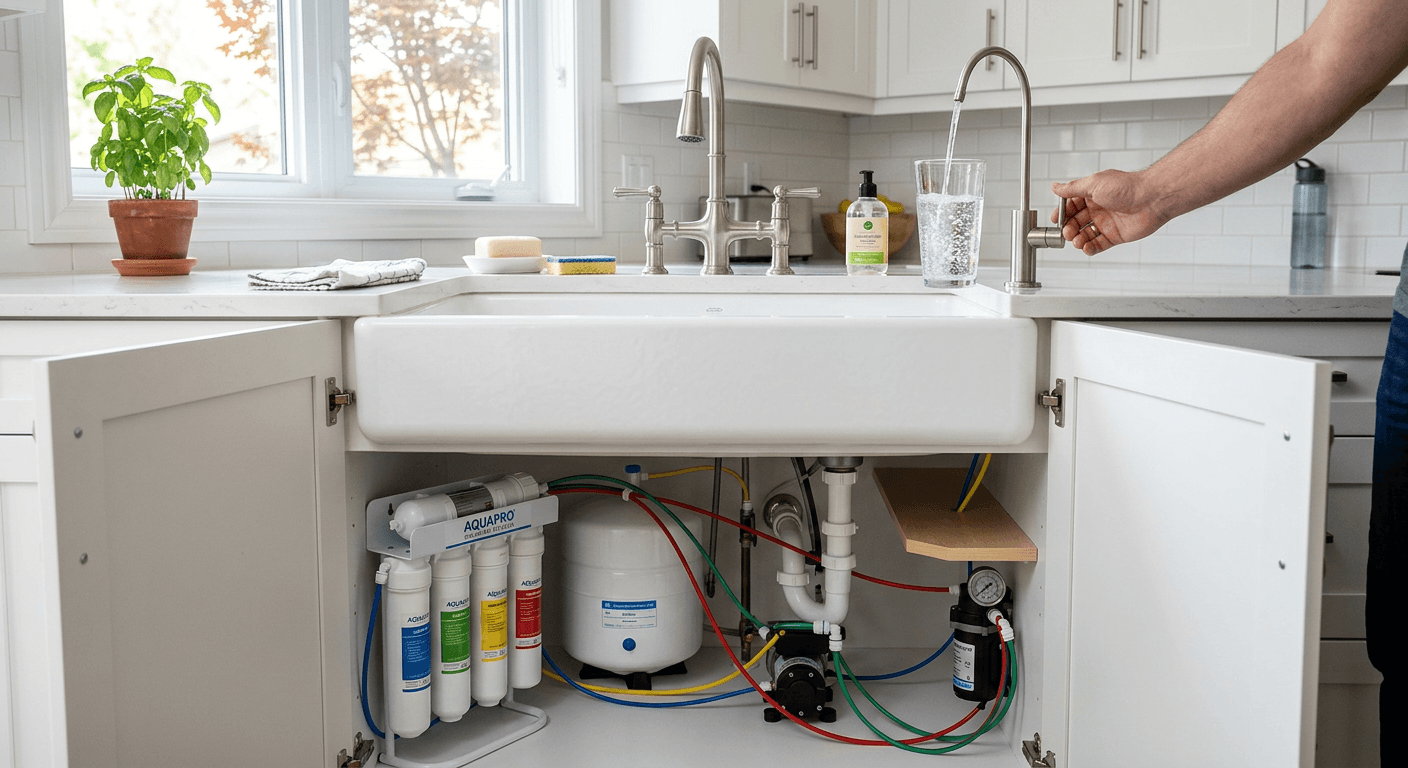
When homeowners across Edmonton, Beaumont, Leduc, and Sherwood Park pull municipal tap water from the North Saskatchewan River, they are pushing dissolved solids, seasonal organics, and chloramines directly against a semi-permeable film. Finding the best reverse osmosis water filter system means matching the specific pressure, footprint, and chemistry of that local supply to the correct filtration mechanics. If the feed water is excessively hard, the membrane scales over and fails prematurely. This chemical reality is why combined installations like our Triton Pure and Triton Pure Tankless packages pair upstream whole-home softening with dedicated point-of-use reverse osmosis.
Quick Summary
The best reverse osmosis water filter system physically forces water through a semi-permeable membrane at high pressure to strip dissolved solids, heavy metals, and chemical additives from your drinking supply. Choosing the right unit requires balancing daily water volume, under-sink storage space, and post-filtration remineralization requirements.
- Tankless architectures deliver continuous water but require electrical power and high upfront investment.
- Traditional tank-based systems operate on baseline municipal pressure without electricity.
- Remineralization stages are critical if you prefer alkaline water or want to prevent acidic leaching into metal fixtures.
- Hard water must be treated before it reaches the reverse osmosis membrane to prevent premature scaling.
Table of Contents
- Why Finding the Right Configuration Requires Knowing Your Plumbing
- How to Classify Reverse Osmosis Topologies
- 1. Waterdrop G3P800 Tankless RO System
- 2. iSpring RCC7AK 6-Stage Reverse Osmosis System
- 3. Aquasana SmartFlow Reverse Osmosis Water Filter
- 4. Rainfresh RO450 Reverse Osmosis System
- Where Each Architecture Belongs in the Home
- Recommended Reads
Why Finding the Right Configuration Requires Knowing Your Plumbing
| Product | System Architecture | Features | Pros | Cons | Target Audience |
|---|---|---|---|---|---|
| Waterdrop G3P800 | Tankless High-Flow | 800 GPD capacity, 10-stage filtration, 3:1 pure-to-drain ratio | Continuous supply, minimal footprint, highly efficient waste ratio | Requires power, high initial cost, complex internal pump | Large families wanting on-demand volume without a tank |
| iSpring RCC7AK | Traditional Tank-Based | 75 GPD membrane, 6 stages, alkaline remineralization | Corrects acidic pH, operates without power, widely available parts | Bulky 6-stage manifold, requires tank space, slower refill | Homeowners wanting alkaline drinking water on a budget |
| Aquasana SmartFlow | Traditional Tank-Based | WQA certified to NSF 401, Claryum technology, 3.2-gallon tank | Thoroughly certified for emerging compounds, reliable bladder tank, predictable performance | Strict 250-gallon filter lifespan, requires tank space, frequent carbon swaps | Safety-focused households wanting verified chemical removal |
| Rainfresh RO450 | Traditional Tank-Based | 50 GPD membrane, 1/8th-turn bayonet cartridges, CSA B483.1 | Effortless maintenance, structurally robust metal tank, Canadian plumbing compliance | Low daily yield, takes hours to refill, basic feature set | Smaller households prioritizing foolproof maintenance |
How to Classify Reverse Osmosis Topologies
Evaluating the best reverse osmosis system under sink requires defining how the unit handles physical water storage and pressure generation. Every system on the market falls into one of two categories along this classification axis: System Architecture.
Tankless High-Flow These systems eliminate the traditional hydro-pneumatic storage tank entirely. Instead of slowly producing water and storing it for later use, they utilize an integrated electric booster pump to drive municipal water through a massive, high-capacity membrane the moment you open the faucet. They save physical space under the sink but require a dedicated electrical outlet to operate. You cannot compare a tankless unit directly to a passive system without factoring in the electrical requirement and the internal complexity of the pump.
Traditional Tank-Based This is the classic configuration used in residential plumbing. These units rely solely on your home's existing municipal water pressure to slowly push water through the membrane, accumulating the purified output in a pressurized storage vessel. When you open the tap, an air bladder inside the tank pushes the water out. While they require significant cabinet space to house the tank and manifold, they operate completely off the grid and generally utilize standardized, easily accessible replacement cartridges.
Practical rule: High-capacity membranes still require pre-treatment; pushing excessively hard water through a Tankless High-Flow architecture will rapidly blind the membrane, regardless of its internal booster pump.
1. Waterdrop G3P800 Tankless RO System
The Waterdrop G3P800 Tankless RO System is a heavy-duty Tankless High-Flow unit built for households that drain conventional storage tanks faster than they can refill. By replacing the bulky bladder tank with an internal electric pump and a massive membrane, it delivers purified water strictly on demand.
High Flow Rates Rely on Internal Booster Pumps
The core mechanism of the G3P800 is its 800-gallon-per-day (GPD) reverse osmosis membrane. An integrated electric booster pump drives it. Because municipal line pressure alone is insufficient to push water through such a dense membrane in real-time, the pump artificially elevates the feed pressure the moment the faucet is engaged. This results in an immediate flow rate. It fills a 6-ounce cup of water in 5 seconds. The system routes the water through a 10-stage filtration process that mechanically and chemically reduces heavy metals like lead and chromium, as well as complex compounds including PFAS and fluoride.
Furthermore, the pressurized injection allows the system to achieve a 3:1 pure-to-drain water ratio. Traditional passive systems often waste four gallons for every one gallon purified, but the forceful mechanics here ensure that three gallons of pure water are generated for every single gallon sent to the wastewater line.
At an initial acquisition cost of $1,199.00 CAD (frequently discounted to $949.00 CAD on sale), the capital required is substantial. The primary limitation of this architecture is its absolute dependence on electricity; in a power outage, the pump cannot engage, and the system produces no water whatsoever. Additionally, the sheer speed of the internal pump means it is entirely unforgiving of silt or heavy scaling, making upstream pre-treatment critical in regions with challenging water profiles.
We specify this unit when a homeowner has access to an under-sink electrical outlet and a household large enough to outpace the recovery rate of a standard pressurized bladder tank.
Pros
- Delivers continuous flow without relying on a limited storage tank.
- Conserves water with a highly efficient 3:1 pure-to-drain ratio.
- Consolidates 10 stages of filtration into a tight under-sink footprint.
Cons
- Requires a dedicated electrical outlet to operate the internal pump.
- Carries a steep initial purchase price compared to passive alternatives.
- Ceases functioning completely during municipal power outages.
2. iSpring RCC7AK 6-Stage Reverse Osmosis System
Built on a Traditional Tank-Based architecture, the iSpring RCC7AK 6-Stage Reverse Osmosis System is designed for homeowners who want to correct the flat, slightly acidic taste inherent to aggressively purified water. It is a passive, modular unit that systematically strips contaminants before actively rebuilding the mineral profile.
Remineralization Corrects Membrane-Induced Acidity
The defining mechanical characteristic of a standard RO membrane is that it indiscriminately removes almost everything dissolved in the water, including beneficial alkaline minerals. This leaves the water with a slightly acidic pH. This water can taste flat. Over decades, it can slowly leach metal from low-quality brass fittings. The RCC7AK addresses this by placing a 75-gallon-per-day membrane at the centre of its process, certified to the NSF/ANSI 58 standard for total dissolved solids (TDS) reduction. After the water sits in the storage tank and is called up to the faucet, it passes through a final alkaline remineralization stage.
This final cartridge contains natural mineral stones that mechanically dissolve back into the water stream, reintroducing calcium and magnesium at a concentration of 30 to 60 mg/l. This specific concentration effectively neutralizes the membrane-induced acidity and restores a rounded, spring-like mouthfeel to the water. Because it operates entirely on municipal pressure, there is no electrical pump involved; water production is a slow, continuous trickle into the holding tank.
Priced at $259.99 USD for the model featuring a brushed gold RO faucet, the system is highly accessible. However, its structural limit lies in its sprawling footprint. Accommodating a 6-stage filtration manifold, a heavy holding vessel, and the associated tubing requires a completely clear cabinet beneath the sink. Those with garbage disposals, deep farmhouse sinks, or complex drain plumbing will often find they simply lack the physical cubic volume required to safely house the components without pinching lines.
We would route a homeowner toward this model when their primary complaint about standard purified water is a metallic or flat taste, provided they have ample, unencumbered cabinet space.
Pros
- Restores calcium and magnesium for a balanced, alkaline pH.
- Operates reliably without any electrical connections.
- Utilizes widely available, standardized filter housing sizes.
Cons
- Occupies a substantial amount of under-sink cabinet volume.
- Refills the storage tank slowly after heavy use.
- Requires careful tubing management to prevent manifold leaks.
3. Aquasana SmartFlow Reverse Osmosis Water Filter
Operating within the Traditional Tank-Based category, the Aquasana SmartFlow Reverse Osmosis Water Filter prioritizes verified chemical reduction over flow rates. It is an under-sink point-of-use system built specifically for residents who demand rigorous, third-party laboratory verification for the removal of emerging contaminants.
Strict Certification Requires Adherence to Maintenance Windows
The mechanism driving the SmartFlow system relies on pairing a standard semi-permeable membrane with Aquasana's proprietary Claryum filtration blocks. The membrane does not do all the heavy lifting. Instead, the system forces water through specialized carbon media. This media targets specific volatile organic compounds and pharmaceuticals. This multi-stage approach has allowed the unit to be certified by the Water Quality Association (WQA) against a comprehensive suite of standards: NSF/ANSI 42, 53, 58, 401, and the Canadian CSA B483.1 standard.
The purified water is held in an included storage tank featuring a total volume of 3.2 gallons. Inside the tank, a butyl bladder separates a pocket of compressed air from the water. As the tank fills, the water compresses the air; when the faucet is opened, the air expands, driving the water up to the tap. Priced starting at $199.99 USD without a faucet, or $224.99 USD with a standard chrome fixture, it offers high-end certification at a baseline cost.
Practical rule: Understand your local water chemistry before committing to a system; reviewing your water testing process results ensures you are not buying membrane capacity you do not actually need.
A rigorous maintenance schedule heavily constrains this system. Because it relies heavily on the carbon and Claryum stages to achieve those strict NSF 401 certifications, the filter media exhausts rapidly. The replacements last for exactly 250 gallons or a maximum of 6 months. If a household pushes past this volume without changing the blocks, the chemical reduction efficiency drops off a cliff, rendering the certifications meaningless. It is not a system you can install and forget about for a year.
We recommend this configuration when a client places absolute priority on verified pharmaceutical and chemical removal and is disciplined enough to adhere to a strict bi-annual maintenance schedule.
Pros
- Holds comprehensive WQA certifications for emerging contaminants.
- Includes a robust 3.2-gallon storage tank for immediate pressure.
- Provides high-level filtration at a very accessible entry price.
Cons
- Mandates a strict 250-gallon or 6-month filter replacement cycle.
- Requires purchasing proprietary Claryum cartridges.
- Storage tank takes several hours to recover once depleted.
4. Rainfresh RO450 Reverse Osmosis System
The Rainfresh RO450 Reverse Osmosis System is a streamlined Traditional Tank-Based model engineered for straightforward, wrench-free maintenance. It strips away complex multi-stage remineralization in favour of a reliable, easy-to-service 4-stage mechanical design that meets rigorous Canadian plumbing standards.
Simplicity of Maintenance Offsets Slower Production
The engineering focus of the RO450 is on the physical user experience during annual maintenance. Traditional systems often require a specialized plastic wrench to unthread stubborn, pressurized sumps, which frequently bind or crack if over-tightened. Rainfresh sidesteps this entirely by utilizing a 1/8th-turn bayonet closure system. To change a cartridge, the user simply twists the housing a fraction of a turn and pulls it straight down. The internal O-rings seal automatically upon reinsertion, drastically reducing the risk of a pinched seal or an under-sink flood.
The system utilizes a conservative 50 GPD membrane. While the membrane is theoretically rated for 50 gallons in laboratory conditions, the actual daily production in a cold-water residential environment yields up to 18 US gallons (68 litres) of purified water per day. This water is stored in an included powder-coated metal storage tank with a 3.2-gallon maximum capacity. The entire assembly has been tested and certified by CSA International to meet NSF/ANSI 58, CSA B483.1, and NSF/ANSI 372 standards, ensuring the materials will not leach lead back into the purified supply.
A sheer lack of output speed severely bottlenecks the RO450. Yielding 18 actual gallons a day equates to less than a gallon an hour of recovery. If a large family empties the 3.2-gallon tank filling a pasta pot and a few water bottles, they will be left waiting hours for the system to repressurize enough to dispense a single glass.
We would select this system for smaller households or individuals who want to personally handle their own filter changes without wrestling with complicated plumbing tools or studying extensive installation background manuals.
Pros
- Allows rapid filter changes via the 1/8th-turn bayonet closure.
- Meets rigorous CSA B483.1 standards for Canadian plumbing.
- Features a durable, powder-coated metal storage vessel.
Cons
- Produces a limited maximum output of 18 actual gallons per day.
- Lacks a remineralization stage to correct the water's pH.
- Struggles to meet the continuous volume demands of large families.
Where Each Architecture Belongs in the Home
Navigating the best reverse osmosis water filters requires mapping your household's daily behaviour against the fundamental physics of the equipment.
If you run a busy kitchen where the faucet is constantly flowing for cooking, drinking, and washing produce, a Tankless High-Flow system is required to prevent bottlenecking. The continuous production of a booster pump ensures you never have to wait for a bladder tank to repressurize, provided you have the under-sink outlet to power it.
Conversely, if your priority is correcting water taste, achieving verified chemical reduction, or keeping your initial budget low, a Traditional Tank-Based system remains the standard. While they require careful management of your cabinet space and patience during their slow recovery cycles, they offer robust, grid-independent purification. Securing comprehensive lifetime warranty coverage on the storage tanks is crucial here, as the internal bladders are under constant mechanical stress. Ultimately, matching the architecture to your space and demand dictates whether the system serves as a seamless upgrade or a daily frustration.