Understanding Hard Water vs Soft Water: The Mechanics of Ion Exchange
Picture draining your hot water tank to replace a burned-out heating element, only to find the bottom third of the cylinder filled with what looks like crushed white chalk. That chalk is calcium carbonate precipitating out of your municipal supply. For homeowners dealing with calcified showerheads, dull laundry, and premature plumbing failures, understanding the mechanics of hard water vs soft water is not about choosing a luxury home upgrade. It is about deciding whether the pipes, fixtures, and appliances in your house will operate at peak efficiency for a decade, or choke on mineral buildup and burn out in three years.
Quick Summary
Hard water contains high concentrations of dissolved calcium and magnesium, which precipitate as destructive scale when heated. A softening system physically extracts these minerals through ion exchange, replacing them to protect household plumbing and appliances from irreversible calcification and premature failure.
- Edmonton's municipal water averages 165 mg/L (9.6 grains per gallon) of hardness.
- Heating hard water forces minerals out of solution, creating insulating scale on heating elements.
- Ion exchange relies on negatively charged resin beads to capture positive calcium ions.
- Soft water drastically reduces soap consumption by preventing the formation of calcium stearate (soap scum).
Table of Contents
- The True Hard Water Definition: What You Are Actually Measuring
- How Scale Buildup Ruins Household Plumbing
- Water Softening Ion Exchange: The Core Mechanism
- Hard Water vs Soft Water: The Daily Differences
- Total Water Refinement: Combining Softening with Reverse Osmosis
- Diagnosing and Testing Your Home's Supply
- FAQ
- Recommended Reads
The True Hard Water Definition: What You Are Actually Measuring
All fresh water begins as soft rainwater. As it falls and percolates through the earth, it acts as a mild solvent, dissolving rock and absorbing minerals. The technical hard water definition is the total concentration of multivalent cations - specifically calcium (Ca2+) and magnesium (Mg2+) - dissolved in a given volume of water.
Water treatment professionals measure this concentration in either milligrams per litre (mg/L) or grains per gallon (gpg). One grain per gallon is equivalent to 17.1 mg/L. Any measurement above 7 gpg (120 mg/L) is classified as hard, and anything above 10.5 gpg (180 mg/L) is considered very hard.
In the capital region, the North Saskatchewan River serves as the primary source. Because this water travels through mineral-dense geological formations before reaching the treatment plant, it carries a heavy mineral load. The municipal supply averages around 165 mg/L (9.6 gpg). This means that every time you run a tap, you are pulling dissolved rock into your home's plumbing infrastructure. While municipal treatment facilities filter out sediment, bacteria, and organic matter, they do not remove dissolved calcium and magnesium. When sizing water softening systems for Edmonton utility connections, this 9.6 gpg baseline dictates the capacity and regeneration frequency required to keep a household scale-free.
How Scale Buildup Ruins Household Plumbing
The damage caused by hard water is driven by a specific chemical quirk: retrograde solubility. Most substances become more soluble as water gets hotter. If you stir sugar into hot tea, it dissolves faster than in iced tea. Calcium carbonate behaves in the exact opposite manner. As water temperature rises, calcium's ability to stay dissolved decreases, forcing it to precipitate out of the liquid and form a solid crust known as scale.
This is why the cold water lines in a house often remain clear for decades, while the hot water tank, dishwasher heating coils, and shower mixing valves fail rapidly. When hard water enters a water heater, the intense heat at the burner or electric element forces the calcium out of solution. It bakes onto the heating element, forming a layer of rock.
Scale is an excellent insulator. Once a heating element is coated, it must heat the layer of rock before it can heat the water. This forces the element to run longer and hotter than its design limits, eventually causing it to burn out entirely. In tankless water heaters, the narrow heat exchangers clog with scale, restricting flow and triggering error codes. If you look at the infrastructure delivering water to Sherwood Park neighbourhoods, the homes that skip mineral extraction inevitably face premature appliance replacement, regardless of the brand of plumbing fixtures they install.
Water Softening Ion Exchange: The Core Mechanism
A water softener is not a filter. A filter acts like a microscopic sieve, physically blocking particles that are too large to pass through. Because calcium and magnesium are dissolved at the atomic level, they pass right through standard mechanical filters. Removing them requires a chemical trade known as water softening ion exchange.

The Resin Bed and Ionic Bonds
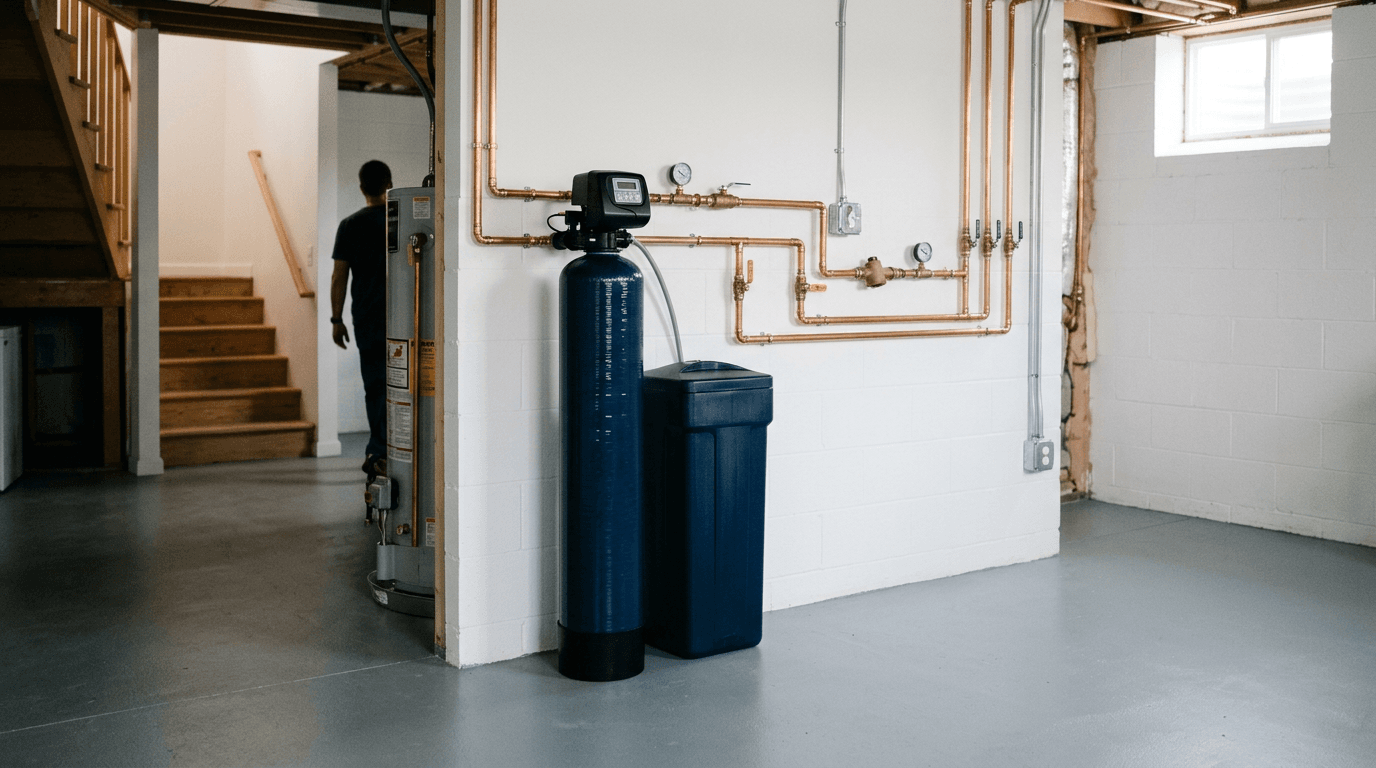
The core of a softening system is a mineral tank filled with millions of microscopic, porous plastic beads called resin. These beads are typically made of cross-linked polystyrene divinylbenzene. During manufacturing, the resin is given a permanent negative electrical charge.
Because opposites attract, these negatively charged beads attract positively charged ions. The system is initially loaded with sodium ions (Na+), which have a weak positive charge. When hard water flows through the resin bed, the calcium (Ca2+) and magnesium (Mg2+) ions enter the tank. Because calcium and magnesium have a much stronger positive charge than sodium, they aggressively bond to the resin beads, kicking the sodium ions off into the water stream. The hard minerals are trapped in the tank, and soft water flows into the house.
The Five-Stage Regeneration Cycle
Eventually, every resin bead becomes saturated with calcium, and the system can no longer soften the water. To restore capacity, the control valve initiates a regeneration cycle using a concentrated saltwater solution (brine) from the adjacent salt tank.
- Backwash: Water flows upward through the resin bed, lifting and expanding it to flush out dirt and iron particles.
- Brine Draw: The system pulls the concentrated sodium brine into the mineral tank. The sheer overwhelming volume of sodium forces the calcium and magnesium to break their bonds with the resin.
- Slow Rinse: The calcium and magnesium are flushed down the drain, leaving the resin beads coated in fresh sodium.
- Fast Rinse: The resin bed is packed back down and rinsed of any remaining excess salt.
- Brine Refill: Fresh water is added back to the salt tank to create brine for the next cycle.
Practical rule: Always use high-purity pellet salt rather than rock salt. Rock salt contains dirt and impurities that accumulate at the bottom of the brine tank, eventually forming a hard crust (a salt bridge) that prevents the system from drawing brine and regenerating the resin.
Hard Water vs Soft Water: The Daily Differences
The chemical differences between hard water and soft water dictate how every fluid interacts with your home, your skin, and your cleaning products.
When you use soap in hard water, the sodium stearate (the active ingredient in soap) reacts immediately with calcium to form calcium stearate. Calcium stearate is an insoluble, sticky precipitate commonly known as soap scum. Instead of lathering and cleaning, the soap binds to the minerals, leaving a dull film on glass shower doors, stiffening laundry fibers, and clogging skin pores. Soft water lacks these reactive minerals, allowing soap to lather instantly and rinse away completely.
| Metric | Hard Water Impact | Soft Water Impact |
|---|---|---|
| Appliance Lifespan | Reduced by 30-50% due to scale buildup on heating elements. | Maximized to manufacturer specifications; no scale insulation. |
| Soap & Detergent Usage | Requires up to 50% more product to overcome mineral interference. | Requires minimal product; lathers instantly and rinses clean. |
| Fabric Wear | Mineral deposits cause fibers to become stiff, brittle, and faded. | Fabrics remain soft, retain colour longer, and wash cleaner. |
| Plumbing Fixtures | Showerheads and aerators clog; glass doors develop permanent etching. | Fixtures remain clear; glass dries without chalky white spotting. |
Residents dealing with specific distribution lines in Leduc often notice that switching to soft water completely changes their cleaning routines. Without the calcium interference, homeowners must drastically reduce the amount of laundry detergent and dish soap they use, as the standard doses will create an overwhelming excess of suds.
Total Water Refinement: Combining Softening with Reverse Osmosis
While ion exchange is the definitive solution for protecting plumbing, it is not a drinking water purification method. The softening process trades calcium for sodium. While the amount of sodium added is minimal - roughly equivalent to the sodium in a slice of white bread per litre - many homeowners prefer their drinking water to be entirely free of dissolved solids, sodium, and municipal chlorine.
This is where layered filtration becomes necessary. A whole-home softener handles the heavy lifting, protecting the pipes and water heater from scale. A point-of-use Reverse Osmosis (RO) system is then installed under the kitchen sink to purify the drinking and cooking water. RO works by forcing water through a semi-permeable membrane at high pressure, stripping out sodium, heavy metals, chlorine, and trace pharmaceuticals.
Packages like the Triton Pure and Triton Pure Tankless are engineered around this exact division of labour. The softener acts as a shield for the house, while the RO system acts as a shield for the human body. Furthermore, feeding soft water into an RO system significantly extends the life of the RO membrane, as it prevents calcium scale from blinding the microscopic pores of the filter.
Diagnosing and Testing Your Home's Supply
You cannot accurately diagnose water hardness by looking at a municipal water report alone. While the city provides an average baseline, the actual hardness at your kitchen tap fluctuates based on seasonal river runoff, the distance from the treatment plant, and the age of the municipal pipes leading to your property. Even in newer developments throughout Beaumont, the fundamental chemistry of the water requires localized testing to calibrate equipment correctly.
Visual symptoms are the first indicator: white crust around faucets, a persistent ring in the toilet bowl, and glassware that looks cloudy straight out of the dishwasher. However, before attempting to repair or service a failing water softener, you must measure the exact hardness level to determine if the resin bed is exhausted.
Conducting an in-home water test requires titration drops rather than cheap paper test strips. A titration test involves adding a chemical reagent drop by drop to a water sample until the colour changes. The number of drops required directly correlates to the grains per gallon of hardness. This precise measurement is the only way to program a softener's control valve accurately, ensuring it regenerates exactly when needed - neither wasting salt through premature regeneration nor allowing hard water to slip through by regenerating too late.
FAQ
What is the difference between temporary and permanent hardness?
Temporary hardness is caused by dissolved bicarbonate minerals (calcium bicarbonate) and can be reduced by boiling the water, which forces the minerals to precipitate as scale. Permanent hardness is caused by sulfate and chloride compounds, which do not precipitate upon boiling. A water softener removes both types through ion exchange.
Does a water softener make the water salty?
No. The ion exchange process replaces calcium with sodium, not sodium chloride (table salt). The resulting water contains a small amount of sodium, but it does not taste salty. For those on strict low-sodium diets, a reverse osmosis system at the kitchen sink will remove this residual sodium.
Why does soft water feel slippery on the skin?
Hard water leaves a layer of soap scum (calcium stearate) on your skin, which creates a squeaky, high-friction feeling that many people mistake for being clean. Soft water rinses all the soap away, leaving only your skin's natural oils. The slippery feeling is simply your clean, hydrated skin without a layer of mineral residue.
How long does the resin in a water softener last?
Standard 8% cross-linked resin typically lasts 10 to 15 years. However, high levels of municipal chlorine or chloramine will oxidize the plastic beads, causing them to turn to mush and restrict water flow. Upgrading to 10% cross-linked resin or installing a whole-home carbon filter to remove chlorine will significantly extend the resin's lifespan.
Can I use potassium chloride instead of sodium chloride in my softener?
Yes. Potassium chloride works exactly the same way as sodium chloride in the ion exchange process, replacing calcium with potassium instead of sodium. It is a great alternative for watering plants or for those avoiding sodium, though potassium chloride pellets are generally more expensive than standard softener salt.