Understanding UV Light Water Treatment and Carbon Filtration in Edmonton
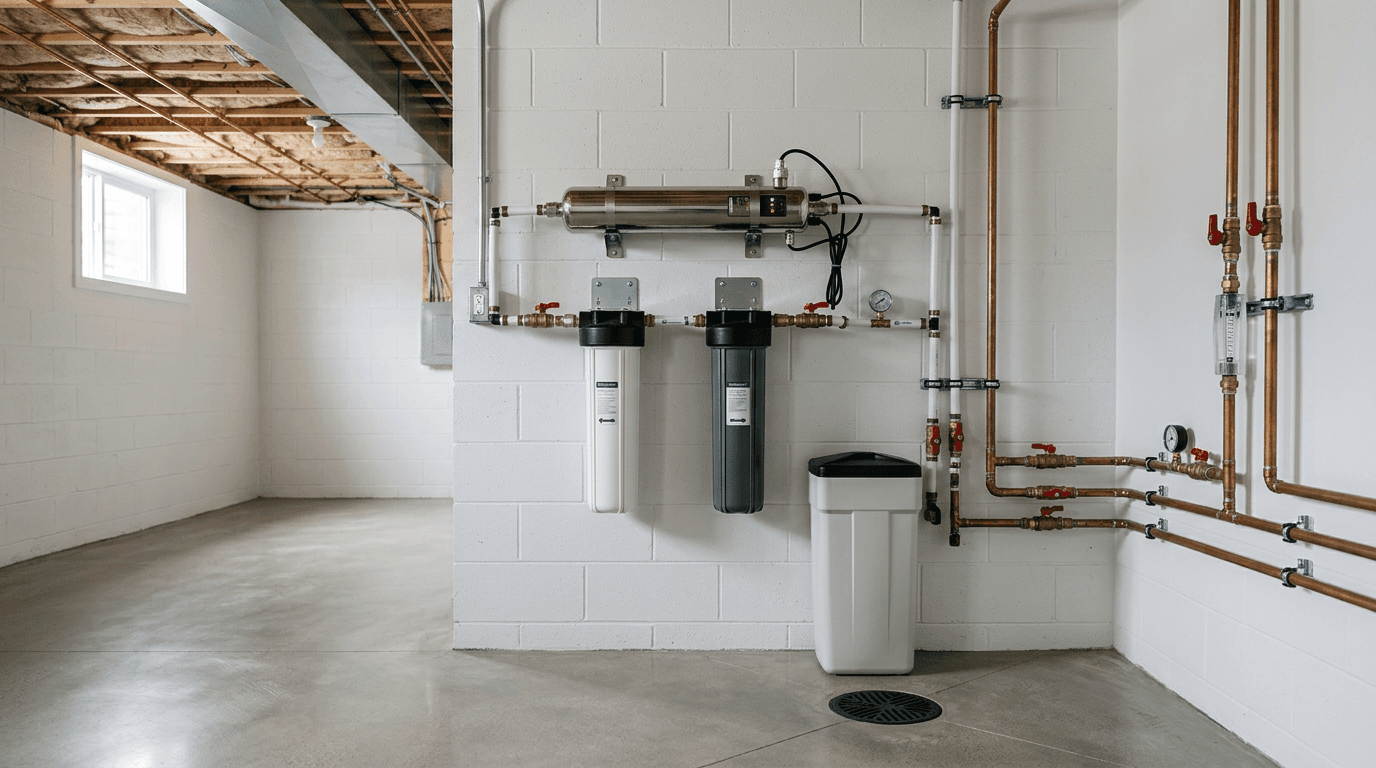
A drop of water leaving Edmonton's municipal treatment plants carries a precisely calibrated dose of chlorine and chloramine to survive its journey through kilometres of underground infrastructure. By the time it reaches a kitchen tap, that chemical payload has done its job of preventing bacterial growth in the municipal mains. However, that exact protective measure becomes a liability for household appliances, skin health, and drinking water taste. Addressing the residual chemicals and secondary pipeline contamination at the residential level requires a specific combination of mechanical, chemical, and biological barriers, usually culminating in UV light water treatment and advanced media filtration.
Quick Summary
Municipal water treatment guarantees safe transit through city infrastructure, but those protective chemicals and accumulated pipeline debris degrade home water quality. Complete residential treatment requires a strategic sequence of filtration stages, beginning with physical extraction, utilizing carbon media to strip chemical additives, and ending with ultraviolet purification to secure ongoing biological safety.
- Carbon filtration operates through physical adsorption, capturing chlorine and volatile organic compounds before they enter household plumbing.
- Ultraviolet purification uses 254-nanometre light wavelengths to scramble the DNA of microorganisms, neutralizing them without adding further chemicals.
- Filtration sequence dictates system lifespan; exposing a UV quartz sleeve to hard, unsoftened water rapidly destroys its transmittance.
- Combined residential solutions must account for local North Saskatchewan River water parameters, which average 165 mg/L of hardness.
Table of Contents
- Why municipal treatment is only the first phase
- How a carbon water filter strips chemical contaminants
- Where a UV water filter steps in against biological threats
- Why the sequence of filtration dictates system survival
- What combined treatment setups actually make sense
- How to identify failure modes in your treatment sequence
- FAQ
- Recommended Reads
Why municipal treatment is only the first phase
Water sourced from the North Saskatchewan River undergoes rigorous processing to meet municipal safety guidelines. The primary goal of utility providers is ensuring that the water remains pathogen-free while traveling through massive distribution networks. To achieve this, water is heavily dosed with chlorine or chloramine, a stable compound designed specifically not to dissipate rapidly.
While this strategy works perfectly for mass distribution, it presents distinct problems at the residential endpoint. Chlorine degrades the rubber seals inside dishwashers, washing machines, and refrigerator ice makers. It strips natural oils from human skin during hot showers, leading to irritation. Furthermore, aging underground infrastructure between the plant and your home introduces sediment, rust, and pipe scale that the initial municipal treatment could not predict.
Evaluating your home's baseline is critical before specifying any equipment. Reviewing a localized Edmonton water hardness and quality guide provides a starting point for understanding exactly what suspended solids and chemical residuals arrive at your property. Treating this water requires removing what the utility added for transit, neutralizing what the transit pipes introduced, and softening the underlying mineral content inherent to the river source.
How a carbon water filter strips chemical contaminants
Extracting dissolved chemicals from water is fundamentally different from catching dirt in a sieve. It relies on chemical kinetics and surface area. When water flows through a properly designed carbon water filter, it encounters activated carbon - a material that has been treated with steam or chemicals to create millions of microscopic pores.
The mechanics of physical adsorption
Carbon filtration works via adsorption, not absorption. Rather than soaking up contaminants like a sponge, the activated carbon provides a massive surface area where chemical molecules become trapped by Van der Waals forces. When chlorine molecules touch the carbon surface, a chemical reaction occurs that converts the active chlorine into harmless chloride ions.
This process is strictly dependent on contact time. If water rushes through the carbon bed too quickly, the chemical reaction remains incomplete, and chlorine bleeds through to the household taps. This is why sizing a whole-home de-chlorination tank correctly matters; undersized units cannot slow the water down enough during peak morning usage to ensure complete adsorption.
Practical rule: Never size a whole-home carbon filter based solely on the pipe diameter; size it based on the peak flow rate of the home (measured in gallons per minute) to guarantee sufficient contact time for chlorine reduction.
Why a carbon block water filter prevents channeling
In point-of-use applications, such as undersink reverse osmosis systems, the physical structure of the carbon is critical. Early designs relied on Granular Activated Carbon (GAC), which resembles coarse black sand. Over time, high-pressure water forces its way through the path of least resistance in a GAC bed, carving microscopic rivers through the media. This phenomenon, known as channeling, allows water to bypass the carbon entirely.
Modern residential systems utilize a solid carbon block water filter to solve this. By compressing powdered activated carbon into a dense, solid cylinder under extreme heat and pressure, manufacturers eliminate the possibility of channeling. Every drop of water is forced to navigate an intricate maze of dense carbon pores. This highly restrictive path not only maximizes chemical adsorption but also acts as a mechanical barrier for microscopic cysts and fine sediment.
Where a UV water filter steps in against biological threats
Chemical extraction makes water pleasant to consume and gentle on appliances, but it deliberately removes the only barrier protecting the home from bacterial growth: the chlorine residual. Once water is de-chlorinated, any bacteria introduced through a localized pipe break, a boil water advisory, or well water contamination can multiply rapidly in the home's warm plumbing lines.
A UV water filter serves as the ultimate biological safeguard. It does not physically remove anything from the water. Instead, it blasts the water stream with ultraviolet light at a precise wavelength of 254 nanometres. When bacteria, viruses, or chlorine-resistant cysts like Cryptosporidium and Giardia are exposed to this specific frequency, the UV energy penetrates their cell walls and permanently scrambles their DNA. They lose the ability to reproduce, rendering them entirely harmless to humans.
However, ultraviolet purification is strictly line-of-sight. If a microorganism can hide behind a particle of sediment, a flake of rust, or a microscopic shadow cast by cloudy water, it survives the chamber. This fundamental limitation dictates the entire architecture of a modern water treatment system. UV cannot function in a vacuum; it requires perfectly clear, highly pre-filtered water to guarantee that the 254-nanometre light reaches every corner of the stainless steel reactor.
Why the sequence of filtration dictates system survival
Putting the right technologies in the wrong order guarantees a catastrophic system failure. The most common error in residential installations is treating filtration as a series of independent units rather than a cohesive sequence.

Because UV light requires absolute water clarity, heavy mechanical pre-filtration is non-negotiable. A robust water filter housing must be installed immediately where the water enters the home, containing a 5-micron spun polypropylene sediment filter. This captures the sand, silt, and municipal pipe scale that would otherwise cast shadows inside the UV chamber.
More importantly, the underlying chemistry of Edmonton water dictates the placement of the ultraviolet system. The local water supply averages 165 mg/L (9.6 grains per gallon) of calcium and magnesium hardness. Inside a UV system, the ultraviolet lamp is protected by a clear quartz sleeve. If hard water flows over this sleeve, the heat generated by the UV lamp causes the calcium to instantly bake onto the quartz glass, creating an opaque white scale. Within weeks, the UV transmittance drops to zero, completely nullifying the biological protection.
For a system to survive, the sequence must be strictly enforced:
- Sediment Pre-filtration: Catches the physical debris.
- Carbon Filtration/De-chlorination: Removes the chemical residuals.
- Ion Exchange Softening: Extracts the calcium and magnesium.
- Ultraviolet Purification: Secures the physically and chemically clean water against biological threats.
Installing a dedicated water softener in Leduc or similar outlying regions ahead of a UV array is not an optional upgrade; it is a mandatory prerequisite to keep the quartz sleeve transparent.
What combined treatment setups actually make sense
Homeowners often struggle to choose between whole-home (Point of Entry) and point-of-use equipment. The reality is that an effective residential setup uses both, deploying specific technologies where they yield the highest return on investment.
For a household looking to address hardness, chlorine, and premium drinking water simultaneously, combined packages like the Triton Pure and Triton Pure Tankless configurations offer a structured approach. The primary defense happens at the utility room, where a high-capacity water softener strips the scale-forming minerals, protecting the home's water heater, fixtures, and downstream filtration equipment.
Below is a comparison of how different technologies target specific residential water problems:
| Treatment Technology | Target Contaminants | Installation Point | Required Maintenance |
|---|---|---|---|
| Ion Exchange Softener | Calcium, Magnesium (Hardness) | Whole-home (Point of Entry) | Replenish sodium chloride salt regularly. |
| Whole-Home Carbon | Chlorine, Chloramine, VOCs | Whole-home (Point of Entry) | Replace media bed every 5-7 years. |
| Carbon Block Matrix | Trace chemicals, organic compounds | Point of Use (Under Sink) | Replace cartridge every 6-12 months. |
| Reverse Osmosis (RO) | Total Dissolved Solids, Heavy Metals | Point of Use (Under Sink) | Replace pre-filters annually, membrane every 3-5 years. |
| Ultraviolet (UV) | Bacteria, Viruses, Cysts | Whole-home or Point of Use | Replace lamp annually, clean quartz sleeve. |
For families upgrading to a comprehensive water softener in Beaumont, integrating an advanced reverse osmosis system at the kitchen sink provides bottled-water quality precisely where it is consumed. RO systems utilize multiple stages of carbon blocks alongside a semi-permeable membrane to strip water down to its molecular base. In rural applications or homes under frequent municipal boil water advisories, a whole-home UV system is then added as the final stage in the utility room to guarantee biological safety for every tap in the house.
Practical rule: Whenever replacing a UV lamp (required every 365 days of operation), physically remove the quartz sleeve and clean it with a mild acidic solution, such as white vinegar, to strip invisible mineral fouling that blocks UV transmittance.
How to identify failure modes in your treatment sequence
Water treatment equipment degrades silently. Unlike a furnace that stops blowing hot air or a pipe that visibly leaks, a compromised filtration system simply begins passing contaminated water. Recognizing the specific symptoms of failure allows you to intervene before scale ruins an appliance or chlorine damages a membrane.
Symptom 1: A distinct drop in household water pressure.
This is rarely a plumbing failure; it is almost always a saturated physical filter. When a sediment cartridge inside its housing becomes completely packed with municipal silt, it acts as a physical wall. Homeowners often mistake this for a failing municipal supply. The fix is strictly mechanical: isolate the housing, depressurize the line, and replace the pleated or spun cartridge.
Symptom 2: The return of chlorine odors at the showerhead.
Carbon media has a finite adsorption capacity. Once every microscopic pore is filled with trapped chemical molecules, the carbon becomes exhausted. Water continues to flow freely, but the chemical reaction ceases. If you notice a faint bleach smell returning to your hot water, the whole-home de-chlorination tank requires a media re-bed, or your undersink carbon cartridges are past their lifespan.
Symptom 3: Rapid scaling on kettles and glass shower doors.
If a home has a softener installed but white, chalky residue begins appearing, the ion exchange resin has stopped functioning. This usually happens for one of two reasons: a salt bridge has formed in the brine tank, preventing the system from drawing the sodium needed to regenerate, or the resin beads have been destroyed by chlorine.
Because systems require site-specific calibration to function properly, guessing at the root cause often leads to wasted money on unnecessary filter changes. The most effective diagnostic step is to book a free water test in Edmonton to measure the exact hardness, chlorine levels, and total dissolved solids bypassing the current setup. Data, rather than guesswork, must drive the repair strategy.
Similarly, homeowners installing a water softener in Sherwood Park must recognize that maintaining these systems is an ongoing commitment. The most sophisticated sequence of sediment, carbon, ion exchange, and ultraviolet purification is only as reliable as its strictest maintenance schedule. Ignoring a filter change does not just compromise that specific stage; it cascades, allowing chlorine to melt softener resin, hardness to blind UV sleeves, and bacteria to colonize carbon blocks.
FAQ
Does a UV system make the water taste better?
No. Ultraviolet light only alters the DNA of microorganisms; it does not remove dissolved minerals, chemicals, or the compounds that cause foul tastes and odors. Taste improvement requires carbon filtration or reverse osmosis.
Why does my whole-home filter housing look cloudy inside?
If the clear sump of your filter housing appears foggy, it usually indicates microscopic air bubbles trapped in the water or a buildup of fine silt against the plastic. If the water itself is cloudy, the filter cartridge has likely bypassed or failed and requires immediate replacement.
Can I install a carbon filter without a water softener?
Yes, carbon systems operate independently of hardness levels. A carbon unit will successfully remove chlorine and organics even in very hard water. However, if you add a UV system to the sequence, a softener becomes necessary to prevent the quartz sleeve from scaling over.
How often should a carbon block cartridge be replaced?
Cartridges must be replaced based on time, not just capacity. Even if you have not reached the manufacturer's stated gallon limit, a carbon block should be swapped every 6 to 12 months. After this period, the de-chlorinated environment inside the filter housing becomes an ideal breeding ground for harmless but unwanted bacterial biofilms.
Are municipal boil water advisories handled by carbon filters?
No. Standard filtration cannot safely extract bacteria or viruses during a boil water advisory. Only a dedicated Class A ultraviolet system, paired with adequate pre-filtration, is certified to neutralize pathogens safely under those conditions.