Understanding Water Filtration and Softeners: The Complete Treatment Process
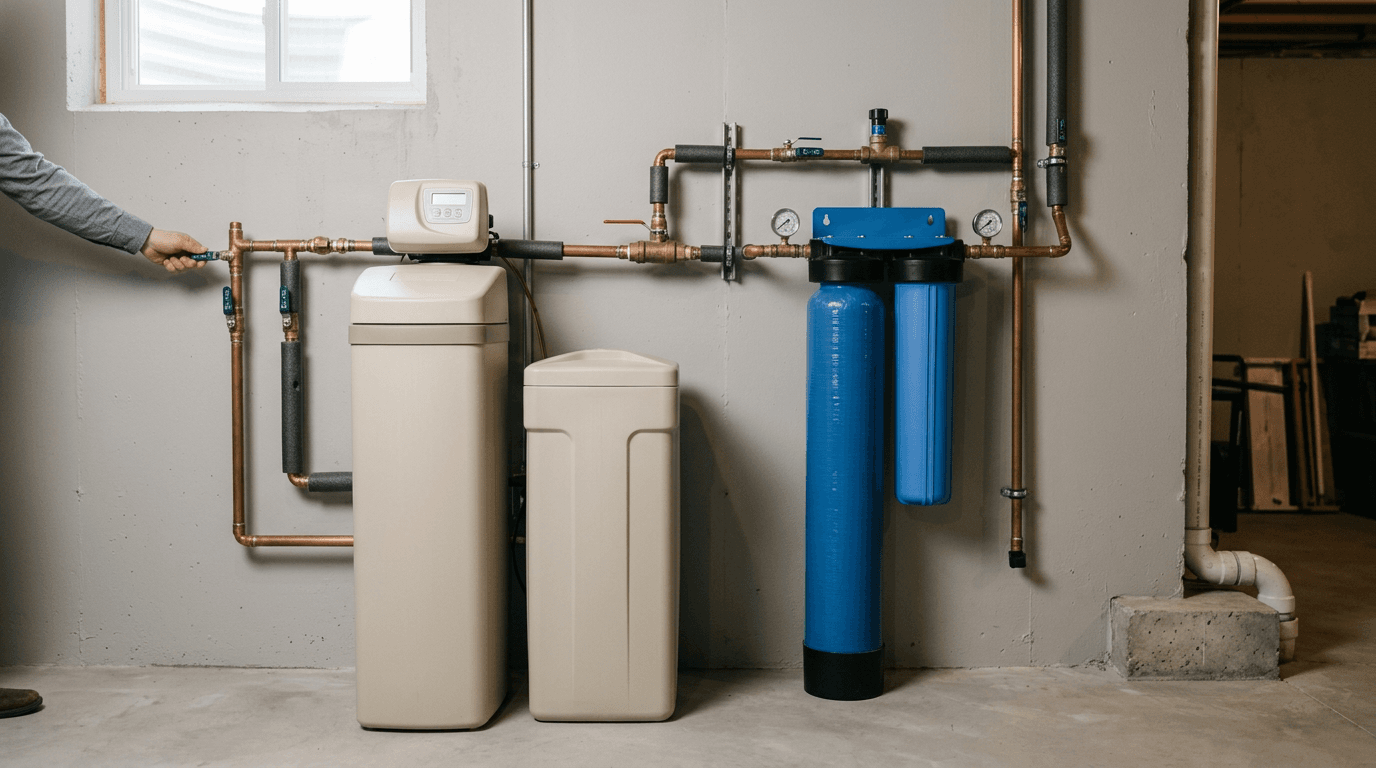
A common misconception among homeowners is that a water softener and a water filter do the same job. In reality, a softener is designed strictly to remove hard minerals like calcium and magnesium, while a filter targets chemicals, sediment, and odours. If you are dealing with scale buildup on fixtures alongside a distinct chlorine taste from the tap, assuming one single tank will fix both issues usually ends in disappointment.
Before investing in residential water treatment, it helps to break down the specific stages of a comprehensive water treatment process. We evaluate these distinct water treatment steps based on two criteria: the specific contaminants they are physically capable of removing, and where they belong in your home's plumbing sequence.
Quick Summary
Choosing between a water filtration and softener system depends entirely on your specific water chemistry. While softeners tackle mineral hardness that destroys appliances, filtration handles the chemicals and particulates that affect taste, smell, and health. Understanding how these distinct components work together allows you to build an effective home treatment strategy.
- Mechanical filters block physical sediment and debris.
- Softeners use ion exchange to remove calcium and magnesium.
- Carbon filtration pulls chlorine and chemical odours from the supply.
- Reverse osmosis pushes water through a membrane for high-purity drinking water.
- Combining processes yields the highest quality water for both plumbing and drinking.
Table of Contents
- 1. Sediment Filtration for Water Treatment
- 2. Ion Exchange Water Softening in Water Treatment
- 3. Carbon Filtration for Water Treatment
- 4. Reverse Osmosis (RO) Purification
- 5. Whole-Home Combined Systems
- 6. Specialized Iron Filtration
- 7. Integrated Point-of-Use Packages
- FAQ
- Recommended Reads
1. Sediment Filtration for Water Treatment
Mechanical sediment pre-filtration is the very first stage in most robust water treatment steps. It is designed for homeowners who receive water containing suspended solids, dirt, sand, or rust flakes. Installed at the point of entry where the water main enters the house, this filter acts as the frontline defender for the rest of your plumbing and subsequent treatment equipment.
The mechanism is remarkably straightforward. Water is forced through a pleated, spun, or string-wound cartridge with microscopic pores, typically rated between 5 and 50 microns. As the water passes through, physical particles larger than the pore size become trapped in the filter media. This prevents abrasive debris from entering your home, protecting sensitive valve seals inside downstream softeners and preventing sediment from clogging aerators.
Physical barriers, not chemical changers
A sediment filter does one job exceptionally well, but it is often misunderstood as a comprehensive purifier. It will clarify cloudy water caused by physical dirt, but it will not alter the water's chemical makeup.
The honest limit of mechanical pre-filtration is that it ignores dissolved solids entirely. If your water contains dissolved calcium, magnesium, chlorine, lead, or bacteria, those contaminants will pass straight through a 5-micron sediment filter as if it were not there. Homeowners relying solely on a sediment filter to improve water taste or protect against hard water scale will see absolutely no improvement. Furthermore, these cartridges require regular physical replacement; ignoring a clogged sediment filter will inevitably lead to a severe drop in household water pressure.
2. Ion Exchange Water Softening in Water Treatment
Water softening in water treatment is a specialized process aimed at one specific problem: hard water. For residents in the capital region, dealing with the heavy mineral content of the North Saskatchewan River makes this an almost mandatory consideration. A water softener is installed at the main line to protect water heaters, dishwashers, and showerheads from destructive scale, while simultaneously alleviating the dry skin and stiff laundry associated with hard water.

The core mechanism is ion exchange. The system contains a tank filled with negatively charged resin beads, which are pre-loaded with sodium or potassium ions. Because calcium and magnesium ions carry a stronger positive charge, they are magnetically drawn to the resin beads as the hard water flows through. The beads grab the hardness minerals and release a harmless amount of sodium into the water in exchange. Once the resin is saturated, the system automatically flushes the tank with a brine solution to strip away the calcium and recharge the beads.
Trading sodium for destructive scale
Ion exchange is the only proven way to physically remove scale-causing minerals from an entire residential water supply at high flow rates. It operates continuously and regenerates automatically, requiring minimal homeowner intervention beyond adding salt to the brine tank.
However, a water softener cannot function as a filter. It does absolutely nothing to remove chlorine, chloramines, volatile organic compounds (VOCs), or heavy metals. If your tap water smells like a swimming pool before a softener is installed, it will still smell like a swimming pool afterward. Additionally, those who are strictly monitoring their sodium intake for medical reasons may want to implement a separate drinking water filter, as the softening process does add a minor amount of sodium to the tap water.
3. Carbon Filtration for Water Treatment
Carbon filtration for water treatment is designed to address the chemical aspects of your water supply. It is specifically aimed at homeowners who find their municipal water unpalatable due to chlorine, chloramines, or distinct chemical odours. Whole-home dechlorination tanks are typically installed directly before or after a water softener to provide clean, odourless water to every tap and shower in the house.
The mechanism relies on adsorption rather than physical blocking. Activated carbon is incredibly porous, possessing a massive internal surface area. As water flows through the carbon bed, chemical molecules like chlorine and various organic compounds are trapped inside the millions of microscopic pores on the carbon's surface. This process effectively strips the water of the chemicals municipalities use for disinfection, preventing you from inhaling chlorine vapours in a hot shower and vastly improving the taste of tap water.
Excellent chemical absorption, poor mineral handling
Carbon filtration is unmatched when it comes to removing chemical tastes and odours without dramatically restricting flow rates. A quality carbon tank can process thousands of gallons of water, keeping your entire home chemical-free.
Carbon filtration is entirely ineffective against inorganic minerals or heavy dissolved solids. This means a carbon filter will not soften water, so it cannot stop scale buildup on your faucets or water heater. If you run hard Edmonton water through a standalone carbon filter, you will get great-tasting hard water that still ruins your appliances. Furthermore, if the water contains high levels of physical sediment or iron, the microscopic pores of the carbon media will quickly become fouled and blinded, rendering the chemical adsorption useless.
Practical rule: Always install a carbon filter before a reverse osmosis membrane, but never rely on carbon alone to stop hard water scale from forming on your plumbing fixtures.
4. Reverse Osmosis (RO) Purification
Reverse osmosis represents the highest level of residential water filtration. It is designed for homeowners who want bottled-water quality directly from their kitchen sink, stripping out almost all Total Dissolved Solids (TDS), including trace pharmaceuticals, heavy metals, and fluoride. Unlike whole-home systems, RO is typically a point-of-use application installed under a specific counter.

The process works by applying household water pressure to force water through a semi-permeable membrane. The pores in this membrane are as small as 0.0001 microns. Water molecules are small enough to pass through the membrane to the clean side, while larger dissolved contaminants are rejected and flushed down the drain. This core step is usually bracketed by sediment pre-filters to catch dirt, carbon pre-filters to catch chlorine (which destroys RO membranes), and a final polishing filter before the water reaches the dedicated faucet.
High purity, slow production rates
Reverse osmosis provides an unmatched level of purification. It removes the stubborn dissolved solids that standard carbon and sediment filters leave behind, resulting in drinking water that is completely free of metallic tastes or chemical residues.
Reverse osmosis systems operate slowly and produce significant wastewater. The membrane is so tight that it processes water very slowly, drop by drop, which is why traditional systems require a storage tank to hold the purified water until you need it. Because it relies on flushing contaminants away, RO systems also send a portion of water down the drain for every gallon they purify. It is entirely unsuited for whole-home application; trying to run a whole house on RO requires commercial-grade pumps and massive holding tanks, making it an impractical choice for treating shower or toilet water.
5. Whole-Home Combined Systems
For homeowners seeking a complete solution to both hard water and chemical additives, combining water filtration and softener technologies into a point-of-entry sequence is the standard approach. This setup is ideal for large families or environmentally conscious residents who want chemical-free showers and scale-free appliances without managing multiple piecemeal devices.
The mechanism involves staging the equipment in a specific sequence. Water first hits a whole-home dechlorination carbon tank to strip out the municipal chlorine. Because chlorine degrades the softening resin over time, removing it first actually protects the downstream equipment. The water then flows into the ion exchange water softener, where the calcium and magnesium are removed. The result is water that is both chemically clean and physically soft by the time it reaches the water heater and splits off to the various bathrooms and kitchen fixtures.
Comprehensive coverage, higher initial footprint
A combined point-of-entry approach guarantees that every appliance and fixture in the home is protected from scale, while simultaneously ensuring that no one is showering in chlorinated water. It treats the problem holistically rather than fixing water one tap at a time.
Opting for a combined setup demands substantial physical space and a major upfront commitment. You need dedicated floor space in a utility room, access to the main water line, a nearby floor drain, and a power outlet. It is a permanent infrastructure upgrade. Furthermore, while it makes the water excellent for bathing and general household use, it does not achieve the ultra-high purity level of reverse osmosis for drinking water. Homeowners in older homes with cramped mechanical rooms may struggle to fit both a carbon tank and a softener side by side.
6. Specialized Iron Filtration
Iron filtration is a highly specific water treatment process geared toward homes on private wells rather than municipal city water. When water is drawn directly from the ground, it often contains dissolved ferrous iron that remains clear until it hits the air, at which point it oxidizes and leaves severe orange rust stains on toilets, sinks, and laundry.
The mechanism uses oxidation and mechanical trapping. Water passes through a specialized media bed (such as Birm or Manganese Greensand) or a tank that introduces a pocket of compressed air. As the dissolved iron passes through the air or oxidizing media, it rapidly changes from a dissolved state into physical rust particles. The filter media then catches these solid rust flakes. The system periodically backwashes, reversing the flow of water to lift the trapped iron out of the media and flush it down the drain.
Targeted oxidation, unnecessary for municipal supplies
An iron filter is the only reliable way to stop severe rust staining and metallic-tasting water on a rural well system. It oxidizes and removes iron concentrations that would quickly foul and destroy a standard water softener.
This specialized technology is entirely redundant for homes connected to municipal water lines. Municipal treatment plants already remove iron before the water enters the city mains. Selling an air-injection iron filter to a homeowner on city water is a severe misapplication of technology. Furthermore, iron filters require very specific flow rates to backwash properly; if your well pump cannot deliver the required gallons per minute, the heavy iron particles will not lift out of the media during the backwash cycle, causing the tank to plug solid and fail.
7. Integrated Point-of-Use Packages
Rather than attempting to achieve drinking-water purity for the entire house, integrated point-of-use packages separate the workload. This approach combines a whole-home softener to protect the plumbing with a dedicated under-sink system for consumption. Our Triton Pure and Triton Pure Tankless packages utilize this exact strategy, pairing a robust softener with a kitchen RO unit.
The mechanism isolates the heavy lifting. The water softener sits in the utility room, removing the harsh calcium and magnesium from the entire supply. When that softened water reaches the kitchen sink, it enters the point-of-use reverse osmosis system. Because the RO system is now receiving soft water, its delicate membrane does not get scaled up by calcium, dramatically extending its lifespan. The RO system then removes the sodium added by the softener, along with the remaining dissolved solids, delivering pristine water to the dedicated drinking faucet.
Strategic placement, localized benefits
This two-tiered integration represents the most efficient use of residential water treatment technology. It applies high-volume softening exactly where it is needed (plumbing protection) and low-volume, ultra-tight filtration exactly where it matters (consumption), lowering the overall maintenance costs of the RO membrane.
These packaged systems restrict ultra-pure water strictly to the kitchen tap and the refrigerator ice maker. If a homeowner expects RO-quality water from their bathroom vanity or their shower, this system will not provide it. It requires an acceptance that bathing water and drinking water have different purity requirements. Additionally, installing a tankless RO requires sufficient space under the kitchen sink and access to a dedicated power outlet, which older kitchens may lack without minor modifications.
Practical rule: Never feed extremely hard water directly into a reverse osmosis system if you can avoid it; pre-softening the water is the single best way to ensure the RO membrane survives its full expected lifespan.
FAQ
Do I need both a water softener and a water filter?
Yes, if you want to remove both hard minerals and chemical tastes. A softener removes calcium to protect plumbing, while a filter removes chlorine and organic compounds for better taste and smell.
What goes first in the water treatment process: filter or softener?
Whole-home carbon filters should always be installed before the water softener. Removing chlorine first protects the softener's resin beads from chemical degradation, extending the life of the softening system.
Does a water softener filter out drinking water contaminants?
No. Softeners only target calcium, magnesium, and trace amounts of dissolved iron. They do not remove lead, chlorine, pesticides, or other harmful drinking water contaminants.
Why does a reverse osmosis system need a pre-filter?
RO membranes are incredibly delicate. Sediment pre-filters prevent physical dirt from plugging the microscopic pores, while carbon pre-filters remove chlorine, which would otherwise chemically melt the RO membrane.