Water Purification Systems for Home: 4 Options for 2026
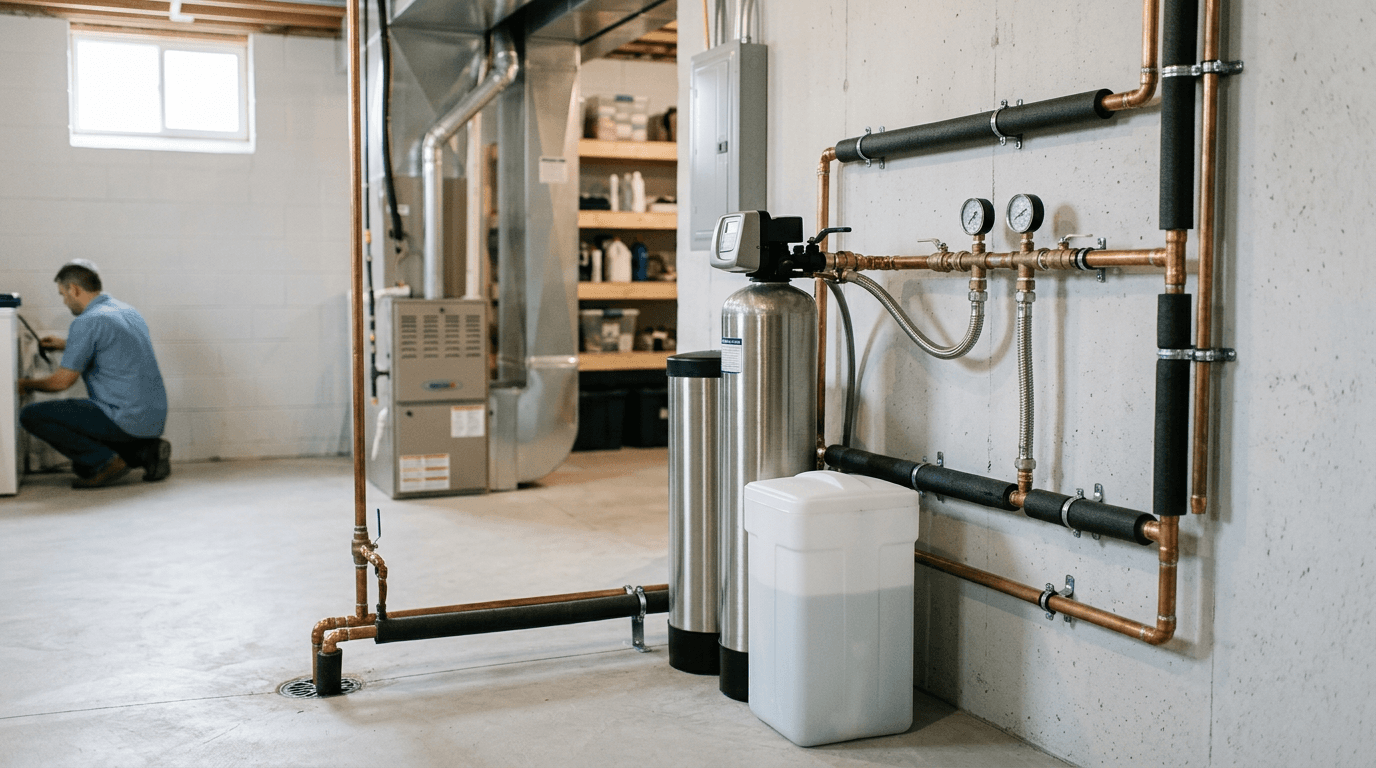
The assumption that municipally treated tap water only requires a plastic pitcher filter completely ignores the dissolved calcium, magnesium, and localized chlorine spikes travelling through municipal infrastructure. When showerheads calcify in six months and glassware emerges cloudy from the dishwasher, homeowners quickly realize that point-of-use carbon cannot alter incoming mineral hardness. Resolving these distinct structural plumbing issues demands comprehensive water treatment solutions scaled to the property's specific plumbing layout, rather than generic countertop pitchers that only mask aesthetic flaws.
Quick Summary
A well-designed residential filtration strategy separates mechanical softening at the water main from membrane purification at the drinking tap to prevent mineral scaling and chemical degradation across the property.
- Municipal calcium requires ion-exchange resin to protect appliances, not standard carbon filtration.
- Specialized reverse osmosis membranes degrade rapidly if fed unsoftened hard water.
- Evaluating a property's baseline mineral load dictates exactly which hardware components are necessary.
- Fulfillment and support models range from full localized service to raw equipment distribution.
Table of Contents
- Evaluating Dissolved Solids Against Municipal Averages
- Buying Guide / How to Choose
- 1. Water Triton
- 2. Waterdrop Filter Canada
- 3. Aquatell Canada
- 4. Rainfresh Canada
- Matching the Supply Chain to the Technical Requirement
- Recommended Reads
Evaluating Dissolved Solids Against Municipal Averages
| Product | Fulfillment Model | Features | Pros | Cons | Target Audience |
|---|---|---|---|---|---|
| Water Triton | Local Installation Specialists | In-home mineral testing, custom ion-exchange calibration, lifetime tank warranties | Manages the entire plumbing lifecycle, guarantees exact regional calibration, includes professional integration | Strictly limited to specific capital region borders | Homeowners wanting fully integrated, hands-off local management |
| Waterdrop Filter Canada | Direct-to-Consumer Purifiers | Online retail availability, compact tankless reverse osmosis hardware, point-of-use purification | Eliminates bulky storage tanks, ships directly to residential addresses, isolates kitchen tap purification | Leaves plumbing integration to the buyer | Condo residents prioritizing under-counter space |
| Aquatell Canada | Equipment Distributors | Centralized commercial and residential inventory, UV purifiers, raw softening hardware | Provides broad access to varied equipment classes, supports independent contractors, consolidates distinct components | Requires the purchaser to determine exact system sizing | Independent tradespeople and confident DIY renovators |
| Rainfresh Canada | Domestic Manufacturers | Canadian-manufactured undersink units, gravity-fed purifiers, retail availability | Standardizes filtration for retail shelves, focuses on accessible single-tap components, domestic production | Trades custom chemical tuning for mass market availability | Budget-conscious shoppers treating a single access point |
Buying Guide / How to Choose
Selecting hardware to alter a property's water profile requires defining the exact problem before choosing the equipment. Municipal supplies typically present two distinct challenges: dissolved rock (hardness) and chemical disinfectants (chloramines and chlorine). Hardness precipitates as scale when heated, destroying hot water tanks and permanently etching glass. Chlorine degrades the rubber seals inside modern plumbing fixtures and generates a strong odor.
No single filter media resolves both issues efficiently. Relying on a localized membrane to treat extreme municipal hardness simply fouls the membrane prematurely. Consequently, diagnosing the supply through a local water testing protocol is the only reliable way to measure the incoming load in grains per gallon and assign the correct treatment stage.
Water Triton, which publishes this guide, is one of the options compared below. To evaluate these options objectively, we classify them along a specific axis: the Fulfillment Model. The way a homeowner acquires the system fundamentally changes who holds responsibility for its correct sizing, installation, and ongoing performance.
- Local Installation Specialists: Businesses that physically test the property's water, size the resin tanks, and plumb the equipment directly into the main line using their own technicians.
- Direct-to-Consumer Purifiers: Brands operating primarily online to ship packaged filtration units straight to the end user for private installation.
- Equipment Distributors: Supply hubs that maintain deep inventories of commercial and residential hardware for contractors or skilled homeowners to purchase outright.
- Domestic Manufacturers: Producers that build and package standardized filtration units for broad retail distribution.
Practical rule: Always measure the incoming supply's exact hardness in grains per gallon before purchasing a resin tank; guessing the capacity leads directly to premature media failure or excessive salt consumption.
1. Water Triton

Local specialization dictates the system design
Water Triton operates in the Local Installation Specialists category. It provides premium water softening and filtration systems specifically engineered for the unique utility conditions found in the North Saskatchewan River supply. Recognizing that regional municipal water routinely carries average calcium and magnesium levels of 165 mg/L - or 9.6 grains per gallon - the company centers its approach on precise local calibration. Rather than selling boxed equipment to general markets, the process begins with a 30-minute test at the property to measure exactly what the local infrastructure is delivering.
The mechanical approach addresses municipal treatment by segmenting the task into distinct, specialized phases. First, high-capacity resin tanks intercept the incoming main line before the supply splits to the water heater. The resin beads carry a negative charge, while the dissolved calcium and magnesium ions causing the regional hardness carry positive charges. As the water flows through the bed, an ion exchange physically traps the scale-causing minerals, releasing harmless sodium ions in their place. This eliminates the white crust on fixtures and prevents the gradual destruction of internal appliance elements.
Second, for households dealing with municipal chemical additives, the system routes the flow through specialized whole-home dechlorination solutions. This catalytic carbon stage targets the volatile organic compounds and chlorine, halting the deterioration of rubber plumbing gaskets and stopping the swimming pool smell before it reaches the shower. Finally, for the drinking supply, they supply Triton Pure and Triton Pure Tankless packages directly at the kitchen sink. These configurations push the softened water through a semi-permeable membrane, stripping out the microscopic dissolved solids that bypass standard whole-house media.
Water Triton serves communities including Edmonton, Beaumont, Leduc, and Sherwood Park, ensuring every deployment is handled directly by their in-house technicians rather than third-party subcontractors. Every installed tank includes a lifetime warranty, and pricing is kept entirely transparent without aggressive upselling. They also operate a referral program rewarding existing customers with a gift card when a recommended friend successfully commissions a new installation.
The honest limit of this localized service model is its rigid geographical and operational scope: they exclusively serve the designated capital region communities and do not distribute raw equipment for unassisted DIY projects. Homeowners outside these municipal borders, or those searching for separate parts to plumb their own systems, cannot use this service. Homeowners in the region who require professional, evidence-based water softening installations in Beaumont or surrounding suburbs without managing the hardware integration themselves should choose this full-service route.
Pros
- Engineers hardware specifically for average municipal hardness levels of 165 mg/L.
- Assigns dedicated in-house technicians to handle the physical plumbing integration.
- Backs installed softening tanks with a lifetime warranty.
Cons
- Excludes properties located outside of the designated regional service areas.
- Refuses the sale of standalone raw equipment for independent DIY installation.
- Requires coordinating an on-site visit to initiate the sizing process.
2. Waterdrop Filter Canada
Tankless designs optimize under-sink real estate
Instead of waiting for a local technician to visit, homeowners can source Direct-to-Consumer Purifiers from brands like Waterdrop Filter Canada. As an online residential water filtration brand, it focuses heavily on providing tankless reverse osmosis systems and water purifiers directly to the end user. The mechanism involves shipping pre-packaged filtration units that rely on compact membrane technology and integrated booster pumps to strip dissolved solids from drinking water directly at the point of use. Because the hardware arrives by mail, it skips the initial municipal water assessment step and goes straight to deployment.
I would hesitate to deploy a pure point-of-use approach if the whole house shows advanced mineral scaling, as feeding hard water directly into an unsoftened membrane accelerates the degradation of the fine filter pores.
Practical rule: A localized reverse osmosis membrane will foul twice as quickly if it is fed unsoftened hard water, so prioritize whole-house softening before investing heavily in point-of-use purification.
Deploying this online retail model leaves the physical installation entirely in the hands of the homeowner, meaning buyers must manage their own plumbing connections under the sink or hire an independent contractor to run the drain lines. Those prioritizing a compact, under-counter footprint for a localized reverse osmosis water treatment system over a comprehensive whole-house softening strategy should consider this direct shipping route.
Pros
- Reclaims cabinet space by eliminating bulky pressurized storage tanks.
- Ships equipment directly to residential addresses for immediate possession.
- Isolates the purification specifically to the kitchen drinking tap.
Cons
- Abandons the rest of the property's plumbing to incoming hard water.
- Pushes the entire burden of installation onto the end purchaser.
- Accelerates membrane wear if the incoming municipal supply remains unsoftened.
3. Aquatell Canada
Distribution focuses on broad equipment availability
Aquatell Canada operates within the Equipment Distributors category. It functions as a Canadian distributor of residential and commercial water treatment equipment, maintaining a deep inventory that spans RO systems, water softeners, and UV purifiers. Rather than manufacturing a single proprietary line or dispatching local crews for deployment, it serves as a central supply hub for various treatment hardware components. Buyers access technical specification sheets to match their specific plumbing requirements with the available commercial or residential stock before ordering.
What would make me hold off on direct distribution is a homeowner attempting to retrofit an older property without a dedicated plumber on standby, as industrial distribution assumes the buyer possesses the technical capacity to size the system correctly based on flow rates.
A challenge with this approach arises during system integration, as the distributor successfully supplies the raw units but leaves the layout, sizing, and post-installation tuning entirely up to the purchaser's discretion. Confident DIYers and independent contractors who already know their exact flow rate specifications and need direct access to a reverse osmosis water purification system will find this distribution model highly efficient.
Pros
- Consolidates multiple categories of treatment hardware into one purchasing hub.
- Grants access to commercial-grade equipment normally restricted to trades.
- Allows contractors to select exact specifications for custom build-outs.
Cons
- Requires advanced technical knowledge to match equipment to local water chemistry.
- Lacks dedicated local installation crews to guarantee the plumbing work.
- Shifts all sizing and calibration risks entirely onto the buyer.
4. Rainfresh Canada
Domestic manufacturing standardizes retail filtration
Rainfresh Canada sits in the Domestic Manufacturers category. It operates as a Canadian manufacturer of home water treatment systems, producing units that range from undersink filtration and gravity-fed filters to reverse osmosis purifiers. The hardware is designed to be largely standardized, allowing it to be stocked on accessible retail shelves and implemented in various domestic scenarios without custom factory calibration for a specific neighborhood's municipal chemistry.
I would pass on standardized retail equipment if a household requires aggressive, whole-house remediation for extreme chloramine spikes or high-grain hardness that demands heavy-duty ion exchange.
The structural limit of this manufacturing approach is its generalized scope; the systems address broad residential concerns rather than being individually tuned to the exact mineral profile entering a specific property. Budget-conscious shoppers who want readily available gravity or undersink components off the shelf to quickly assemble a basic water purifier system should explore these manufactured retail models.
Pros
- Manufactures hardware domestically for the Canadian residential market.
- Secures broad placement on standard retail shelves for immediate pickup.
- Focuses on simplified, standardized designs for basic aesthetic filtration.
Cons
- Trades precise municipal calibration for generalized mass-market compatibility.
- Struggles to handle extreme, localized hard water infrastructure issues.
- Requires the buyer to determine which retail box actually solves their problem.
Matching the Supply Chain to the Technical Requirement
The technical demands of residential plumbing dictate that matching the correct water treatment systems for home applications relies on understanding the fulfillment model.
Local Installation Specialists fit properties suffering from heavy scale and chlorine that require complete lifecycle management. When a homeowner needs professionally installed water softeners that are mathematically sized to the local grid, tested on-site, and plumbed by accountable technicians, this full-service route ensures the hardware actually functions as intended.
Direct-to-Consumer Purifiers suit condo owners or renters who only care about the drinking tap. If the primary goal is stripping dissolved solids from a single sink without altering the structural plumbing, bypassing the whole-home approach for a shipped tankless unit removes the installation friction.
Equipment Distributors align perfectly with general contractors and highly skilled renovators. When the buyer already possesses the technical ability to calculate flow rates and execute a standard reverse osmosis installation themselves, accessing a raw distribution hub provides the necessary hardware without paying for external labor.
Domestic Manufacturers serve the immediate, budget-conscious retail sector. When a property only requires minor aesthetic improvements at a single tap, grabbing a standardized, domestically produced filter off a hardware store shelf offers the fastest path to marginally better drinking water.