Water Softener vs Reverse Osmosis: Comparing Edmonton Treatment Systems
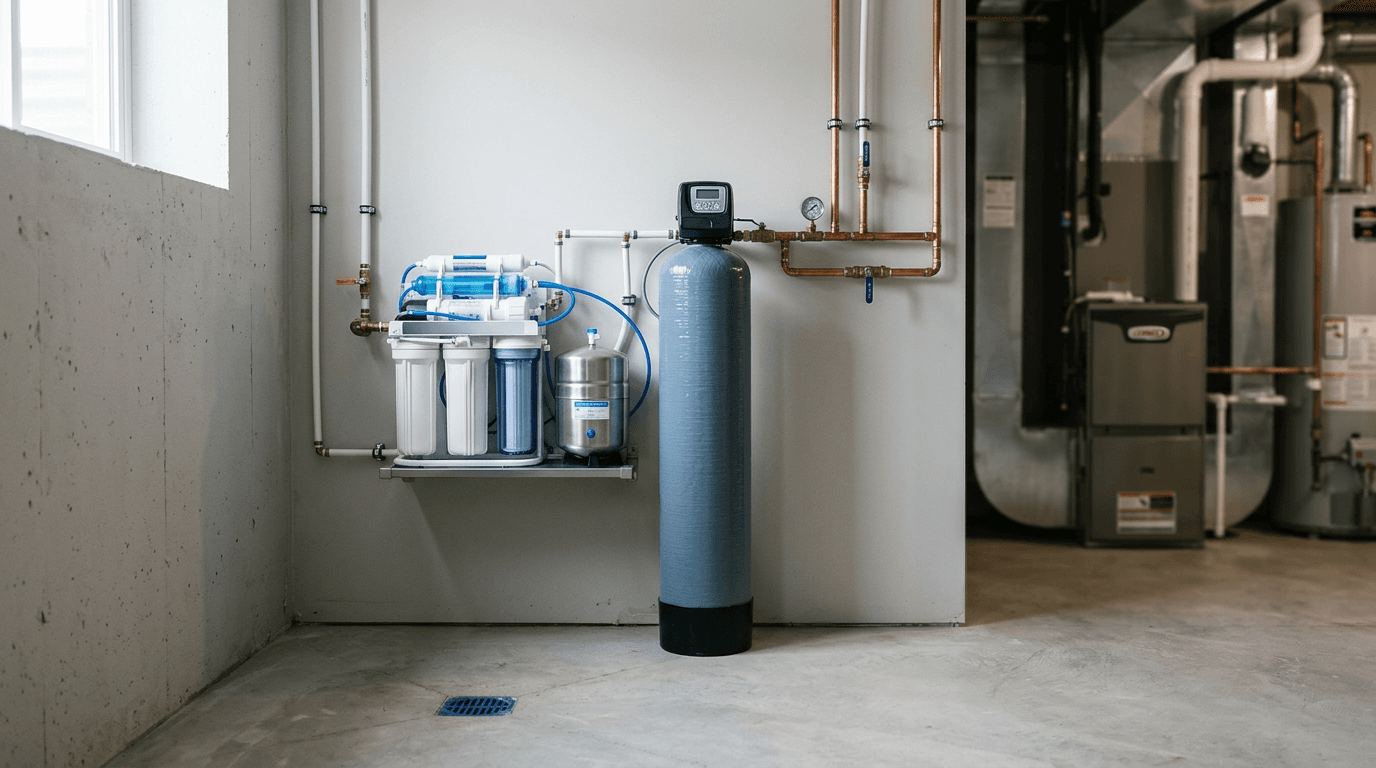
A common misconception among Edmonton homeowners is that tackling hard water and improving drinking water quality require the exact same equipment. They do not. When evaluating a water softener vs reverse osmosis, the distinction comes down to what you are trying to remove: dissolved minerals that destroy plumbing, or microscopic contaminants that alter taste. Edmonton’s municipal water supply carries an average hardness of 165 mg/L (9.6 grains per gallon), which drives many residents to seek treatment, but choosing the wrong system leaves the actual problem unsolved.
Quick Summary
The choice between a water softener and reverse osmosis depends entirely on your treatment objective. Softeners use ion exchange to remove calcium and magnesium, protecting pipes and appliances from scale. Reverse osmosis forces water through a semi-permeable membrane to purify drinking water at a single tap.
- Softeners treat the whole home but do not purify drinking water.
- Reverse osmosis purifies drinking water but cannot handle whole-home flow rates.
- Carbon filters remove chlorine taste but leave hard minerals intact.
- Edmonton’s hard water often requires combining both technologies for complete treatment.
Table of Contents
- Comparison Table
- How to Choose Your Filtration Approach
- 1. Ion Exchange Water Softeners
- 2. Tank-Based Reverse Osmosis
- 3. Tankless Reverse Osmosis
- 4. Whole-Home De-chlorination
- 5. Combined Softening and RO Solutions
- Mapping Your Edmonton Home's Needs
- Recommended Reads
Comparison Table
| System Category | Treatment Objective | Features | Pros | Cons | Target Audience |
|---|---|---|---|---|---|
| Traditional Water Softeners | Scale Prevention | Ion exchange resin, brine tank, metered regeneration | Prevents scale buildup, protects appliances, improves skin hydration | Requires salt refills, does not remove chemical contaminants, takes up floor space | Edmonton homeowners with scale buildup |
| Tank-Based Reverse Osmosis | Point-of-Use Purification | Semi-permeable membrane, storage tank, dedicated faucet | Highly purified water, low upfront cost, distinct taste improvement | Slow production rate, consumes under-sink space, produces wastewater | Households wanting bottled-quality tap water |
| Tankless Reverse Osmosis | Point-of-Use Purification | Direct-flow membrane, compact design, integrated pump | Continuous water flow, minimal footprint, highly efficient | Higher initial investment, requires electrical outlet, potential membrane scaling | Homes with limited cabinet space |
| Whole-Home De-chlorination | Aesthetic Filtration | Granular activated carbon, high flow valve, backwashing | Removes chlorine taste, no filter cartridges, protects softeners | Does not soften water, cannot remove heavy metals, requires backwash drain | Environmentally conscious residents disliking chlorine |
| Combined Softening and RO Solutions | Comprehensive Treatment | Softener plus RO integration, multi-stage defense | Complete home protection, pure drinking water, synergistic operation | Highest initial cost, complex installation, requires routine maintenance | Large families and new homeowners |
How to Choose Your Filtration Approach
Navigating the options requires defining exactly what you want the system to achieve. Comparing a water softener vs water filter is impossible without establishing the underlying objective. The market categorizes residential water treatment along a primary axis of Treatment Objective, which separates systems by their actual mechanical function rather than their marketing promises.
Scale Prevention systems are designed exclusively to target the calcium and magnesium that create hard water. They do not make water safer to drink; they make it less destructive to your home's infrastructure.
Point-of-Use Purification systems focus entirely on producing small volumes of highly refined water for consumption. They operate at low flow rates and sit near the kitchen sink.
Aesthetic Filtration systems target the chemical additives, primarily chlorine, that municipalities use for disinfection. They improve the sensory experience of water across the entire home but leave the mineral content untouched.
Comprehensive Treatment combines these mechanisms, acknowledging that Edmonton, Beaumont, Leduc, and Sherwood Park often present both hard water and chlorine taste issues simultaneously.
1. Ion Exchange Water Softeners
Many homeowners only start looking into scale prevention when a relatively new dishwasher fails or shower glass becomes permanently etched. Ion exchange water softeners are the structural defense against Edmonton’s 9.6 grains per gallon water hardness. They are installed at the main water line, treating every drop before it enters the household plumbing.
The mechanism relies on a resin tank filled with negatively charged beads. These beads are initially coated with sodium ions. As hard water flows through the tank, the positively charged calcium and magnesium ions are drawn to the resin, displacing the sodium into the water stream. Once the resin is saturated with hard minerals, the system flushes them down the drain using a saltwater brine, resetting the beads for the next cycle.
Whole-home protection requires active maintenance
Ion exchange systems require consumable salt and cannot filter chemical contaminants. Homeowners must routinely haul heavy bags. This keeps the brine tank filled. Furthermore, if you are debating a water softener vs filter for drinking water quality, a softener alone will disappoint you. It leaves chlorine, chloramines, and trace organics completely untouched.
Practical rule: If your primary complaint is the taste or smell of your tap water, a softener is the wrong tool. Softeners fix infrastructure problems, not culinary ones.
Choose an ion exchange water softener when your primary goal is extending the lifespan of your plumbing and appliances, and alleviating dry skin caused by hard water.
Pros
- Eliminates white scale on fixtures entirely
- Dramatically extends the lifespan of water heaters
- Reduces the amount of soap and detergent required
Cons
- Mandates regular heavy lifting for salt replenishment
- Adds a marginal amount of sodium to the diet
- Requires a floor drain and electrical outlet for installation
2. Tank-Based Reverse Osmosis
The question of water softener or reverse osmosis often arises when families tire of buying bottled water. Tank-based reverse osmosis represents the traditional approach to point-of-use purification, stripping tap water down to its basic molecular components right beneath the kitchen sink.

These systems push water through a series of pre-filters before forcing it against a semi-permeable membrane with microscopic pores. Because household water pressure is relatively low, this membrane processes water very slowly - often drop by drop. To ensure you have water when you open the tap, the system stores the purified water in a small, pressurized holding tank. When you turn on the dedicated RO faucet, air pressure inside the tank pushes the water out.
Storage constraints limit on-demand availability
The honest limit of a tank-based system is its finite capacity and spatial footprint. Once you empty the typical two-to-three-gallon storage tank, you must wait hours for the system to process more. Additionally, the holding tank consumes the majority of the usable space beneath a standard kitchen counter, making it a poor fit for cramped apartment kitchens or complex cabinetry layouts.
Choose a tank-based reverse osmosis system when you want highly purified drinking water at the lowest possible upfront installation cost, and have ample cabinet space to sacrifice.
Pros
- Produces exceptionally pure drinking water
- Operates without requiring an electrical connection
- Represents the most cost-effective entry into RO purification
Cons
- Runs out of water during heavy usage periods
- Dominates under-sink storage space
- Relies on rubber bladders that can degrade over time
3. Tankless Reverse Osmosis
A common frustration with traditional under-sink filters is running the tank dry while filling a large pasta pot. Tankless reverse osmosis systems remove this bottleneck by generating purified water in real-time, matching the Point-of-Use Purification category without the storage constraints.
Instead of relying entirely on household line pressure, tankless systems incorporate an internal booster pump. This pump aggressively forces water through a high-capacity semi-permeable membrane the moment you open the tap. The increased pressure allows the membrane to process water fast enough to provide a steady stream directly to the faucet, bypassing the need for a pressurized holding tank entirely.
Mechanical complexity introduces new dependencies
Operating a tankless RO system requires constant electrical power and leaves the membrane vulnerable to extremely hard water. Because these units require an internal pump, they must be plugged into an under-sink outlet. If your home experiences a power outage, your purified water access stops. Furthermore, without a pre-softener, pushing heavily mineralized water rapidly through the membrane can accelerate scaling and shorten the membrane's lifespan.
Opting for a tankless reverse osmosis system makes sense when you demand continuous, unlimited purified water for cooking and drinking, provided you have an accessible under-sink power source.
Pros
- Supplies an endless stream of purified water
- Frees up significant space in the kitchen cabinet
- Reduces the volume of wastewater compared to tank models
Cons
- Costs substantially more upfront than traditional units
- Requires a dedicated electrical outlet to operate
- Generates a slight humming noise while the pump runs
4. Whole-Home De-chlorination
Environmentally conscious residents often seek a way to remove the pervasive smell of municipal chlorine without installing restrictive under-sink units. Whole-home de-chlorination addresses Aesthetic Filtration by treating the water immediately after it enters the house, before it splits to the various bathrooms and the kitchen.
This mechanism relies on a large tank. It is filled with granular activated carbon. As municipal water flows through the carbon bed, the highly porous surface area traps chlorine molecules and organic compounds through adsorption. Periodically, the system reverses the water flow to backwash the media. This lifts and churns the carbon. Doing so flushes out trapped sediment and prevents the bed from compacting, which ensures consistent flow rates throughout the home.
Aesthetic improvement does not alter mineral hardness
A carbon de-chlorination tank cannot soften water or remove heavy metals. If you are debating reverse osmosis vs water softener, realize that a carbon filter replaces neither. It will not stop scale from destroying your water heater, nor will it remove microscopic dissolved solids from your drinking glass. It exists solely to eliminate chemical tastes and odors.
Practical rule: Pair a carbon filter with a softener if you want comprehensive protection; the carbon removes the chlorine that would otherwise slowly degrade the softener's ion exchange resin.
Installing a whole-home de-chlorination system works best when your primary grievance is the smell of a swimming pool when you run the shower, and you want a zero-maintenance approach to fixing it.
Pros
- Eradicates chlorine odor from every tap and shower
- Operates for years without requiring cartridge replacements
- Protects downstream plumbing fixtures from chemical degradation
Cons
- Fails to prevent calcium and magnesium scale buildup
- Requires access to a floor drain for the backwash cycle
- Cannot purify water to the level of reverse osmosis
5. Combined Softening and RO Solutions
When new homeowners arrive in Edmonton, they frequently realize that neither a softener nor a filter alone solves the entire municipal water puzzle. Comprehensive Treatment packages, such as combining a central softening unit with dedicated RO systems, offer a multi-staged defense mechanism.
The system works sequentially. The whole-home softener intercepts the municipal feed, trading hard minerals for sodium ions. This conditioned, soft water then travels through the home's plumbing. When it reaches the kitchen sink, the reverse osmosis unit takes over. Because the water entering the RO membrane is already free of scale-causing calcium, the RO system operates at peak efficiency, stripping out the sodium added by the softener alongside any remaining trace contaminants.
Maximum protection requires maximum investment
Deploying combined setups introduces a double burden of cost and labor. Purchasing and installing two distinct mechanical systems represents a significant upfront capital expenditure. It also means managing two different maintenance schedules: monitoring salt levels for the central unit while tracking membrane and pre-filter lifespans for the under-sink system.
Choose a combined softening and RO solution when you want absolute control over both your home's infrastructure health and your family's drinking water quality, and are prepared for the initial financial outlay.
Pros
- Delivers optimal water quality for both appliances and drinking
- Softened feed water dramatically extends RO membrane life
- Removes the sodium trace introduced by the softening process
Cons
- Represents the highest initial installation cost
- Requires maintenance tracking for two separate technologies
- Demands space at both the main water line and the kitchen sink
Mapping Your Edmonton Home's Needs
Selecting the right system means aligning the technology with your specific pain points, evaluated through the categories of our treatment objective lens.
For Scale Prevention, when the issue is failing appliances, stubborn white residue on shower glass, and dry skin after bathing, a traditional ion exchange water softener is the necessary intervention.
For Point-of-Use Purification, if your primary concern is the taste, odor, or microscopic purity of the water you actually consume, reverse osmosis is the solution. Choose tank-based systems for cost efficiency, or upgrade to tankless models if under-sink space is at a premium.
For Aesthetic Filtration, if the smell of chlorine during a hot shower is the main grievance and scale is not a concern, a whole-home de-chlorination tank provides a low-maintenance remedy.
For Comprehensive Treatment, when facing the full spectrum of Edmonton's hard, chlorinated water, combining a softener with a dedicated reverse osmosis unit - such as the Triton Pure or Triton Pure Tankless packages - ensures both your plumbing infrastructure and your drinking water are fully protected.