Water softening ion exchange explained: what it changes in your home's plumbing
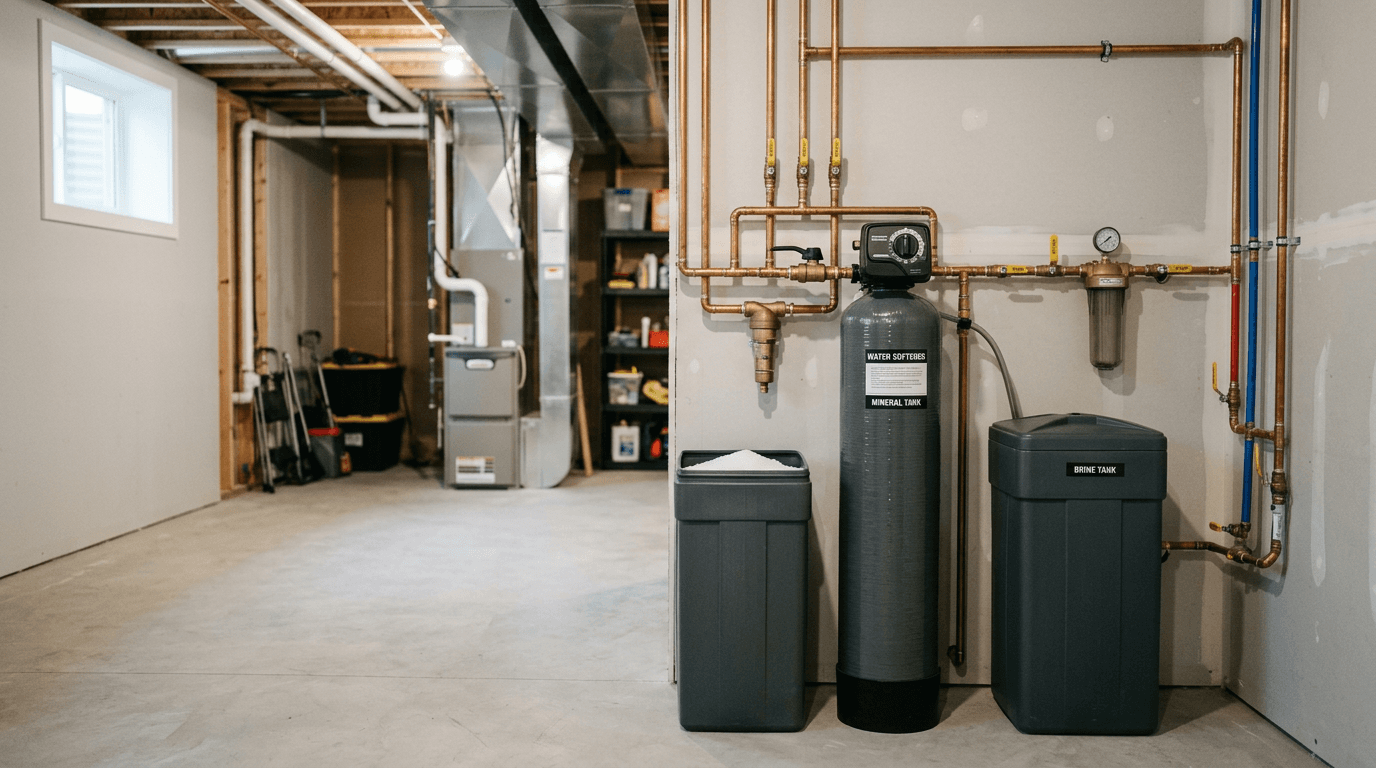
The clue usually shows up on chrome before it shows up in a test report: a white crust around the faucet aerator, glassware that never looks fully rinsed, and a water heater that starts sounding slightly rougher year by year. In Edmonton homes, that pattern often points to hardness minerals - mainly calcium and magnesium - and the practical question is not whether soft water feels nicer, but what water softening ion exchange is actually doing inside the tank and why that matters to pipes, fixtures, and appliances.
Quick Summary
Water softening ion exchange is a treatment process that swaps hardness minerals such as calcium and magnesium for sodium or potassium on a resin bed. The result is water that forms far less scale inside plumbing and appliances, but it does not remove chlorine, sediment, or every dissolved substance.
- Hardness causes scale because calcium and magnesium precipitate onto hot and evaporating surfaces.
- Ion exchange works by trading those minerals for another positively charged ion on resin beads.
- A softener protects plumbing differently than a filter - it changes the minerals rather than straining them out.
- If chlorine taste or odour is the complaint, softening alone is the wrong fix.
Table of Contents
- Water softening ion exchange is a chemistry problem before it is a plumbing purchase
- Ion exchange works because the resin prefers one swap over another
- The biggest mistake is expecting water softening treatment to do every job
- Most visible hard-water symptoms look alike, but the fixes are not the same
- The real water softener benefits show up where water is heated, stored, and left to dry
- Softening in water treatment works best when paired with the right second stage
- A good system fit depends more on raw water and household use than on tank size alone
- Comparison Table
- Who should install this, and who should skip it
- FAQ
- Recommended Reads
Water softening ion exchange is a chemistry problem before it is a plumbing purchase
Hard water is not dirt in the water. That distinction matters because it explains why water softening in water treatment uses exchange chemistry instead of a simple particle filter. The issue is dissolved calcium and magnesium ions. Because they are dissolved, they move straight through ordinary screening media.
In Edmonton and surrounding communities such as Beaumont, Leduc, and Sherwood Park, homeowners often notice hardness first in kettles, shower glass, and water heaters. That tracks with the chemistry. The trouble appears most aggressively where water is heated or allowed to evaporate, because those conditions make hardness minerals come out of solution and stick to surfaces.
Why hardness builds scale instead of simply washing away
When water carries calcium and magnesium bicarbonates, heating shifts that balance. Some dissolved material converts into less soluble forms, including calcium carbonate, which deposits as scale. That is why a hot water tank, heating element, dishwasher interior, and faucet aerator usually show the problem before a cold supply line does.
The important consequence is practical: scale is not only cosmetic. It narrows passages, coats valves, and insulates heating surfaces from the water they are supposed to heat. Even a thin mineral layer changes heat transfer, so equipment has to work through that coating.
What to check in your own home today
Look at three spots: the kettle element or interior, the showerhead nozzles, and the aerator on the bathroom faucet used most often. If the deposits are chalky and reappear quickly after cleaning, hardness is a credible cause. If the residue is slippery, rust-coloured, or leaves black particles, you may be dealing with a different treatment issue altogether.
Practical rule: If the symptom gets worse on hot surfaces and where droplets dry, think hardness first. If it shows up equally in drinking water taste, think beyond a softener.
Ion exchange works because the resin prefers one swap over another
A residential softener is basically a controlled exchange bed. Inside the mineral tank are resin beads carrying exchange sites loaded with sodium or, in some systems, potassium. As hard water passes through, calcium and magnesium ions displace those ions on the resin. That is the core mechanism of softening in water treatment.

What the resin bed is actually doing
The resin is not dissolving into the water and it is not trapping scale like a sponge traps dirt. It is providing charged sites that temporarily hold ions. Hardness ions have a stronger attraction to those sites than the sodium or potassium currently sitting there, so the swap happens as water moves through the bed.
That is why softened water still contains dissolved material - just not the same hardness load as before. The treatment changes the composition enough to reduce scale formation in normal residential use. It does not create pure water.
If you want a plain-language explanation tied to local testing and treatment choices, pages about water softeners in Edmonton with installed pricing and free in-home water testing in Edmonton are relevant because the deciding factor is raw water condition, not just a homeowner's guess from spots on dishes.
Why regeneration is part of the treatment, not a side issue
The resin bed eventually fills up with calcium and magnesium. Once most exchange sites are occupied, hardness starts passing through. Regeneration restores the bed by flushing it with a concentrated brine, which pushes the hardness ions off the resin and reloads the exchange sites with sodium again.
This is where many homeowners oversimplify the process. Regeneration is not maintenance in the casual sense; it is how the chemistry is reset. If settings are wrong for the household's hardness and water use, one of two things happens: the system regenerates too often and wastes salt and water, or too late and allows hardness leakage.
The biggest mistake is expecting water softening treatment to do every job
A softener is excellent at one specific job. Problems start when people expect it to solve taste, odour, chlorine, sediment, or every stain in the house. Water softening treatment should be judged on scale control and hardness reduction, not on whether it behaves like a whole-home filter or a drinking-water purifier.
What a softener changes
It reduces hardness minerals that cause scale and soap interference. That usually means less mineral crust on fixtures, easier lathering, less film on shower glass, and less scaling inside water-using equipment.
For plumbing, the key benefit is internal. A pipe or valve can look fine outside while mineral build-up is already reducing performance in aerators, cartridges, and appliance water paths.
What it does not change
It does not remove chlorine taste and smell by itself. It does not replace reverse osmosis for drinking-water polishing. It does not act as a sediment filter for grit. And it does not correct every water quality complaint that gets lazily labelled as “hard water.”
If chlorine is part of the complaint, the relevant category is whole-home dechlorination in Edmonton, not a softener alone. If the issue is point-of-use drinking water, a page on reverse osmosis and installed systems sits closer to that need than hardness treatment does.
Most visible hard-water symptoms look alike, but the fixes are not the same
The most common misdiagnosis is “everything white is hard water.” In practice, four different issues can produce similar-looking complaints, and each needs a different response.
Four problems homeowners confuse with each other
1. True hardness scale
Symptom: chalky white crust on kettle interiors, showerheads, and around taps, especially where water dries repeatedly.
Mechanism: calcium and magnesium precipitate out, particularly with heat and evaporation.
Check today: remove an aerator and inspect for brittle mineral flakes.
2. Soap film made worse by hardness
Symptom: cloudy shower doors and a dull film on tubs even after cleaning.
Mechanism: soap reacts with hardness ions and leaves residue that is part mineral, part soap scum.
Check today: if the film is heaviest where body wash and shampoo are used, this is likely in the mix.
3. Chlorine taste or odour
Symptom: the water may be clear, with no obvious scale, but smells like a pool or tastes sharp.
Mechanism: disinfectant residual, not hardness.
Check today: compare cold drinking water odour right from the tap with residue on fixtures - if taste is the main complaint, softening is not the main fix.
4. Sediment or corrosion byproducts
Symptom: grit, black specks, or rust-coloured staining.
Mechanism: particulate matter or plumbing corrosion, not ion exchange failure.
Check today: collect water in a clear glass before and after running the tap for a minute.
Of these, true hardness scale is most often the real cause in homes where spots worsen on heated appliances and evaporating surfaces.
The questions that tell you which problem you have
Ask these before deciding on treatment:
- Does the problem appear mainly after water dries, or while drinking it?
- Is it worst on hot-water appliances and shower glass?
- Do you see crusty deposits, a greasy film, or actual particles?
- If a softener is already installed, are the symptoms constant or do they get worse near the end of the regeneration cycle?
Those answers separate hardness from chlorine, soap film, and sediment surprisingly quickly.
The real water softener benefits show up where water is heated, stored, and left to dry
The phrase water softener benefits gets used too loosely. The meaningful benefits are not “better water” in the abstract. They are mechanical and household effects you can verify.

First, fewer scale deposits inside hot-water equipment and fixtures. That matters because valves, cartridges, dishwasher internals, and water heater components all have narrow passages or heat-transfer surfaces where mineral build-up causes trouble long before a pipe fully blocks.
Second, cleaning changes. Soft water lets soaps and detergents rinse differently because they are not reacting as heavily with calcium and magnesium. The reader should take that as a mechanism, not a promise about exact product usage or savings.
Third, some households notice comfort changes on skin, hair, and laundry. That is real for many homes, but it is also subjective. The hard, objective case for a softener is still plumbing protection and scale reduction.
If maintenance planning is part of the decision, a page on water softener service and maintenance in Edmonton is one of the more relevant local references because performance depends on ongoing setup and serviceability, not just the day of installation.
Practical rule: Judge a softener first by whether it controls scale at the fixtures and hot-water equipment that used to build it. Feel and taste come second because they are easier to argue about.
Softening in water treatment works best when paired with the right second stage
Most whole-home water setups are stronger when they are treated as stages, not as one miracle box. A softener addresses hardness. Another stage may address chlorine or drinking-water refinement.
Whole-home carbon and reverse osmosis solve different problems
A whole-home carbon dechlorination tank is for chlorine taste and odour throughout the house. Reverse osmosis is for highly refined water at a dedicated drinking point. Neither is a substitute for ion exchange when the problem is scale in plumbing.
That distinction is useful in Edmonton, Beaumont, Leduc, and Sherwood Park because homeowners often describe one complaint while really having two: hardness on fixtures and chlorine in taste. The treatment path changes depending on whether the complaint is whole-home, point-of-use, or both.
Where combined softener plus RO packages make sense
Combined packages make the most sense when the household wants both plumbing protection and better drinking-water refinement from the kitchen tap. In that setup, the softener handles hardness for the whole house, while the RO system deals with the water meant for direct consumption.
Locally, package names such as Triton Pure and Triton Pure Tankless refer to that combined softener plus RO approach. The practical distinction between tank and tankless RO is delivery style and footprint, not whether the softener chemistry changes.
A good system fit depends more on raw water and household use than on tank size alone
Homeowners often shop by tank size because it is visible and easy to compare. In practice, fit depends on three things working together: incoming hardness, household water use pattern, and whether the goal is hardness only or hardness plus chlorine or drinking-water treatment.
That is why a proper test matters before deciding on equipment. Hardness level, chlorine presence, and the household's peak usage pattern affect regeneration frequency, salt use, and whether breakthrough happens before the system resets.
Where pricing is part of the planning, water softener cost in Edmonton for 2026 prices is a useful local reference point because installed costs vary by the treatment scope, not just by whether a tank is present.
For larger families, the wrong sizing choice usually shows up as inconsistent results - good performance after regeneration, then creeping scale return before the next cycle. For smaller households, the failure mode is often the opposite: a system set too aggressively for actual use.
Comparison Table
| Treatment approach | What it changes | How it works | Best fit | What it will not do |
|---|---|---|---|---|
| Ion-exchange softener | Calcium and magnesium hardness | Exchanges hardness ions on resin for sodium or potassium | Homes with scale, spotting, and hard-water interference | Does not remove chlorine or produce purified drinking water |
| Whole-home carbon dechlorination | Chlorine taste and odour | Adsorbs chlorine through carbon media | Homes bothered by chlorine at every tap | Does not soften hard water |
| Reverse osmosis at point of use | Drinking-water dissolved contaminants | Pushes water through a membrane at a dedicated tap | Households focused on kitchen drinking water | Does not protect whole-home plumbing from scale |
| Combined softener + RO | Whole-home hardness plus drinking-water refinement | Softener treats the house; RO treats consumption water | Homes wanting plumbing protection and refined drinking water | Does not replace whole-home dechlorination if chlorine at showers and laundry is the complaint |
Who should install this, and who should skip it
A residential softener suits homeowners whose main problem is hardness: scale on fixtures, mineral build-up in hot-water equipment, and the familiar pattern of residue where water dries. It is especially relevant in the Edmonton area, including Beaumont, Leduc, and Sherwood Park, where households commonly evaluate hardness alongside chlorine taste concerns.
It is a weaker fit for readers whose only complaint is drinking-water taste, a chlorine smell at the tap, or visible sediment. Those homes may need a different stage of treatment, or a combination rather than a softener alone.
The honest position is this: if your evidence points to hardness, ion exchange is the standard residential answer because it directly changes the dissolved minerals causing the scale. If your evidence points elsewhere, forcing a softener into the job will only leave you with a cleaner-looking tank and the same original complaint.
FAQ
Does water softening remove chlorine?
No. Ion exchange targets hardness minerals, mainly calcium and magnesium. Chlorine taste and odour need a different treatment stage, usually whole-home carbon if the concern is across the house.
Is soft water safe for home plumbing?
Softened water is designed to reduce scale formation in plumbing and appliances by changing the hardness load. The practical result is usually less mineral build-up in fixtures, valves, and hot-water equipment.
Why does my house still have spots after a softener is installed?
There are several possibilities: the spots may be soap film rather than hardness, the system may be undersized or incorrectly set, the resin may be near exhaustion before regeneration, or the problem may not be hardness at all. Check whether the residue is crusty mineral deposit or a wipeable film first.
What is the difference between a softener and reverse osmosis?
A softener treats whole-home hardness using ion exchange. Reverse osmosis refines drinking water at a specific tap using a membrane. They solve different problems and are often paired rather than substituted.
How do I know whether I need softening in water treatment or something else?
Start with the symptom pattern. If the problem is scale on hot or drying surfaces, softness is the likely target. If the problem is taste, odour, or particles in the water, another treatment stage may be the actual need.