Well Water Treatment Systems for Home: Edmonton Filtration Guide
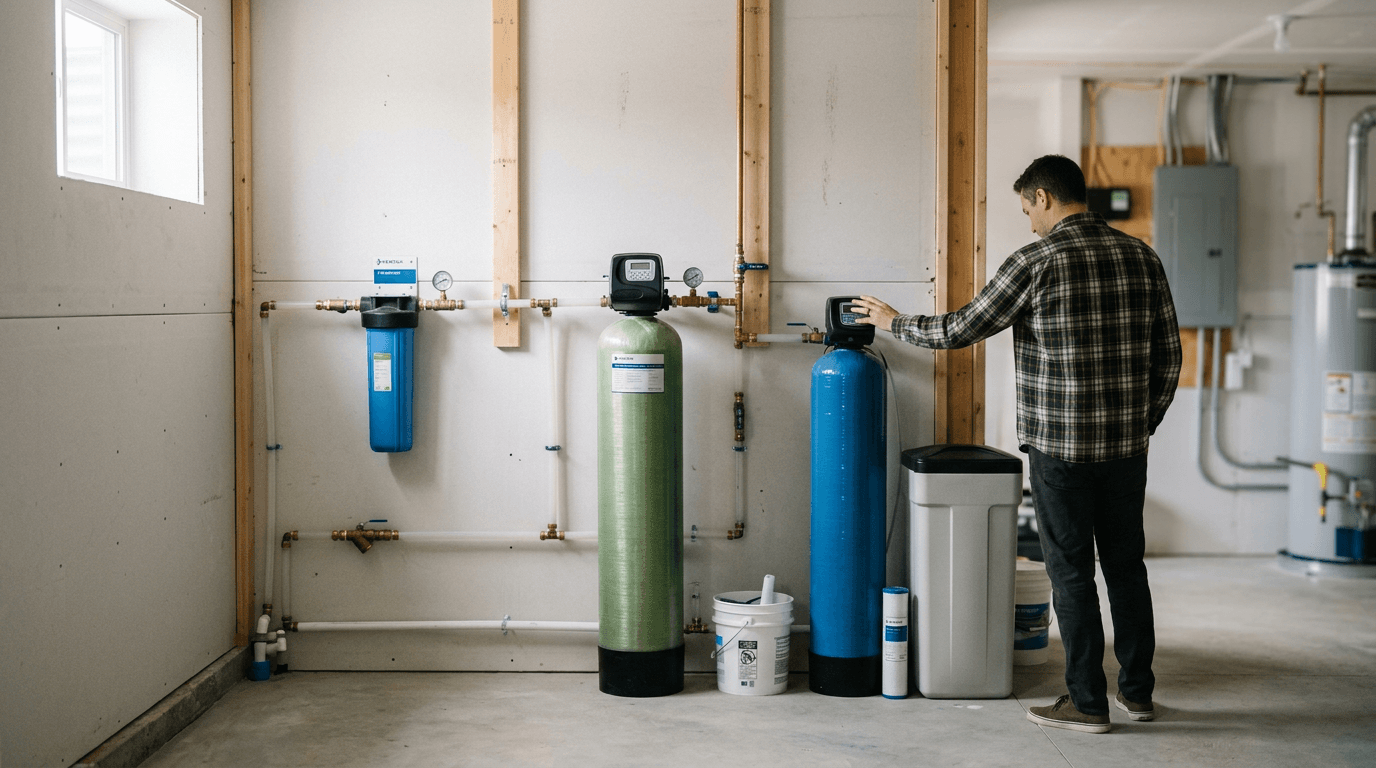
A homeowner drawing from a private well outside Edmonton often faces a sudden realization: the water testing report they just received lists iron, manganese, and hardness levels that make municipal water look pristine. That report is the starting line. Treating well water is not about buying a single, universal filter off a hardware store shelf. It requires a sequence of specialized equipment designed to address the specific contaminants present in that exact aquifer.
Quick Summary
Treating well water effectively requires a sequential approach to filtration and softening, tailored to the specific contaminants identified through professional water testing.
- Test the water first to identify the exact mineral and bacterial load.
- Address heavy metals and sediment before softening the water.
- Use specialized systems like reverse osmosis for drinking water purity.
- Maintain the equipment regularly to prevent bacterial growth and media fouling.
Table of Contents
- Step 1: Test Your Well Water Profile
- Step 2: Remove Sediment and Heavy Metals
- Step 3: Address Water Hardness
- Step 4: Install Point-of-Use Purification
- Common Pitfalls & Troubleshooting
- FAQ
- Recommended Reads
Step 1: Test Your Well Water Profile
Before selecting any well water treatment systems, you must know what you are treating. Well water quality fluctuates based on agricultural runoff, seasonal changes, and the specific geology of your area, whether you are in Beaumont, Leduc, Sherwood Park, or rural Edmonton. A comprehensive water test should screen for iron, manganese, hardness (calcium and magnesium), pH levels, and harmful bacteria like E. coli and coliform.
Without a precise baseline, homeowners often purchase equipment that either fails to address their primary issue or gets rapidly destroyed by an unmeasured contaminant. For example, installing a standard water softener when your iron levels exceed 2 parts per million (ppm) will foul the resin bed within months.
Practical rule: Never buy well water systems based on how the water looks or smells; base your purchase entirely on the results of a certified laboratory or professional in-home test.
Step 2: Remove Sediment and Heavy Metals
The first physical barrier in a well water filtration system is typically a sediment filter, followed by specialized media to remove heavy metals. Well water frequently carries dissolved iron (clear water iron) and manganese. When exposed to oxygen, these minerals precipitate out, causing rust-coloured stains on fixtures and black sludge in toilet tanks.
To treat this, an iron filter utilizing oxidation - often via an air injection system or chemical oxidants like potassium permanganate - forces the dissolved metals into a solid state. The filter media (such as Birm or Katalox Light) then traps these oxidized particles. The system backwashes periodically to flush the trapped metals down the drain.
The mistake many rural homeowners make is relying on a standard string-wound cartridge filter to handle high iron loads. Cartridge filters are designed for minor particulate matter, not heavy metal precipitation. High iron levels will clog a cartridge filter in days, severely restricting water pressure to the entire house.
Step 3: Address Water Hardness
Once sediment and heavy metals are removed, the next step in a whole-home well water treatment setup is softening. Hard water, common in the aquifers around the Edmonton capital region, contains high concentrations of calcium and magnesium. These minerals create scale buildup inside plumbing, destroy water heaters, and leave laundry stiff.
A water softener uses an ion exchange process. The hard water passes through a tank filled with resin beads carrying a negative charge, which hold sodium ions. As the positively charged calcium and magnesium ions pass through, they stick to the resin, displacing the sodium into the water. When the resin is saturated, the system regenerates by flushing the resin with a concentrated saltwater brine.
The most common error in this step is sizing the softener incorrectly. A system undersized for the home's water usage and hardness level will regenerate too frequently, wasting salt and water, and shortening the lifespan of the resin bed. Conversely, an oversized unit may channel - where water creates pathways through the resin rather than passing evenly through it - reducing softening efficiency.
Step 4: Install Point-of-Use Purification
While whole-home filtration and softening make the water safe for bathing, cleaning, and appliances, drinking water often requires a final polishing step. A reverse osmosis (RO) system is the standard point-of-use solution for removing trace contaminants, sodium added during the softening process, and dissolved solids.

Reverse osmosis works by forcing water through a semi-permeable membrane that rejects the vast majority of impurities, including nitrates, lead, and arsenic, which are sometimes found in agricultural areas. In setups like the Triton Pure or Triton Pure Tankless packages, the RO system is installed under the kitchen sink and provides purified water to a dedicated faucet and the refrigerator ice maker.
The critical failure point here is installing an RO system without adequate pre-filtration. If hard water or iron-laden water reaches the RO membrane, it will scale over and fail prematurely. The membrane relies on the upstream softener and iron filter doing their jobs first.
Common Pitfalls & Troubleshooting
Treating well water involves multiple systems working in sequence. When the water quality drops, diagnosing the issue requires checking the components in order.
- Symptom: Sudden drop in water pressure throughout the house.
- Fix: Check the sediment pre-filter first. A clogged sediment filter is the most common cause of pressure loss in well systems. Replace the cartridge if it is heavily discoloured or blocked.
- Symptom: Rust stains reappearing on plumbing fixtures despite having an iron filter.
- Fix: The iron filter may have lost its oxidative charge or the media is fouled. If it uses an air injector, verify the injector is not clogged. If it requires a chemical regenerant, ensure the reservoir is full. Often, the system simply needs a manual backwash cycle initiated.
- Symptom: Water feels hard again, and scale is forming on the showerhead.
- Fix: The water softener has likely stopped regenerating. Check the brine tank for a salt bridge (a hard crust that forms above the water level, preventing salt from dissolving). Break the bridge with a broom handle and initiate a manual regeneration.
- Symptom: The RO system is producing very little water at the dedicated faucet.
- Fix: The pre-filters on the RO unit are likely clogged, or the storage tank has lost its air charge. Replace the pre-filters (carbon and sediment) first. If the problem persists, the RO membrane itself may be fouled due to upstream softener failure.
FAQ
How often should I test my well water?
Health authorities recommend testing private well water at least once a year for bacterial contamination (coliform and E. coli) and every two to three years for chemical parameters like nitrates, iron, and hardness, especially after major weather events or spring runoff.
Can a water softener remove iron from well water?
Standard water softeners can remove small amounts of ferrous (clear water) iron - typically up to 1 or 2 ppm. However, relying on a softener for iron removal will foul the resin bed quickly. A dedicated iron filter should be installed prior to the softener for levels above 1 ppm.
Do well water treatment systems for home require a lot of maintenance?
Maintenance depends on the system. Softeners require regular salt top-ups. Iron filters need periodic checks of their injection systems or regenerant levels. RO systems require pre-filter changes every 6-12 months and membrane replacement every 2-3 years. Neglecting this schedule leads to system failure.
Is reverse osmosis necessary if I have a whole-home filter?
Yes, if you want drinking water free from the sodium added by the softener and from trace dissolved solids like nitrates or arsenic that whole-home sediment and iron filters cannot remove. RO provides the final, high-purity polishing step.