What a UV Water Filter and Carbon Block Actually Do for Edmonton Homes
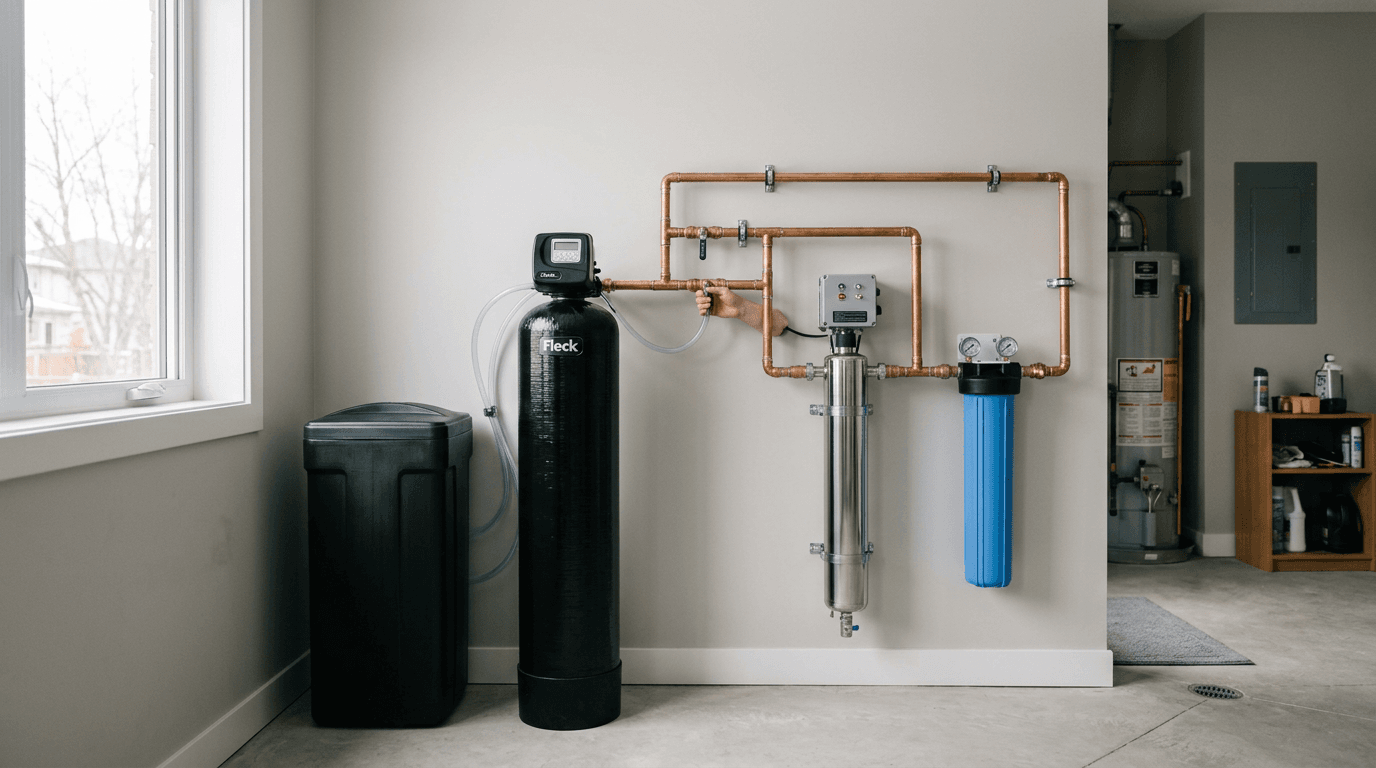
Homeowners often assume that once they install a water softener to eliminate white scale on their fixtures, their tap water is completely purified. This is a specific and common misconception. While ion exchange handles the calcium and magnesium that destroy hot water appliances, it does nothing to address the chemical taste of municipal additives or the microscopic biological risks that can enter a private system. To target those distinct issues and actually alter what you drink, a home requires specialized components like a uv water filter and activated carbon working alongside the softener, rather than expecting one machine to perform three fundamentally different jobs.
Quick Summary
A comprehensive water treatment system divides labour among specialized components: softeners handle structural minerals, carbon blocks extract chemical additives, and ultraviolet lamps neutralize biological pathogens. Stacking these technologies in the correct sequence ensures both the protection of your plumbing and the safety of your drinking water.
- Activated carbon physically traps organic sediment and chemically adsorbs volatile compounds.
- Ultraviolet light alters the cellular DNA of bacteria so they cannot reproduce or cause illness.
- Filtration stages must be carefully matched to the system's flow rate to guarantee sufficient contact time.
- Hard water must always be softened before ultraviolet exposure to prevent mineral scaling from blocking the light rays.
Table of Contents
- Why Removing Hardness Does Not Fix Taste and Safety
- How a Carbon Block Extracts Chlorine and Volatile Chemicals
- When UV Water Treatment Becomes a Non-Negotiable Necessity
- Where Whole-Home and Point-of-Use Systems Belong
- Why Component Synergy Dictates System Lifespan
- What Causes Advanced Filtration to Fail Prematurely
Why Removing Hardness Does Not Fix Taste and Safety
The ion exchange process inside a water softener is highly specific: it targets the dissolved calcium and magnesium that create hard water. In regions drawing from river sources, this hardness often averages around 165 mg/L, which is enough to rapidly calcify fixtures and destroy hot water tank heating elements. A softener pulls these minerals out and replaces them with a fractional amount of sodium. Readers evaluating their own setups can review the local chemistry baselines in the Edmonton Water Hardness & Quality Guide to understand exactly what a softener leaves behind.
However, municipal water treatment plants must also inject chlorine into the supply. This chemical additive is necessary to keep the water biologically safe as it travels through miles of underground infrastructure. Once that water crosses your property line, the chlorine's job is done, leaving behind an abrasive chemical profile that dries out human skin and ruins the taste of coffee.
Because a softener uses a specialized plastic resin designed only for mineral capture, it allows chemical additives and dissolved organics to pass straight through. In fact, continuous exposure to high levels of municipal chlorine actually degrades the cross-linking in the softener's resin bed over time, turning the rigid beads into a useless mush. Fixing the taste, smell, and chemical makeup of the water requires a distinct technology based on adsorption rather than ion exchange.
How a Carbon Block Extracts Chlorine and Volatile Chemicals
Activated carbon operates on an entirely different mechanical principle. Instead of swapping ions, it physically traps microscopic debris and chemically attracts volatile organic compounds. The raw carbon material is baked at extreme temperatures to fracture its structure, creating a labyrinth of microscopic pores. A single handful of activated carbon contains the surface area of several football fields, giving the water a massive contact zone as it flows through.
A carbon water filter comes in two primary configurations: granular and block. Granular activated carbon consists of loose flakes inside a cartridge. While inexpensive, loose media is susceptible to channeling. Water under pressure will inevitably find the path of least resistance, carving small rivers through the loose carbon and bypassing the filtration media altogether.
A carbon block water filter solves this by compressing the carbon into a dense, solid cylinder. Water is forced radially through the dense walls of the block before exiting through the hollow core. Because there are no loose particles to shift, the water cannot bypass the filtration. The immense surface area of the block catches organic compounds and engages in a catalytic reaction with chlorine, converting the harsh chemical into benign chloride.
Practical rule: Always install a simple mechanical sediment pre-filter directly upstream of any advanced carbon block; allowing common pipe silt to reach the block will physically blind its microscopic pores long before its chemical adsorption capacity is actually exhausted.
When UV Water Treatment Becomes a Non-Negotiable Necessity
While municipal water is treated with chlorine to kill pathogens, private wells or homes located at the far edges of rural municipal lines often face biological risks that require targeted neutralization. This is the domain of uv light water treatment, which uses the ultraviolet-C (UV-C) spectrum to inactivate bacteria, viruses, and parasitic cysts like Cryptosporidium and Giardia.
A UV system does not filter anything out of the water physically. Instead, the water flows through a stainless steel reactor chamber containing a high-intensity lamp housed inside a clear quartz sleeve. The lamp emits light exactly at the 254-nanometer wavelength. When biological contaminants pass through this light, the UV-C energy penetrates their cell walls and physically fractures their DNA - specifically creating thymine dimers. Once the DNA is scrambled, the pathogen is sterile. It cannot reproduce, and a pathogen that cannot reproduce cannot cause an infection in a human host.
The effectiveness of uv water treatment is entirely dependent on the transmission of that light. If the water is cloudy, or carries high levels of dissolved tannins, those particles will cast microscopic shadows. A bacterium hiding in the shadow of a silt particle passes through the chamber completely unharmed. Because this technology requires highly specific operating conditions, verifying your home's baseline transmission levels through a Free In-Home Water Testing Edmonton assessment is the only reliable way to know if a lamp will actually be effective.
Where Whole-Home and Point-of-Use Systems Belong
Filtration components must be placed strategically to manage the flow rates and volumes a household demands. Treating every drop of water that enters the house requires different equipment than polishing a few litres a day at the kitchen sink.

A carbon water filter system for home entry is typically a large tank containing specialized catalytic carbon. Installed right where the main line enters the building, this point-of-entry (POE) system strips chlorine before it can reach the home's plumbing. This prevents the inhalation of vaporized chlorine in hot showers and protects the rubber seals inside washing machines and dishwashers.
Conversely, point-of-use (POU) systems sit right where the water is consumed. While whole-home carbon handles chlorine, it does not remove dissolved heavy metals, fluorides, or the total dissolved solids (TDS) that affect the subtlety of drinking water and cooking. That level of extreme purification is best left to an under-sink system.
| Component | Installation Point | Primary Target | Fundamental Limitation |
|---|---|---|---|
| Whole-Home Carbon Tank | Point of Entry (Main Line) | Chlorine, chloramine, volatile organics | Does not lower Total Dissolved Solids (TDS) |
| Under-Sink Reverse Osmosis | Point of Use (Kitchen) | Heavy metals, dissolved solids, fluorides | Low flow rate; cannot supply whole house |
| Ultraviolet Reactor | Point of Entry (Post-Filtration) | Bacteria, viruses, parasitic cysts | Requires perfectly clear, softened water |
| Ion Exchange Softener | Point of Entry (Main Line) | Calcium, magnesium, dissolved iron | Does not improve taste or biological safety |
Why Component Synergy Dictates System Lifespan
No single water treatment component functions perfectly in isolation. The longest-lasting setups rely on the strategic sequencing of components so that each machine protects the one downstream from it. When you rely on a single, oversized filter to do everything, it will inevitably fail at its weakest point.
If you live in communities with varying neighborhood plumbing vintages, relying on a dedicated Water Softener Leduc, AB setup handles the mineral scale first. By placing this softener at the very beginning of the plumbing line, you extract the hardness before it reaches the rest of the equipment. If hard water hits a UV chamber, the calcium will immediately bake onto the hot quartz sleeve, creating an opaque mineral scale that blocks the ultraviolet light and renders the pathogen defence useless.
The carbon stage sits next, pulling out the municipal chlorine. This is critical because the thin-film composite membranes used in point-of-use purification are highly sensitive to oxidation. Even trace amounts of chlorine will eat microscopic holes through the membrane in a matter of weeks.
By stacking these targeted technologies, the homeowner receives both comprehensive structural protection and premium drinking water. Modern configurations like the Triton Pure and Triton Pure Tankless packages take advantage of this exact synergy, combining heavy-duty softening for the entire home with dedicated reverse osmosis system installations in Edmonton right at the tap. Whether you are located centrally or relying on a Water Softener Beaumont, AB to treat hard perimeter water, the sequence remains the same.
What Causes Advanced Filtration to Fail Prematurely
Understanding what these systems do also requires understanding exactly how they break down. When a homeowner reports that their advanced filtration has stopped working, the root cause almost always traces back to a mismatch between the component's specifications and the home's operating conditions. For households dealing with the specific chemistry demands of a Water Softener Sherwood Park, AB environment, diagnosing the pressure drop often reveals one of these underlying issues.
1. Exhausted Pre-Filtration Cascades
The most common reason an expensive drinking water membrane fails prematurely is an exhausted carbon pre-filter. A standard 10-inch carbon block is rated for a specific volume of chlorine reduction. Once that capacity is reached, chlorine breaks through and immediately attacks downstream components.
2. Excessive Flow Rates Over UV Lamps
Ultraviolet purification is rated by dose, measured in millijoules per square centimetre (mJ/cm²). The dose delivered depends entirely on how long the water stays in the reactor chamber. If a household installs a UV system rated for 8 gallons per minute (GPM), but subsequently runs a shower, a dishwasher, and a garden hose simultaneously to draw 12 GPM, the water rushes past the lamp too quickly. The pathogens receive a sub-lethal dose of light and enter the plumbing unharmed.
3. Biological Fouling of Carbon Beds
Because carbon strips out chlorine, the interior of a carbon block is effectively a chlorine-free zone. If the home uses well water that has not been properly sterilized via UV upstream, bacteria will colonize the porous carbon media itself.
Practical rule: Inspect the ultraviolet system's quartz sleeve every six months; if it is cloudy or covered in mineral scale, the system is no longer neutralizing bacteria, regardless of whether the digital monitor claims the lamp is functioning.
FAQ
Does a carbon block remove water hardness?
No. Carbon blocks target organic compounds and volatile chemicals like municipal chlorine. They have absolutely no effect on dissolved inorganic minerals like calcium and magnesium, which require an ion exchange process to physically remove from the water.
Can I install a UV light before my water softener?
Placing ultraviolet treatment ahead of mineral extraction guarantees failure. Hard water will rapidly bake a layer of calcium scale onto the hot quartz sleeve, blocking the light transmission and rendering the biological defence entirely useless.
Will UV treatment alter the taste of my drinking water?
Ultraviolet purification adds nothing to the water and physically removes nothing from it; it only alters cellular DNA. Because it does not extract dissolved solids or chemical additives, it has zero impact on the taste, odour, or clarity of the water.
How do I know when my carbon media is exhausted?
For point-of-use units under the sink, a sudden return of chlorine smell or a drop in flow pressure indicates the microscopic pores are either blinded by sediment or chemically saturated. Whole-home tanks require routine testing of the outbound water, as chemical breakthrough often occurs well before a noticeable pressure drop.