What Is a Reverse Osmosis System? How Membrane Filtration Actually Works
A glass of tap water should not smell like a swimming pool, nor should a kettle grow thick white crusts after a month of use. Yet, for many homeowners in the capital region, this is the daily baseline. When standard fridge filters fail to touch dissolved solids or heavy chlorine, the conversation usually shifts to advanced filtration. Understanding what is reverse osmosis system technology requires looking past the basic sediment screens you see in standard pitchers. It is a highly pressurized, multi-stage separation process that strips water down to its molecular foundation, leaving behind the heavy metals, chemical byproducts, and dissolved minerals that basic carbon filters simply cannot catch.
Quick Summary
A reverse osmosis water filtration system is a purification mechanism that uses household water pressure to force tap water through a semi-permeable membrane. This process physically separates pure water molecules from dissolved impurities, safely flushing the contaminants down the drain and reserving the purified water for drinking.
- Filters out almost all dissolved solids, including chlorine, lead, and fluorides.
- Requires adequate water pressure (typically 40 to 60 PSI) to overcome natural osmotic resistance.
- Functions best when paired with pre-filtration to protect the delicate membrane from hard water scale.
- Available in traditional storage tank models or high-efficiency tankless configurations.
Table of Contents
- How Pressure Overcomes Natural Osmosis
- Why Precision Membranes Outperform Standard Carbon Filters
- Where Stored Water Costs You Space and Efficiency
- Why Reverse Osmosis Cannot Function Without a Drain Line
- Why Reverse Osmosis Requires Pre-Treatment in Hard Water Cities
- When Stripped Water Requires a Mineral Recharge
- When Ignored Filters Destroy Membrane Lifespans
- FAQ
- Recommended Reads
How Pressure Overcomes Natural Osmosis
To grasp what reverse osmosis water filtration relies on, you must first understand the natural principle it works against. In nature, osmotic pressure is the force that drives water through a cell wall from a low-solute environment to a high-solute environment. If you place a semi-permeable membrane between a tank of pure water and a tank of salty water, the pure water naturally migrates into the salty side to equalize the concentrations.
Reverse osmosis is the mechanical application of force to reverse this natural thermodynamic drive. By applying external pressure (the hydrostatic pressure from your home's plumbing), the system forces the concentrated, untreated tap water against a thin-film composite (TFC) polyamide membrane. This material is dense enough that pure water molecules can diffuse through its polymer matrix, while larger ions - like calcium, sodium, and lead - are sterically hindered and rejected.
The key variable here is net driving pressure. If your municipal water supply delivers 50 PSI, but the natural osmotic pressure of your heavily mineralized tap water pushes back with 10 PSI, your net driving pressure is only 40 PSI. If your incoming pressure drops too low, the natural osmotic force resists the flow, and the system stalls.
Why Precision Membranes Outperform Standard Carbon Filters
Most homeowners mistake a basic carbon block filter for a comprehensive purification system. A standard fridge or pitcher filter relies entirely on adsorption - a chemical process where contaminants bond to the porous surface area of the activated carbon. While exceptionally effective at grabbing volatile organic compounds (VOCs) and free chlorine, carbon filters operate on a finite capacity. Once the binding sites are full, the filter ceases to work. More importantly, carbon cannot bind to inorganic dissolved metals or salts.
A true reverse osmosis water filtration system uses a multi-stage approach. It still employs carbon blocks to handle the chlorine, but it relies on the RO membrane to perform the heavy lifting of stripping out total dissolved solids (TDS). The membrane does not "fill up" with contaminants; it physically blocks them based on molecular weight and atomic radius. This is why RO is the gold standard for tackling emerging contaminants like per- and polyfluoroalkyl substances (PFAS), arsenic, hexavalent chromium, and agricultural nitrates.
When comparing filtration methods, understanding what reverse osmosis systems actually do comes down to recognizing this dual-barrier approach. The system uses carbon blocks in its pre-filtration stages to eliminate the chemicals that cause bad taste and odour, then relies on the membrane to separate the dangerous, tasteless dissolved solids that a pitcher filter simply ignores.
Practical rule: Test your tap water's Total Dissolved Solids (TDS) with a digital meter, then test your filtered water. A healthy RO membrane should drastically reduce the incoming TDS reading, leaving only a tiny fraction of the original contaminants.
Where Stored Water Costs You Space and Efficiency
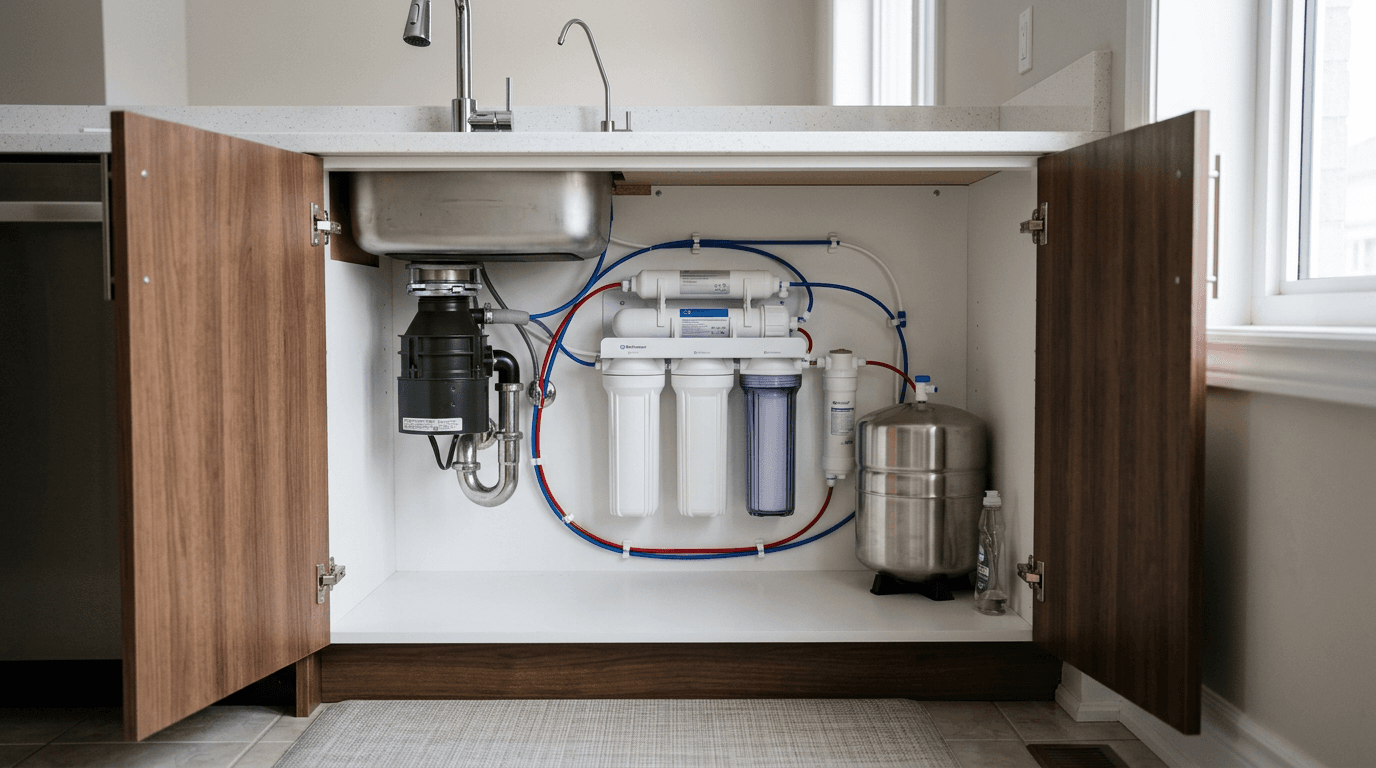
The traditional setup for residential reverse osmosis involves a multi-stage filter manifold feeding into a pressurized hydropneumatic storage tank beneath the kitchen sink. Because the process of forcing water through a 0.0001-micron membrane is inherently slow, a standard system might only produce 50 gallons per day. The tank stores two to three gallons of purified water so that when you open the dedicated faucet, the flow is immediate and robust.

The hidden mechanical flaw in this design is backpressure. Inside the steel tank is a butyl rubber bladder pre-charged with air. As the RO membrane slowly drips purified water into the tank, it compresses the air bladder, building the pressure necessary to eventually push the water up to your sink faucet. As the tank fills, the internal pressure pushes back against the RO membrane. This massive drop in driving pressure drastically reduces the membrane's rejection rate and significantly increases the amount of wastewater sent to the drain.
Modern advancements have shifted the market toward high-flow, direct-production units. Upgrading to tankless reverse osmosis Edmonton configurations circumvents this physics problem entirely. By incorporating an electric booster pump, a tankless unit instantly pressurizes the water to 80 or 100 PSI before driving it through a massive, high-capacity membrane. Because there is no storage tank pushing back against the membrane, the net driving pressure remains constantly high, resulting in superior contaminant rejection and a dramatic reduction in wasted water.
Why Reverse Osmosis Cannot Function Without a Drain Line
A common point of confusion for new owners is the continuous sound of trickling water coming from the sink drain while the system is actively purifying. Unlike a standard carbon pitcher filter, which acts like a sponge and traps contaminants inside its media, an RO membrane operates more like a microscopic turnstile. It actively separates the incoming water into two distinct streams: the permeate (the purified drinking water) and the brine (the wastewater carrying the rejected contaminants).
This cross-flow filtration is what allows the membrane to clean itself continuously. If an RO system simply trapped the dissolved calcium, heavy metals, and salts on its surface, the 0.0001-micron pores would permanently clog within a few hours of operation. Instead, the incoming water sweeps across the surface of the membrane at a high velocity. As the pure water molecules are forced through the microscopic pores, the remaining water flushes the rejected impurities off the surface and carries them safely down the drain line.
A proper reverse osmosis system installation in Edmonton requires precise routing of this drain line to prevent backflow. The ratio of wastewater to pure water depends heavily on the system's design. Traditional air-bladder tank systems generally operate at a 3:1 or 4:1 ratio - meaning four gallons of water are sent to the drain for every one gallon of drinking water produced. High-efficiency systems utilizing internal permeate pumps or direct-flow technology can reduce this ratio to an impressive 1:1, drastically lowering water usage while maintaining the vital self-cleaning cross-flow.
Why Reverse Osmosis Requires Pre-Treatment in Hard Water Cities
Hard water is the absolute nemesis of thin-film composite membranes. Water hardness is driven primarily by dissolved calcium and magnesium. When highly concentrated against the surface of an RO membrane, these minerals precipitate out of solution and form dense calcium carbonate scale - the exact same white, chalky crust you see inside your electric kettle.
If you live in an area with notoriously hard water - such as Edmonton, Beaumont, Leduc, or Sherwood Park - running untreated municipal water directly into an RO unit guarantees premature membrane failure. The local water supply can reach hardness levels that rapidly overwhelm standard pre-filters. Once scale forms over the membrane's microscopic pores, water production grinds to a halt.
Because of this, comprehensive water management requires a sequential approach. Installing water softeners in Edmonton explicitly calibrated for the heavy calcium load of the region protects the entire home's plumbing and removes the hardness minerals at the point of entry. With the scale-forming minerals removed, the under-sink RO system is freed to focus strictly on removing sodium, heavy metals, and trace contaminants.
For homeowners seeking a cohesive, unified solution, combined packages streamline this protection. Implementing comprehensive solutions like the Triton Pure or Triton Pure Tankless packages ensures that a whole-home softening unit seamlessly protects the localized drinking water membrane. The softener handles the heavy lifting against calcium scaling, while the RO system refines the drinking water to absolute purity.
When Stripped Water Requires a Mineral Recharge
Because reverse osmosis is incredibly aggressive at separating dissolved solids, it does not distinguish between harmful contaminants and beneficial minerals. The membrane efficiently removes toxic lead, arsenic, and agricultural runoff, but it also strips out natural calcium, magnesium, and potassium. The resulting reverse osmosis water is exceptionally pure, but it is also mildly acidic and entirely devoid of mineral content.
When water is completely stripped of dissolved solids, it becomes a hungry solvent. It aggressively absorbs carbon dioxide from the surrounding air, reacting to form weak carbonic acid. This drops the pH of the purified water into the slightly acidic range (typically between 5.5 and 6.5). If this low-pH water is run directly through copper plumbing or the copper boilers of high-end espresso machines, it will actively leach the metal, leading to pinhole leaks and metallic-tasting coffee. Furthermore, water devoid of minerals often tastes noticeably "flat" to the human palate, as we naturally associate the crispness of spring water with trace alkaline minerals.
To counteract this, premium systems introduce a remineralization stage as the final step before the water reaches your tap. After the water leaves the storage tank (or immediately after the membrane in a tankless unit), it passes through a specialized cartridge packed with crushed marble, calcite, or natural coralline calcium. The slightly acidic pure water dissolves trace amounts of these alkaline minerals, simultaneously neutralizing the pH, protecting metallic appliance internals, and restoring a crisp, refreshing taste profile.
When Ignored Filters Destroy Membrane Lifespans
An RO system is not a set-it-and-forget-it appliance. While the primary membrane is designed to last anywhere from two to five years, its survival depends entirely on the pre-filters positioned ahead of it. Municipal tap water carries sediment, rust, and heavy concentrations of chemical disinfectants.
The thin-film composite membranes used in modern residential systems are highly sensitive to oxidative damage. If municipal chlorine or chloramine reaches the membrane, it literally burns microscopic holes through the polymer layers, destroying its ability to reject contaminants. The carbon pre-filters exist specifically to absorb these disinfectants before they reach the membrane. If you fail to replace those carbon pre-filters annually, the chemical disinfectants break through, the membrane fails, and you are effectively drinking standard, unpurified tap water.
| Component | Primary Function | Typical Replacement Interval | Failure Symptom |
|---|---|---|---|
| Sediment Pre-Filter | Traps dirt, rust, and silt. | 6 - 12 Months | Drastic drop in water production speed. |
| Carbon Pre-Filter | Neutralizes chlorine and chloramines. | 6 - 12 Months | Chlorine taste returns; rapid membrane failure. |
| RO Membrane | Separates dissolved solids (TDS) and heavy metals. | 2 - 5 Years | High TDS readings in the purified water. |
| Post-Carbon Filter | Polishes taste as water leaves the storage tank. | 12 - 24 Months | Musty or flat-tasting water from the dedicated faucet. |
Practical rule: Write the installation date directly on the filter housings with a permanent marker. Relying on memory or waiting for a noticeable drop in water quality means the membrane has already been compromised.
Consulting an Edmonton water hardness and quality guide can help you gauge exactly how heavily your pre-filters are working. A simple annual filter swap ensures the expensive membrane operates efficiently for its full designed lifespan. If you notice the system running continuously to the drain, or if the tank takes significantly longer to fill, the sediment pre-filters have likely clogged with silt and are restricting the required operating pressure.
FAQ
Does reverse osmosis remove fluoride from drinking water?
Yes. Because fluoride compounds dissolve into microscopic ions, standard carbon filters cannot trap them. Reverse osmosis relies on incredibly fine membrane pores and ionic charge rejection to separate and flush away nearly all naturally occurring or municipally added fluoride.
How often do I need to change the filters in an RO system?
The pre-filters (sediment and carbon blocks) must be replaced every 6 to 12 months to protect the main membrane from chlorine and physical debris. The reverse osmosis membrane itself typically lasts 2 to 5 years, depending on your incoming water quality and how strictly you adhere to the pre-filter replacement schedule.
Why is my reverse osmosis tank filling so slowly?
Slow production is almost always caused by a loss of net driving pressure. This can occur if your home's incoming water pressure drops below 40 PSI, if the sediment pre-filters are clogged with silt, or if the air bladder inside the storage tank has lost its charge and is creating excessive backpressure against the membrane.
Can I connect a reverse osmosis system to my refrigerator?
Yes, most under-sink reverse osmosis systems can be tee-connected to a refrigerator's ice maker and water dispenser. However, if you are running highly purified, un-remineralized water to the fridge, ensure that the tubing and the refrigerator's internal components are not made of exposed copper, as the pure water's lower pH can cause metallic leaching over time.