What Is Reverse Osmosis Water: How Edmonton Homes Purify Tap Water
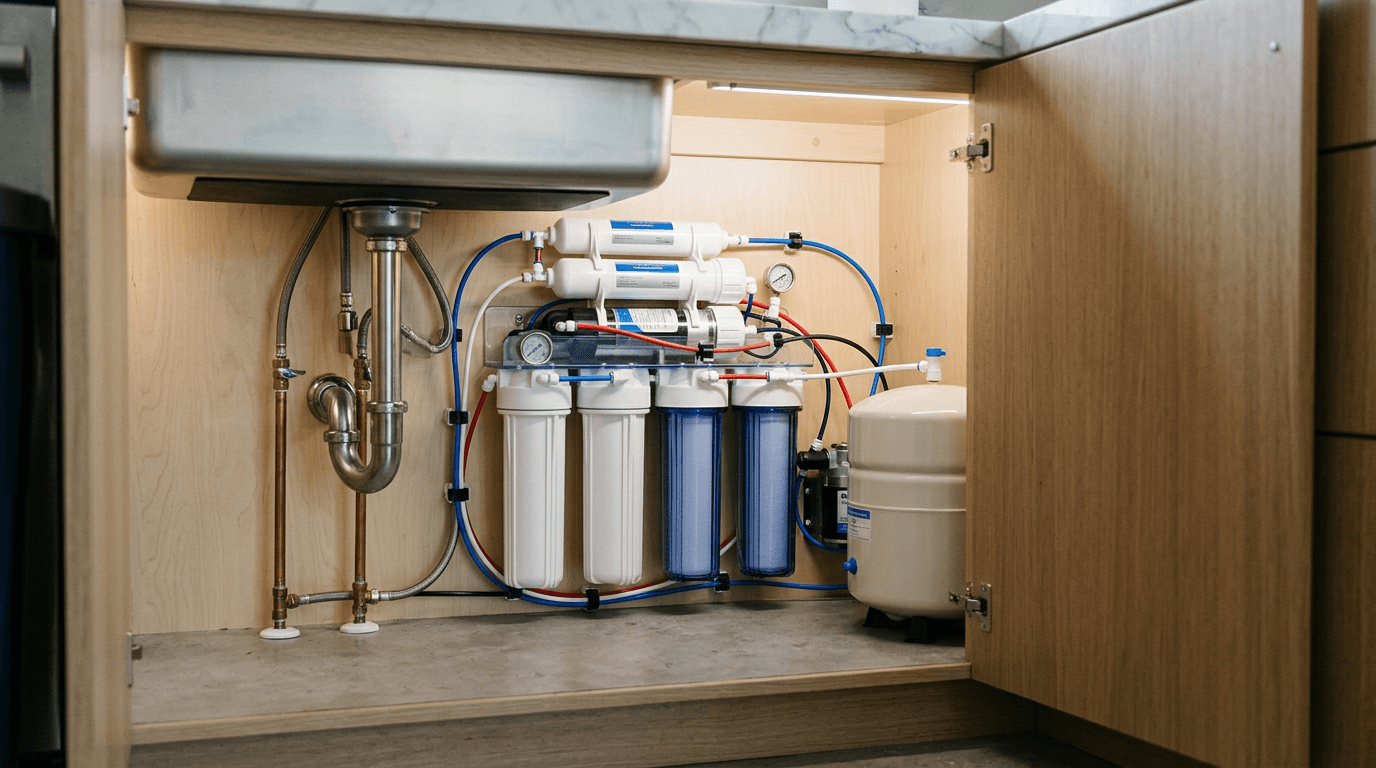
Most homeowners assume that a standard refrigerator filter or a drop-in carbon pitcher provides the highest tier of drinking water purity. In reality, those filters only capture large particles and mask the taste of chlorine, leaving dissolved heavy metals, fluoride, and trace pharmaceuticals completely untouched. To answer the question of what is reverse osmosis water, you have to abandon the idea of a simple sponge or sieve. It is not just another layer of carbon; it is an active, mechanical separation process that strips water down to its molecular foundation. In the Edmonton capital region, where municipal water arrives with significant hardness and treatment chemicals, relying on basic carbon leaves the heaviest filtration work undone.
Quick Summary
Reverse osmosis is a pressure-driven mechanical filtration process that forces tap water through a microscopic, semi-permeable membrane to trap dissolved inorganic solids and heavy metals. It produces highly purified drinking water at a dedicated sink faucet.
- Molecular barrier: The membrane physically blocks contaminants at a 0.0001-micron scale rather than simply absorbing tastes.
- Pressure dependence: It relies entirely on your home's incoming water pressure to overcome natural osmotic resistance.
- Sequential defence: The unit requires upstream sediment and carbon filters to protect the delicate membrane from chlorine.
- Functional waste: The system continuously uses a stream of water to wash rejected contaminants down the drain, preventing the membrane from fouling.
Table of Contents
- Cross-Flow Filtration Prevents Immediate Clogging
- The Membrane Strips the North Saskatchewan River to a Blank Slate
- Baseline Plumbing Pressure Dictates System Efficiency
- Unpacking the Assembly Line Beneath the Sink
- Hard Water Scales Polyamide Membranes Instantly
- Storage Tanks Impose Limits That Tankless Manifolds Bypass
- FAQ
- Recommended Reads
Cross-Flow Filtration Prevents Immediate Clogging
Osmosis is a natural cellular behaviour where a weaker saline solution migrates toward a strong saline solution to equalize the concentration. To purify water, residential systems force the exact opposite to happen. By applying physical pressure to highly concentrated municipal tap water, the system pushes H2O molecules through a semi-permeable barrier, leaving the dissolved salts, heavy metals, and impurities trapped on the incoming side.
Understanding how a reverse osmosis water filter works physically requires looking at the microscopic architecture of the filter itself. The primary barrier is a thin-film composite (TFC) membrane covered in pores sized at roughly 0.0001 microns. For context, a human hair is about 70 microns wide. A water molecule is small enough to squeeze through this 0.0001-micron gap; a lead molecule, a fluoride ion, or a dissolved calcium particle is not.
Crucially, this is not a dead-end filter. If you push highly contaminated water directly into a microscopic screen, it will clog entirely within hours. Instead, these systems utilize cross-flow filtration. The incoming water travels strictly across the surface of the membrane. As pure water is forced through the pores, the remaining sweeping flow carries the rejected contaminants away to the drain. This continuous washing action is what allows the unit to process thousands of litres of water over several years without immediate failure.
The Membrane Strips the North Saskatchewan River to a Blank Slate
Municipal treatment facilities do an excellent job making water biologically safe, but public safety metrics do not equate to a pure end product. If you review a comprehensive Edmonton water hardness and quality guide, you will see that the water pulled from the North Saskatchewan River carries seasonal agricultural runoff, varying levels of dissolved solids, and necessary treatment chemicals like chlorine or chloramine.
When local homeowners ask what reverse osmosis does to water, the most accurate answer is that it removes everything the treatment plant added, alongside everything the river picked up along the way. While standard fridge filters capture particulates down to about 1 micron, the membrane strips out sodium, nitrates, copper, radium, and arsenic. It removes the chemical by-products of municipal chlorination, such as trihalomethanes.
However, this aggressive extraction has a secondary consequence: the purified water drops slightly in pH. Because the membrane strips out all the natural alkaline minerals that previously buffered the water, the remaining trace carbon dioxide turns into weak carbonic acid. This leaves the water with a slightly acidic profile and a distinct, blank taste. Many modern installations counteract this by adding a remineralizing cartridge at the end of the line, which introduces precise amounts of calcium and magnesium back into the drinking water specifically to balance the pH and improve the taste.
Baseline Plumbing Pressure Dictates System Efficiency
The entire separation process hinges on force. Without enough physical pressure pushing against the tap water, natural osmotic pressure pushes back, and the water simply will not pass through the microscopic pores. Fully understanding how reverse osmosis works requires assessing your home's baseline plumbing metrics before making any modifications beneath the sink.
Most residential membranes require a minimum of 40 pounds per square inch (psi) of incoming line pressure to function. If your home sits reliably at 60 psi, the system operates highly efficiently, producing clean water rapidly and sending a standard ratio of waste down the drain. When line pressure drops below that threshold, the membrane struggles severely. Production slows to a trickle, and the ratio of wastewater to pure water spikes aggressively, meaning the system continuously dumps water down the drain while failing to fill your holding tank.
For residents in rural subdivisions or older neighbourhoods experiencing low municipal flow, technicians must install an electric booster pump directly ahead of the membrane. This pump artificially raises the driving pressure, ensuring the unit is pushed hard enough to yield the required purification rates regardless of what the street pipes deliver.
Unpacking the Assembly Line Beneath the Sink
A standalone polyamide membrane cannot survive raw municipal tap water on its own. To function over years rather than days, it relies on a sequence of sacrificial protective stages. When examining what a reverse osmosis system is, you are actually looking at a multi-stage assembly line designed entirely to protect the most sensitive, expensive component sitting in the middle. For those scheduling a reverse osmosis system installation in Edmonton, the hardware typically breaks down into four distinct zones.

Stage 1: The Sediment Barrier
The first housing the water encounters contains a tightly spun polypropylene sediment filter. Its sole job is to capture physical debris: sand, silt, rust flakes from older city pipes, and dirt. If these large particulates reached the later stages, they would immediately blind the carbon blocks and tear the delicate membrane.
Stage 2: The Carbon Shield
The second stage is arguably the most critical for membrane survival. It houses a dense carbon block designed to remove chlorine and chloramine. The thin-film composite membrane achieves phenomenal rejection rates for dissolved metals, but it has a chemical weakness: free chlorine burns the polyamide material on contact. The carbon block absorbs the chlorine entirely, sacrificing itself so the membrane remains structurally intact.
Stage 3: The RO Membrane
Once the water is free of physical debris and chemical oxidizers, it enters the central housing containing the membrane itself. This is where the cross-flow filtration occurs. The feed line splits into two streams here: the purified permeate that travels to the storage tank, and the brine that carries the concentrated dissolved solids to the sink drain.
Stage 4: The Polishing Filter
Because the purified water sits inside a pressurized rubber bladder in the holding tank, it can sometimes pick up a flat or slightly stale taste. Before the water reaches the dedicated drinking faucet, it passes through a final post-carbon polishing filter to ensure the taste is perfectly crisp.
Hard Water Scales Polyamide Membranes Instantly
Even with sediment and carbon filters in place, the membrane faces one massive local threat: hard water. The Edmonton region averages roughly 165 mg/L (around 9.6 grains per gallon) of hardness. If you feed that raw, untreated water directly into a membrane, the high concentrations of calcium and magnesium rapidly scale over the 0.0001-micron pores. Within a matter of months, the microscopic screen chokes completely, water production stops, and the membrane must be thrown away.
This reality is why any practical discussion of what a reverse osmosis water filtration system is must include whole-home treatment. Treating the water at the point of entry before it ever reaches the kitchen sink is the only reliable way to guarantee longevity. Homeowners searching for a water softener in Leduc, AB often realize that softening the water is step one in purifying it. The softener removes the calcium scale at the main water line, meaning the unit beneath the sink only has to handle the manageable dissolved solids and trace chemicals.
This sequential approach is why combination packages, like the Triton Pure, are the regional standard. Feeding mechanically softened water to a membrane extends its functional life from roughly eighteen months to upwards of five to seven years.
Practical rule: Never feed hard water exceeding 7 grains per gallon directly into a reverse osmosis membrane without an upstream softener; the calcium carbonate will scale the microscopic pores and permanently ruin the unit in months.
Storage Tanks Impose Limits That Tankless Manifolds Bypass
Because forcing water molecule by molecule through a barrier is an incredibly slow physical process, a traditional system cannot purify water fast enough to fill a glass on demand. It must generate the water slowly over several hours and store it in a pressurized holding tank. However, modern engineering has introduced a second option for large families or tight kitchens.
For homeowners lacking cabinet footprint, high-output manifold systems - such as those featured in the Triton Pure Tankless package - use an internal electric pump to force water through a massive, high-capacity membrane rapidly enough to provide direct, on-demand flow at the faucet.
| Feature | Traditional Pressurized Tank | Modern Tankless Manifold |
|---|---|---|
| Water Delivery | Stores pure water in a 3-gallon under-sink reservoir | Pumps water through the membrane directly on demand |
| Space Requirement | Consumes roughly half a standard base cabinet | Slim profile sits tight against the cabinet wall |
| System Pressure | Output flow drops as the holding tank empties | Output flow remains consistently high via the internal pump |
| Electrical Needs | Operates entirely on natural municipal line pressure | Requires a standard 120V outlet beneath the sink |
| Waste Efficiency | Discards roughly four litres per pure litre generated | Discards as little as one litre per pure litre generated |
If you have a large household that regularly empties the traditional 3-gallon storage tank, or if you simply cannot spare the cabinet real estate, tankless architecture is the necessary route. Conversely, if you want a system that continues dispensing purified water even during a municipal power outage, the traditional hydro-pneumatic tank remains the preferred standard. Those needing a water softener in Beaumont, AB or surrounding areas should evaluate their cabinet space prior to installation.
Practical rule: Measure your under-sink cabinet height and footprint before committing to a traditional hydro-pneumatic tank; standard units require at least 15 inches of vertical clearance to accommodate the shut-off valve and the routing tubing without kinking.
FAQ
Does the membrane remove fluoride from municipal tap water?
Yes. The microscopic pores are specifically sized to block heavy inorganic ions. Fluoride molecules are larger than 0.0001 microns and are rejected and flushed down the drain alongside the heavy metals.
Why does the system constantly run water down the drain while operating?
The system uses continuous water flow to wash the rejected contaminants off the surface of the membrane. Without this functional waste stream, the dissolved solids would instantly blind the pores and destroy the unit.
Can I connect the purified water output directly to my refrigerator's ice maker?
Yes. By running a split line from the permeate output tubing, you can supply your fridge. However, you must ensure your system has sufficient tank pressure to push the water vertically up to the refrigerator's intake valve.
Does the purification process make the water taste flat or acidic?
Because the membrane strips out all natural alkaline minerals (like calcium and magnesium), the resulting water can taste somewhat "blank" and sits slightly acidic. Many systems integrate an alkaline remineralizer cartridge at the final stage to restore a crisp taste.
How do I know if my home has enough water pressure to operate a tankless system?
Tankless units have internal electric pumps that drive their own pressure. However, for traditional tank systems, booking a free in-home water testing in Edmonton allows a technician to gauge your exact baseline flow metrics and determine if an external booster pump is required.