Why DIY Water Testing Kits Miss the Mark on Home Plumbing Safety
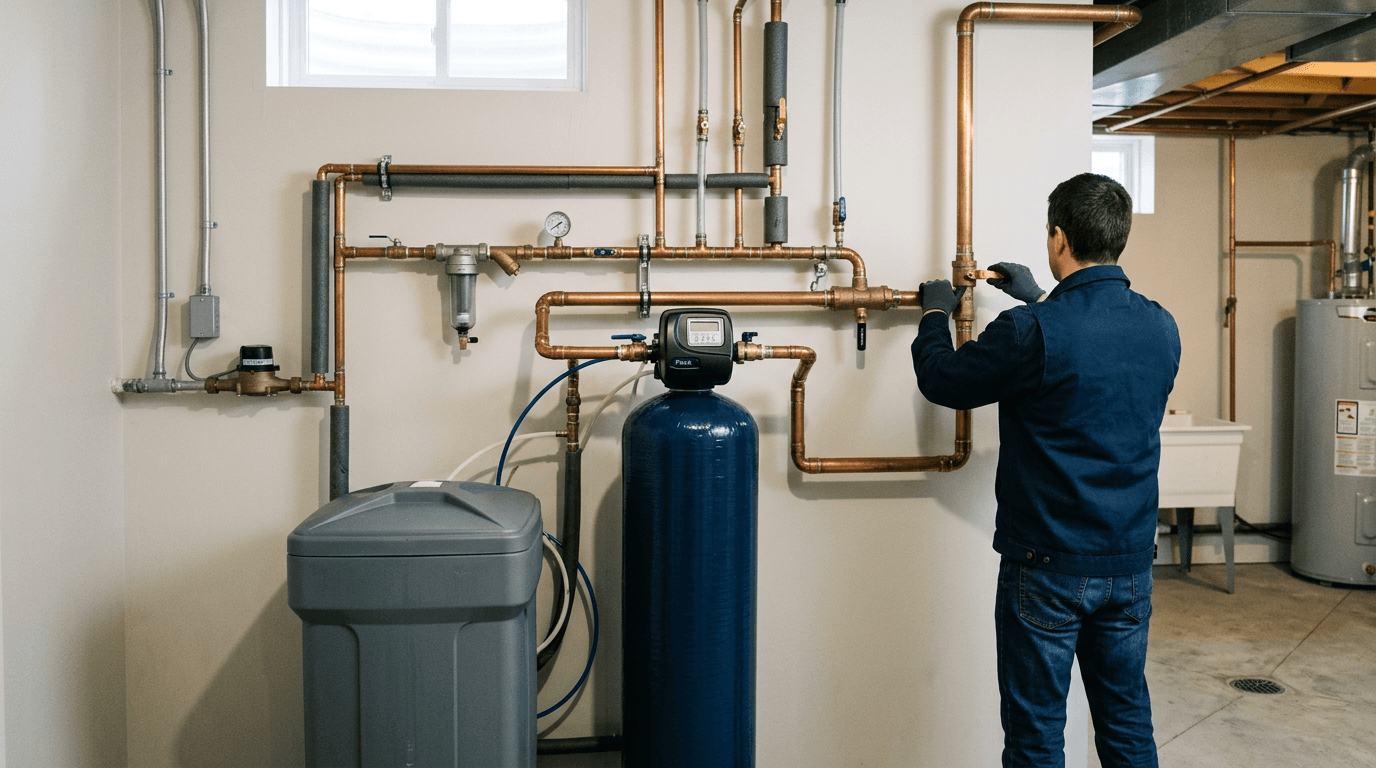
Many homeowners assume that buying over-the-counter water testing kits and dipping a reactive paper strip into a glass of tap water provides all the data needed to select a home filtration system. The strip turns purple, you read a number like 165 mg/L, and you immediately shop for a system rated for that capacity. This assumption treats residential water treatment as a static math equation rather than a dynamic plumbing ecosystem. In reality, a colour-coded chemical strip cannot measure your home's peak flow rate, assess the age and condition of your internal pipes, or account for the distinct chemical variations found across municipal water supplies. Relying purely on a paper strip to size a major appliance routinely leads to premature resin degradation, restricted water pressure, and persistent scaling on modern fixtures. Understanding exactly how and when to measure your home's water chemistry requires looking past the static snapshot and evaluating the mechanical demands of your daily household usage.
Quick Summary
Professional water analysis bridges the gap between knowing your water's basic chemistry and properly sizing a whole-home treatment system to handle everyday household demands. While basic chemical strips can identify broad ranges of hardness, they lack the diagnostic depth required to prevent appliance scaling, resolve chlorine odours, or ensure a membrane filtration unit functions efficiently over time.
- Basic reactive strips provide a static snapshot but completely ignore critical flow rate and plumbing variables.
- Identifying your exact mineral composition determines whether your home requires a simple carbon filter or a high-capacity ion exchange tank.
- Rural private wells require specialized diagnostic analysis that standard municipal test strips cannot provide.
- Combined treatment packages rely on precise, site-specific flow measurements to function without dropping household water pressure.
Table of Contents
- Quick Summary
- Why water testing kits fail to capture peak plumbing demand
- What breaks first when you size a system purely on chemistry
- How ion exchange alters your plumbing ecosystem
- Where colour-coded paper strips obscure the real threat
- Why private wells demand targeted diagnostic protocols
- When combining reverse osmosis makes sense for large households
- FAQ
- Recommended Reads
Why water testing kits fail to capture peak plumbing demand
The fundamental limitation of standard retail water testing kits is that they isolate chemistry from mechanics. A test strip is designed to measure milligrams per litre (mg/L) or parts per million (ppm) of specific dissolved minerals in a static container. In the Edmonton capital region, for instance, water drawn from the North Saskatchewan River typically averages 165 mg/L (approximately 9.6 grains per gallon) of hardness. A chemical strip will confirm this concentration accurately enough. However, knowing the mineral density of your tap water is entirely useless without simultaneously calculating your household's peak flow rate.
When water flows through a treatment system, the chemical reaction - specifically, the exchange of hard mineral ions for soft ones - takes time. This is known as contact time. If a large family runs a high-efficiency washing machine, a dishwasher, and a primary shower at the exact same time, the water demand spikes drastically. The water moves through the treatment tank so rapidly that the chemical exchange cannot fully execute unless the resin bed volume is explicitly sized for that high Gallons Per Minute (GPM) velocity.
A test strip cannot tell you your GPM. If you purchase a unit based solely on a hardness number, you risk installing a system with a valve that severely bottlenecks your home's water pressure during peak morning hours. Proper sizing requires evaluating the number of bathrooms, the types of fixtures installed, the diameter of the incoming supply line, and the aggregate simultaneous draw. This is exactly why utilizing free in-home water testing in Edmonton provides a clearer picture than a DIY kit; it measures the mechanical plumbing environment alongside the chemical baseline.
What breaks first when you size a system purely on chemistry
When a homeowner relies exclusively on a static measurement to purchase treatment equipment, the resulting mismatched system will eventually fail. These failures are rarely catastrophic bursts; instead, they present as slow, compounding inefficiencies that look identical to a broken machine but stem entirely from improper initial sizing. There are three distinct ways a poorly specified system breaks down under real-world household pressure.

First is resin channelization. When a tank is undersized for a home's peak flow rate, the incoming water enters the tank with too much velocity. Instead of dispersing evenly across the entire resin bed, the pressurized water carves a fast, narrow trench straight through the middle of the beads.
- Symptom: You notice white scale spotting on glassware despite the brine tank being full of salt.
- Diagnostic question: Are you filling the brine tank every two weeks with exceptionally fine-grain salt that bridges at the top?
Second is premature exhaustion, which occurs when a system is sized for a daily average rather than peak demand. The system exhausts its ion exchange capacity by Thursday but is not scheduled to regenerate until Sunday, leaving the home unprotected for three days.
- Symptom: The water feels remarkably soft early in the week but leaves harsh, dry residues on your skin by the weekend.
- Diagnostic question: Does your water quality fluctuate wildly depending on the day of the week?
Third is aggressive flow restriction. High-efficiency systems often use smaller internal valves. If installed on a high-flow plumbing manifold, the valve becomes a physical choke point for the entire property.
- Symptom: The shower head loses significant pressure the exact moment a toilet is flushed elsewhere in the house.
- Diagnostic question: Does placing the treatment system into bypass mode instantly restore water pressure across all fixtures?
Of these, premature exhaustion is the most common failure mode, driven by miscalculating the actual water usage of the occupants.
Practical rule: Size your system for your home's peak 15-minute simultaneous plumbing demand, not its estimated daily average consumption.
How ion exchange alters your plumbing ecosystem
To understand why proper measurement matters, you have to look closely at what is hard water doing inside your pipes. Hardness is not a toxin; it is a physical characteristic caused primarily by dissolved calcium and magnesium bicarbonate. In cold water, these minerals remain suspended and largely invisible. However, when introduced to thermal stress - such as the heating elements inside a hot water tank or a dishwasher - the dissolved bicarbonate physically precipitates out of the water, crystallizing into hard white scale on the nearest metallic surface. Over time, this scale acts as an insulator, forcing heating appliances to consume significantly more energy to achieve the same temperature.
The mechanical process used to reverse this involves replacing these rigid, crystallizing minerals with something highly soluble. When debating hard water vs soft water, the core difference lies in ion exchange. A specialized tank contains millions of synthetic resin beads charged with sodium or potassium ions. As the rigid calcium and magnesium ions pass through the bed, they are physically trapped by the beads, which release the highly soluble sodium ions into the water stream in their place. Because sodium does not precipitate under heat, the resulting water protects internal plumbing infrastructure.
This chemical swap also fundamentally changes how water interacts with organic fats and common cleaning agents. In untreated water, calcium bonds with the fatty acids in soap to create a sticky, insoluble curd - this is the stubborn scum you see on glass shower doors. It is also the exact same curd that clings to human skin, stripping natural oils and causing severe dryness. By removing the calcium, ion exchange prevents this curd from forming entirely, allowing soap to undergo complete saponification and lather efficiently. For skin health seekers and those managing dermatological sensitivities, this pure lathering process removes the primary irritant from their daily routine. Reviewing a localized Edmonton water hardness and quality guide will demonstrate exactly how much calcium is being forced through your home's specific plumbing layout daily.
Where colour-coded paper strips obscure the real threat
Even if you correctly calculate your flow rate, relying on a basic water hardness test kit introduces severe chemical blind spots. Retail test strips utilize chemical reagents bonded to paper pads. When these pads are exposed to ambient bathroom humidity, extreme temperature fluctuations during shipping, or simply time on a shelf, the reagents degrade. A degraded strip may display a light pink hue instead of a deep red, leading a homeowner to drastically underestimate their mineral concentration.
More dangerously, standard hardness strips ignore the secondary chemicals that actively destroy treatment equipment. Municipal water treatment facilities utilize heavy doses of chlorine or chloramines to keep water bacteriologically safe as it travels through miles of underground infrastructure. While safe for consumption, chlorine is an aggressive oxidizer. When heavy municipal chlorine hits a standard-density cross-link resin bed inside a softening tank, it attacks the physical structure of the beads. Over a few years, the solid resin degrades into a mushy, restrictive gel that halts water flow entirely.
A paper strip measuring only calcium will never warn you about high chlorine levels. Proper analysis requires liquid titration drops, which offer a far narrower margin of error and can test for a much wider spectrum of volatile compounds simultaneously. This dual-threat analysis is critical when evaluating long-term water softening systems for Beaumont properties, where local municipal treatment variables must be factored into the equipment's lifespan.
Comparing Diagnostic Approaches
| Diagnostic Method | Accuracy Variance | Metrics Measured | Flow Rate Analysis | Risk of Equipment Mis-sizing |
|---|---|---|---|---|
| DIY Chemical Strip | High (Subjective colour match) | Hardness, sometimes pH | None | Severe |
| Liquid Drop Titration | Low (Distinct colour change) | Hardness, Chlorine, Iron | None | Moderate |
| Professional In-Home Analysis | Exact (Calibrated digital meters) | Comprehensive chemistry | Dynamic GPM & pipe sizing | Minimal |
Why private wells demand targeted diagnostic protocols
The diagnostic limitations of retail kits become exponentially more dangerous outside of municipal boundaries. For properties relying on aquifers, standard well water testing requires protocols that look for completely different failure modes. Municipal water is tightly regulated, meaning the variables are generally limited to hardness and chlorine. A private well, however, is subject to unregulated environmental runoff, shifting water tables, and deep-earth mineral deposits.
A typical over-the-counter well water test kit is usually designed to screen for coliform bacteria or nitrates - safety markers required for basic potability. What these kits frequently miss are the complex nuisance minerals that instantly foul standard filtration equipment. Iron, for example, exists in multiple states. Ferrous iron (clear water iron) remains dissolved and can sometimes be managed by a high-capacity resin bed. Ferric iron (red water iron) has already oxidized and will rapidly coat a resin bed in a rust-coloured sludge, preventing ion exchange entirely.
Furthermore, rural wells frequently contain tannins - organic acids created by decaying vegetation that give water a faint yellow tint and a bitter taste. Tannins bind aggressively to standard resin, permanently destroying its ability to regenerate. If a homeowner utilizes a basic hardness strip, they might purchase a standard ion-exchange unit, only to have the entire system permanently destroyed by unmeasured iron or tannins within six months. This is why installing a water softener in Leduc on a rural property demands an on-site, multifaceted diagnostic test capable of differentiating between ferrous iron, ferric iron, and organic tannins before any equipment is recommended.
When combining reverse osmosis makes sense for large households
Once the accurate flow rate and chemical baseline are established, homeowners often realize that a single treatment tank cannot solve every water issue simultaneously. Whole-home ion exchange is strictly designed to protect plumbing infrastructure, water heaters, and the skin barrier by removing rigid minerals. It does not purify the water for drinking; in fact, the trace amounts of sodium added during the exchange process, while perfectly safe, can slightly alter the taste of the tap water.

For large families seeking comprehensive treatment, splitting the filtration strategy into two dedicated systems is the most mechanically sound approach. This involves installing an appropriately sized softening and de-chlorination system at the point of entry to protect the entire house, paired with a specialized reverse osmosis (RO) membrane at the primary kitchen sink for drinking and cooking. An RO system forces water through a semi-permeable membrane at high pressure, rejecting dissolved solids, heavy metals, and residual sodium down the drain, providing bottled-quality water directly from a dedicated tap.
Packages like the Triton Pure and Triton Pure Tankless are engineered explicitly to balance these dual demands. The whole-home unit removes the harsh calcium and chlorine that would otherwise prematurely foul the delicate RO membrane in the kitchen. For environmentally conscious residents, opting for a tankless RO variant significantly reduces the volume of wastewater typically associated with membrane filtration, ensuring high-purity drinking water without excessive environmental impact. Sizing these paired solutions correctly requires precise pressure calculations, which is why proper reverse osmosis system installation in Edmonton always follows a thorough mechanical assessment. This dual-pronged strategy ensures that water softener solutions in Sherwood Park operate at peak efficiency without compromising the culinary quality of the home's drinking water.
FAQ
Can I reuse a DIY hardness testing strip after it dries?
No. The chemical reagents embedded in the paper pad undergo a permanent, irreversible reaction once exposed to water. Allowing the strip to dry and attempting to dip it again will yield completely inaccurate results and obscure the true mineral concentration of your plumbing.
Why does my municipality report a different hardness number than my home test?
Municipalities report the average hardness level as the water leaves the central treatment facility. By the time that water travels through miles of aging concrete or iron distribution mains and enters your specific neighbourhood, it has often gathered additional sediment and minerals, resulting in a higher hardness reading at your actual tap.
Will a standard softening tank remove the chlorine taste from tap water?
No. A standard ion-exchange softening unit is designed exclusively to remove calcium and magnesium. To remove the taste, smell, and drying effects of municipal chlorine, the water must pass through a dedicated catalytic carbon filter or a combination de-chlorination system before it enters the resin bed.
How often should rural properties test their well water quality?
Rural property owners should conduct a comprehensive well water analysis at least once a year. Because aquifers are subject to seasonal agricultural runoff, shifting water tables, and ground thaws, the chemical composition of a well can change drastically between spring and autumn.
Does soft water naturally leave a slimy residue on the skin?
No. The "slippery" feeling often noticed after installing a system is actually your skin's natural essential oils. Hard water creates a sticky soap curd that causes friction. Soft water rinses soap away entirely, leaving behind clean, naturally hydrated skin without any mineral friction.